Search This Blog

Friday, November 17, 2023

Falling Rent is Extremely Rare, Yet Economists Keep Expecting That

 The only time rent went negative year-over-year was in the Great Recession, even then, just barely. Yet, every month we see reports of falling rent and expectations that it soon will.

Housing units completed from the Census Department, Rent from the BLS, chart by Mish

I created the above chart today because people keep saying rents will fall due to the massive number of rents under construction.

For over a year we have seen stories saying the price of rents is declining.

The Stories

Headlines Wrong

The headlines all have one thing thing in common: They are all wrong. Even the Wall Street journal is in on the silliness.

February 27, 2023 WSJ: Apartment Rents Fall as Crush of New Supply Hits Market

If you read the stories, they are generally based on asking prices for new rentals or the notion that supply will soon crush demand causing prices to drop.

But asking prices, even actual prices for new leases do not mean prices are falling. The number of existing leases dwarfs the number of people moving.

CPI Rent

Rent of primary residence, the cost that best equates to the rent people pay, jumped 0.5 another percent in October. 

Rent of primary residence has gone up at least 0.4 percent for 27 consecutive months!
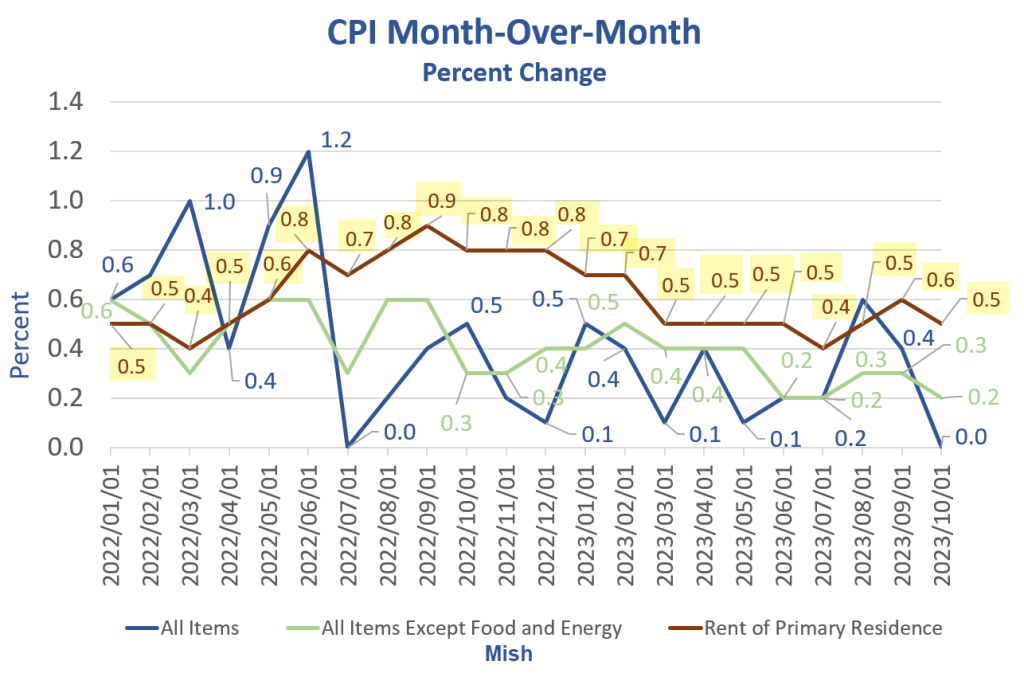
CPI month-over-month data from the BLS, chart by Mish

People keep telling me rents are falling, I keep saying they aren’t (and the data proves it).

For discussion, please CPI Unchanged Thanks to Decline in Energy, but Rent Jumps 0.5 Percent

Let’s now put a spotlight on supply, shown in the first chart, with additional details.

Housing Units Under Construction vs Completed Units

Housing data from the Commerce Department, chart by Mish

The only time in the history of this data that rent prices declined year-over-year was in the Great Recession. And that was after completed units crashed 76.8 percent from 2.245 million annualized units to 520,000 annualized units.

A year-over-year decline in rent happened exactly once in history, May of 2010. The preceding and following months had no gain. And those were the only two months of zero percent increases year-over-year (lead chart).

Yet, every month we see nonsense about falling rent based on new leases, or soon to be falling rent based on massive supply.

The Prosecution Rests

In Mish vs the Media, rebutting the idea rents have been declining, the prosecution rests.

Rents have not been declining. Perhaps they will after 27 consecutive monthly increases of at least 0.4 percent, but history strongly suggests rent prices are sticky.

However, It will not take declining rents to make the Fed happy. Increases of 2.0 percent would. But even 2.0 percent or less increases are rare (lead chart, dashed line).

Year-over-year rent is up 7.2 percent.

Due to easy-to-beat year-over-year comparisons, perhaps that the year-over-year rate declines rapidly. But that can happen even as rent increases 0.3 percent monthly.

Thus, a year-over year decline to 2.0 percent is not necessarily a good result, just a better one.

The New Residential Construction Report Shows Housing Starts Rise 1.9 Percent

For more on residential construction, please see The New Residential Construction Report Shows Housing Starts Rise 1.9 Percent

NAHB Housing Sentiment and Traffic Head Toward the Post-Pandemic Low

The National Association of Homebuilders survey is one of the grimmest since the Covid pandemic.

For discussion, please see NAHB Housing Sentiment and Traffic Head Toward the Post-Pandemic Low

Existing Home Sales vs New Home Sales

On October 19, I noted Existing Home Sales Drop Another Two Percent to a 13-Year Low

In sharp contrast, on October 25, I noted New Home Sales Jump 12.3 Percent Smash Expectations

New home sales are much better than existing home sales because builders are offering mortgage rate buydowns, build smaller homes, and are cutting back on lot and room sizes.

Add it all up and you are not getting a bargain buying anything today. Blame the Fed for these conditions.

How the Fed Destroyed the Housing Market and Created Inflation in Pictures

For discussion of the Fed’s role in this mess, please see How the Fed Destroyed the Housing Market and Created Inflation in Pictures

The Fed is largely responsible for the Great Recession crash, but this one is totally on them.

https://mishtalk.com/economics/falling-rent-is-extremely-rare-yet-economists-keep-expecting-that/

Lawler: Early Read on Existing Home Sales in October

 Chart of the Week:  Mortgage Rates Follow MBS Yields, Not 10-Year Treasury Yields


For an explanation of “why”, see Lawler: Update on Mortgage/Treasury Spreads

From Tom Lawler:

Mortgage Rate vs. MBS Spread30 Year FRM: Optimal Blue Conventional Conforming 30-year Fixed-Rate Mortgage where LTV<=80% and FICO>740.

CC MBS Yield: Yield on notional par agency 30-year MBS

Note: there is some “spurious” volatility in the mortgage spreads because Optimal Blue measures rate lock activity throughout the day while the MBS and Treasury yields reflect late afternoon yields.

Wednesday, November 15, 2023

'While All Inflation Feels Bad, Housing Inflation Is the Worst'

 Two weeks ago, I asked why Americans were in such a rotten mood when the data said the economy is in such good shape. The disconnect has only grown since. Inflation, we just learned, eased in October, extending a two-week rally in stocks and bonds. And yet the University of Michigan’s index of consumer sentiment keeps falling.

Many readers offered reasons for their sour mood that had little to do with the economy: the border, crime, President Biden, former President Donald Trump

As for economic reasons, readers made it clear they cared less about inflation dropping, which only meant prices were rising more slowly, than about the fact that the level of prices is painfully high compared with three years ago. 

It is also clear that not all inflation is equal. Three things in particular have our attention: gasoline, food and houses

Gasoline and groceries are a big part of your budget, and you buy them every week, so you notice when the price goes up—and stays up. Their prices have also risen especially steeply: 43% and 20%, respectively, since January 2021, versus 15% for the consumer-price index excluding food and energy. 

This helps explain why consumer sentiment is lower than unemployment and inflation would predict. Specific prices don’t enter into the University of Michigan’s index. That said, a rising share of respondents spontaneously mention food or gas prices in the interview and they have much lower sentiment than those who don’t, Joanne Hsu, director of the university’s survey, said. That jibes with my anecdotal evidence. “Obviously, you don’t do much grocery shopping or have a car that uses gasoline,” was one reader’s quite typical reaction to my column.

The good news is, gasoline is down about a third since its mid-2022 peak. Grocery prices haven’t fallen, but they are only up 2% in the past year; dairy, eggs, chicken and meat are flat. Even if they don’t drop, maybe a long spell of not going up will loosen their grip on our psyche.

Housing is an entirely different matter. The Bureau of Labor Statistics, which compiles the CPI, doesn’t measure the cost of homeownership with home prices. Rather, it estimates what a homeowner would pay to rent their own house. This “owners’ equivalent rent” tends to track rents rather than houses and is up 17% since the start of 2021. 

But if you’re actually in the market, what matters is the price of a home and the mortgage rate. Since January 2021, home prices, despite a late 2022 dip, have risen 29%, according to the S&P/Case-Shiller national home price index, and mortgage rates have nearly tripled. The buyer of the typical home thus faces a monthly principal and interest payment of nearly $2,200, more than double the level of early 2021, the National Association of Realtors calculates. No wonder the net share of consumers telling the University of Michigan it is a good time to buy a home is the lowest since 1982.  

If you own a house and have no plans to move, you might not care, or you might even enjoy your home rising in value. But for buyers, this matters more than gasoline or food prices: A home affects decisions about marriage, children, career and where to live.

Brian McCusker attests to that. “Gasoline and food don’t scare me: I’ll go out to eat less. I’ll buy a moped,” he told me. “Housing is that one thing a lot of people view as the American dream…That first house proves a lot about you as an American adult.” So it bothers him that at age 33, with a master’s degree in school counseling with a concentration in children and family-based therapy, he’s back at home, living with his parents. “My grandparents and my parents both had houses at my age,” he said.

Since January 2021, home prices have risen 29% and mortgage rates have nearly tripled. PHOTO: ROBERTO SCHMIDT/AGENCE FRANCE-PRESSE/GETTY IMAGES

He had graduated at the start of the year from a university in Southern California. Unable to find a job in his field, and faced with paying $2,000 rent on his condominium when his roommate moved out, he moved back to Michigan’s Upper Peninsula where he grew up, where he’s now working in community mental health.

Career opportunities, such as launching his own practice, are limited. In places where opportunities are better, like Northern Virginia, Florida or Southern California, McCusker can’t afford the down payment on a house, and “even if I did, I would be house broke, spending half of my paycheck or more on mortgage costs alone.”

Less than 1% of households in any given month will buy a house. But 17% plan to buy a home in the next 12 months, and add to that the millions like McCusker who want to buy their first house or trade up but can’t afford to. They have all seen their hopes wilt.

As of yet, this hasn’t made a dent in homeownership rates, which are higher among almost all age groups than before the pandemic, according to the Census Bureau. 

But homeownership will probably fall if it remains this unaffordable. John Burns, chief executive of John Burns Research and Consulting, says it will take some combination of falling mortgage rates, lower prices and rising incomes for affordability to return to normal, but, absent a recession, that will take years.

Mortgage rates have dropped with easing inflation, but they aren’t headed to prepandemic levels, given upward pressure from structural forces such as global supply shocks and budget deficits. Burns said home prices are likely to flatten out but not fall next year. His home-builder clients see single-family housing starts rising 17%, to a level still lower than before the 2007-09 recession and below long-run growth in new households. Behind restrained building: financing costs, a shortage of developable land and onerous permitting.

Fixing supply constraints is a job for state and local—not federal—lawmakers. Unfortunately, local resistance to development demonstrates that while no one is rooting for high gasoline and food prices, plenty of people want home prices to stay high. 

https://www.wsj.com/economy/housing/while-all-inflation-feels-bad-housing-inflation-is-the-worst-f12f518d

Tuesday, November 14, 2023

Lawler: New Census Long-Term Population Projections Are MASSIVELY Lower Than Previous

 From housing economist Tom Lawler:


Last Friday Census released new long-term projections of the US resident population, this time going out to 2100. The last time Census released long-term population projections was in 2017 (going out to 2060), and the 2023 projections for the “middle” scenario are massively lower than the 2017 projections.

Freddie Case-Shiller NAR House PricesHere is a chart showing the “middle-case” projections for the US resident population for the 2017 release compared to the 2023 release. (Note: Census has not released updated population estimates for 2011 through 2019 that reflect Census 2020 results, but I have estimated what 2016 to 2019 would look like based on updated net international migration estimates for 2010 through 2019.)
...
I have been looking into these projections and have found some “issues” for the projections over the next few years, and I’ll be rewriting more about this topic soon. However, for those analysts who have kept using the 2017 population projections for analysis purposes even though it was obvious they were woefully out of date, these latest population projections have surely left them “dazed and confused.”

Out Of Office: Global Vacancies Hit Record High

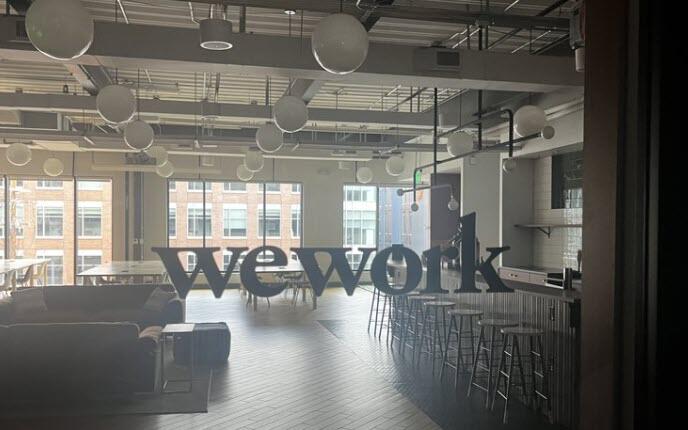
 The shockwaves from WeWork's bankruptcy last week continue to reverberate around the commercial real estate market, leaving office landlords around the world trembling with fear at the prospect of losing one of their largest tenants.

Especially in prime markets such as New York City, San Francisco, London and Paris, WeWork played an outsized role in the office rental market, occupying large swaths of premium office space.

According to Bloomberg, "Dormant locations in New York dominate a list of nearly 70 leases the coworking giant intends to terminate, court papers show. The roughly 40 contracts at issue include space near Union Square and in Fulton Center, a retail and transit facility in downtown Manhattan."

As Statista's Felix  Richter reports, WeWork’s demise come at the worst possible time for landlords, who are already struggling to find tenants, as many companies are reducing their office footprint to reduce costs and adapt to the post-pandemic world of hybrid work.

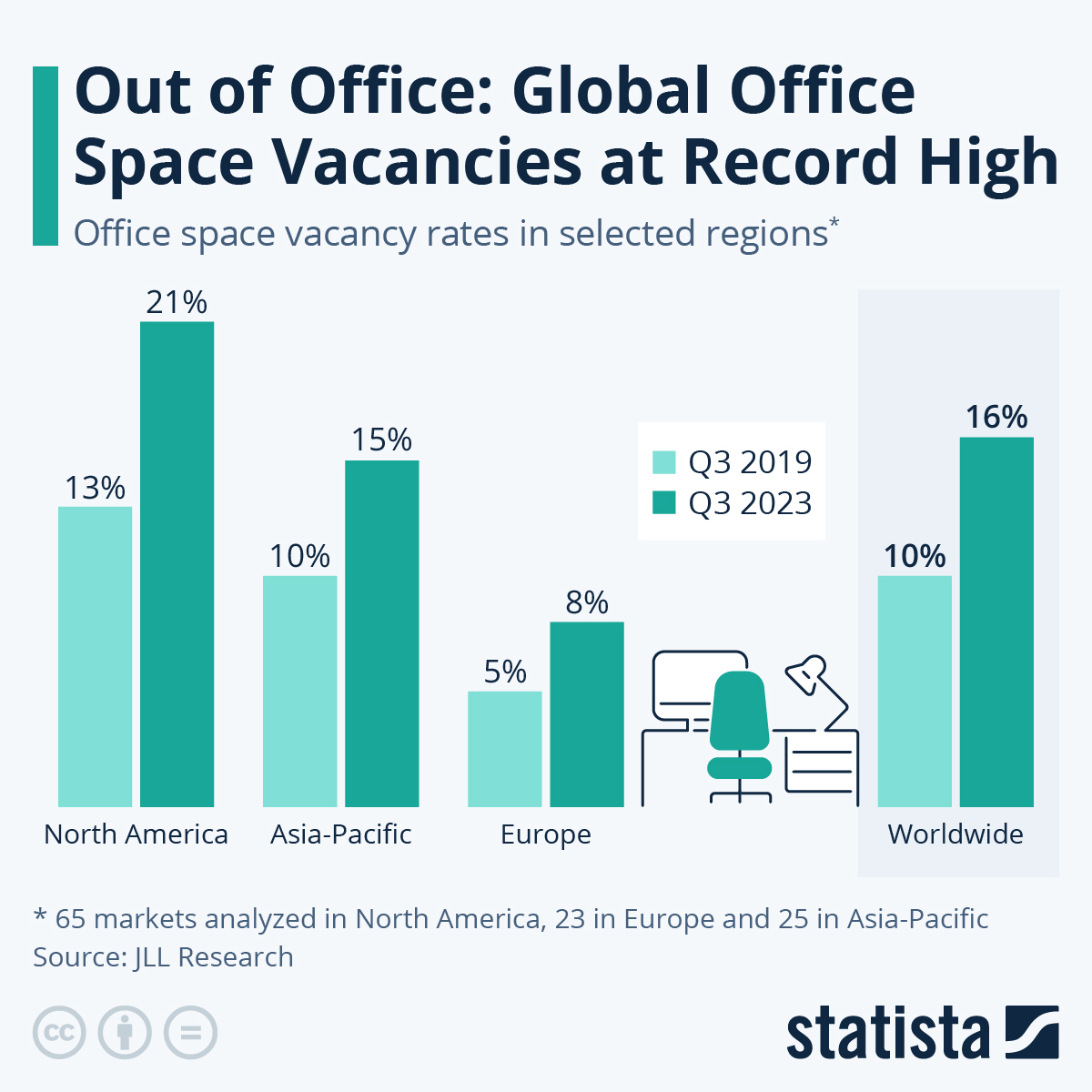
According to real estate specialist Jones Lang LaSalle (JLL)office vacancy rates are higher than ever, reaching 21 percent in the U.S. and Canada in Q3 2023 and 16 percent globally, i.e. in the 100+ markets analyzed by JLL Research. In both cases, that’s an increase of 60 percent compared to pre-pandemic vacancy rates, which stood at 13 and 10 percent in North America and globally in Q3 2019, respectively.

Infographic: Out of Office: Global Office Space Vacancies at Record High | Statista


At the end of June, WeWork operated 906,000 workstations in 777 locations across 39 countries, with total (current and long-term) lease obligations amounting to $14.2 billion.

While it’s unclear what will happen to these locations post-bankruptcy, landlords look certain to lose out on a large chunk of their agreed-upon leases and to end up with even more excess supply of prime office space.

As of June 2022, the company rented nearly 20 million square feet of office space across the US. And what's happening in NYC is coming to a city near you.

Weeks ago, Scott Rechler, Chairman and CEO of RXR Realty, warned the CRE crisis was just getting starting...

https://www.zerohedge.com/personal-finance/out-office-global-vacancies-hit-record-high


Sunday, November 12, 2023

NYers face skyrocketing costs to switch to electric heat under new ‘green’ policies: study

 New York residents could face skyrocketing heating bills under the state’s new “green” policies — which may not even have a significant impact on greenhouse-gas emissions, a new study warns.

A review by the Empire Center for Public Policy says the state’s new rules will push homeowners to buy expensive electrified heat pumps while being forced to phase out their natural gas, oil and propane systems.

But even then, the new electrification policy could only have a negligible impact on greenhouse emissions while burning up homeowners’ wallets, according to the analysis, “In Cold Reality: The Cost and Challenge of Compulsory Home Electrification in New York.”

“New York’s plan to steer homeowners and landlords toward electric heat could backfire due to high costs and practical concerns,” the authors say.

“The costs of heat pump installation and building shell weatherization are high and will place a substantial economic burden on many homeowners, even with state and federal subsidies.

“The cost of installing a heat pump and weatherizing a home: $14,600 to $46,200,” says the study, prepared by Empire Center fellow James Hanley.

Even with the extensive state and federal subsidies, the upfront price tag of heat pumps and weatherization will likely push many homeowners to instead buy low-cost but energy-hungry electric furnaces, the report says.

The electric furnaces put considerably greater stress on the state’s grid, defeating the purpose of using cleaner, non-fossil burning energy, the report claims.

The green push from the state comes along with Gov. Kathy Hochul’s plan to ban gas stoves in newly constructed homes by 2025. New York’s 2019 Climate Leadership and Community Protection Act calls for reducing statewide greenhouse gas emissions by 85 percent by 2050.

The state’s Climate Action Council proposed meeting that goal in large part by electrifying 85 percent of the state’s buildings. But it also has recommended a prohibition on the replacement of fuel-burning furnaces as of 2030, which would push the mandate closer to 100 percent, the report said.

Only 13 percent of all New York residential units are currently heated with either electricity or solar energy.

In Staten Island, only 5% of homes have electric heat — the lowest of any county in the state.

Heating oil is used in one in five or 1.4 million New York homes — including in the coldest parts of the state such as the Adirondacks, as well as Long Island.

Hanley of the Empire Center said the impact of this electrification would be felt most acutely in upstate rural New York, where the median household income of owner-occupied homes is the lowest in the state.

“The low rate of electric heating in many of the state’s more rural and lower-income counties means much of the choice will fall on homeowners who can least afford it,” the report said “And those who have unexpected equipment failures in midwinter may not be able to arrange contractors for their necessary shell upgrades in time to ensure comfort for the remainder of the season.”

The report said the state could instead curb emissions by setting clean fuel standards that encourage the use of biofuels.

Whether homeowners choose heat pumps or electric furnaces, mandatory electrification will lead to the elimination of propane and oil furnaces by the late 2040s and early 2050s, and no later than the early 2060s. The home heating oil delivery industry will likely go out of business.

“By choosing a single model for all homeowners to follow, the state’s Climate Action Council closed the door on the potential to reduce greenhouse gas emissions through the use of clean fuel standards using fuels supplied by an existing distribution system,” Hanley said. “In doing so, it acted without regard for consumer preference, homeowner cost, or whether there were more cost-effective means of achieving reductions in greenhouse gas emissions.

“This is the fundamental problem at the heart of New York’s command-and-control attempt to restructure its economy to make what amounts to barely detectable reductions in global emissions. Albany can ban things, but it can’t control how people replace them.” 

Hochul’s office rebutted the findings.

“Under the status quo, New York consumers are stuck with dramatic fluctuations on utility bills and sky-high costs after extreme weather events,” a rep for the governor said. “Governor Hochul is making sure the clean energy revolution is affordable for New Yorkers, which is why she’s invested nearly $1.6 billion on energy affordability initiatives.”

The current state budget includes $200 million to shave high electric bills for 800,000 households whose family income is under $75,000, Hochul’s office said.

The budget also created a separate $200 million fund that helps 20,000 low-income families upgrade their homes by adding insulation or buying new energy-efficient appliances.

The governor insists that participating families will pay no more than 6% of their incomes on electricity.

https://nypost.com/2023/11/12/metro/nyers-face-skyrocketing-costs-to-switch-to-electric-heat-study/

$1B Silicon Valley-backed utopian city ‘California Forever’ facing national security probe

 A planned utopian city in California continues to face a high-stakes probe by a US national security panel – and state politicians still aren’t satisfied that the secretive project isn’t linked to China.

Since 2017, a little-known firm called Flannery Associates has stealthily bought up nearly $1 billion in land next to Travis Air Force Base, sparking alarms on Capitol Hill that a foreign entity could be backing the project for nefarious purposes.

Similar concerns arose last year after a Chinese firm bought 300 acres of land near an Air Force drone base in North Dakota.

In August, Flannery tried to calm nerves by revealing its backers included US tech tycoons such as LinkedIn co-founder Reid Hoffman and venture capitalist Marc Andreessen.

The group has said the land’s proximity to Travis was unintentional and outlined plans to develop a picturesque city featuring sustainable energy, a pedestrian-friendly layout and good-paying jobs.

Nevertheless, the US Treasury Department’s Committee on Foreign Investment in the United States (CFIUS) – an interagency panel responsible for vetting business transactions for potential national security risks – is still actively reviewing the project as of this month, a pair of California lawmakers told The Post.

Rep. John Garamendi (D-Calif), who previously blasted Flannery for using “strong-arm mobster techniques” to acquire land from local farmers, told The Post that the firm’s explanation to date is “only half of the story” – and claimed the project bears the hallmarks of a “patient” foreign investment scheme.

“To say it’s ‘American money’ is not a complete explanation of who is the investor,” Garamendi said. “I’ve been around long enough to understand the way foreign money – legitimate and illegitimate – is invested in the United States. Usually in an LLC, in a real estate transaction.”

Flannery Associates was originally registered as an LLC in Delaware, which does not require an ownership disclosure. The project’s organizers describe California Forever as Flannery’s parent company.

Flannery has rankled Solano County residents with vaguely-defined plans to build the city on patches of dry, unincorporated farmland that is pockmarked with wind turbines and abandoned gas wells and is known to lack enough infrastructure to support a large population.

Catherine Moy, the mayor of Fairfield, Calif., said the feds are “still investigating” the situation and were “not 100% (sure) that China is not behind funding on this.”

“CFIUS, they’re still going forward with their investigation. You can trust but verify, especially with things like this,” Moy said. “A couple of the investors already are very connected with China, business-wise.”

The CFIUS probe was first reported by CNN in August – weeks after it emerged that Garamendi and fellow US Rep. Mike Thompson (D-Calif.) had asked the panel and the FBI to investigate the matter.

The duo noted that Travis is a critical military transport hub known as the “Gateway to the Pacific” that serves as a key conduit for shipments to Ukraine, among other key functions.

“My concerns with the land acquisition in Solano County have always been on national security and food security,” Thompson said in a statement. “Their rapid acquisition of land around Travis Air Force Base caused concern about who was making the purchases and their ultimate goal.”

A spokesperson for Travis Air Force base confirmed that “senior officials are actively supporting all involved federal and Solano County agencies regarding the land purchases.” The spokesperson referred further questions to the Treasury Department.

The Treasury Department did not return multiple requests for comment.

When reached for comment, a Flannery Associates spokesperson said the project has “no other foreign investors” beyond those it has disclosed.

The firm has said its investors are passive and have no role in day-to-day operations.

“While most area electeds have taken an open-minded approach to the opportunity our project presents for local jobs, investments, homes for middle class families, and clean power, a couple of local politicians are unfortunately and irresponsibly spreading rumors and misinformation to insinuate that California Forever is a not an American company,” the spokesperson said.

Flannery said it has “complied with all government inquiries” and provided documents that “unquestionably prove that over 97% of our invested capital comes from US investors, and that the remaining less than 3% comes from UK and Irish investors.”

So far, the list of publicly-disclosed Flannery investors includes Hoffman, Andreesen, his investment firm Andreesen Horowitz, former Sequoia Capital partner Michael Moritz, Stripe co-founders Patrick and John Collison, Chris Dixon, John Dooer, Nat Friedman, Daniel Gross and Laurene Powell Jobs, the prominent philanthropist and widow of Apple co-founder Steve Jobs.

Moritz spent nearly four decades at Sequoia Capital and helped spearhead the venture firm’s expansion into China before exiting last June. Sequoia Capital itself has not been linked to Flannery Associates or the “California Forever” project, though the House Select Committee on China recently revealed it was probing the firm’s investments and business interests in China.

Moritz did not immediately return requests for comment.

A Sequoia Capital spokesperson confirmed that the firm had received the select committee’s letter about the probe, was “reviewing it and will respond.”

Flannery CEO Jan Sramek has scrambled to downplay the project’s ties to the tech industry, describing it as a “city of yesterday.”

Its website specifically rejects the notion that it is building a “tech utopia” and said Flannery is “not proposing a pie-in-the-sky ‘utopian’ fantasy.”

Critics, including Garamendi and Moy, argue that Sramek and his team are merely trying to reframe the project due to local backlash.

“The story has changed,” Moy said. “Any credibility he was trying to earn after being secretive for five years is being lost because he’s changing the story now. That’s what happens with people who you can’t trust.”

https://nypost.com/2023/11/12/business/utopian-city-california-forever-still-faces-national-security-probe-pols/