Search This Blog

Saturday, August 27, 2022

Get Used to Startups Trying to Reinvent Housing

 IN 2016, THE WeWork cofounder Adam Neumann described home as “a feeling” rather than something you own. He was introducing WeLive, his company’s concept for rental apartments, where lease terms were flexible and apartments came furnished, right down to the linens and toiletries. The idea swapped traditional tenancy for “membership,” allowing people to move between WeLive apartments as easily as Equinox members could swipe into a gym in a different city.

WeLive didn’t last long. It began to crumble, along with the rest of the business, in 2019, when WeWork’s bid to go public revealed that the company was losing more than $200,000 every hourThe company went into crisis mode and halted plans to open more apartments. The remaining two WeLive sites began to operate more like hotels, until WeWork eventually sold them.

Three years later, Neumann is back with his second swing at reinventing housing—and the Silicon Valley commentariat are unimpressed. His new startup, Flow, is another branded apartment concept, expected to offer community features and other amenities, on flexible terms. Reportedly, Neumann owns 4,000 apartment units in four cities (Atlanta; Miami and Fort Lauderdale, Florida; Nashville, Tennessee) to begin the project, which is slated to launch in 2023.

Journalists and investors have suggested that Andreessen Horowitz’s $350 million investment in Flow, valuing it at $1 billion, could soon be vaporized like so much of WeWork’s cash. Neither Neumann nor his investors have revealed much about Flow, but the backlash toward the idea of giving the entrepreneur a second chance has been swift. On Tuesday, Forbes published claims—denied by a spokesperson for Neumann—that Flow might compete with a rental-amenities startup called Alfred he had previously invested in.

None of that means that Neumann and Andreessen have not identified a market with potential. The gridlock in the US housing market has necessitated new ideas about how, and where, people live. And unlike when WeLive launched in 2016, plenty of startups are now trying to reinvent rental housing for a generation of people who likely won’t buy homes. Flow could become part of a new sector that manages to fundamentally change the way some Americans think about housing, by creating upsides in remaining a renter. That could be lasting and profitable—even if it doesn’t mitigate many of the downsides of the US housing crunch.

For the past two decades, a confluence of factors has caused young Americans to give up on buying houses, a pattern also seen in the UK and some other European countries. New construction has stalled, existing supply has remained tied up, and population booms in urban areas have driven up housing costs. Nearly one in five homes in the US is now bought by institutional investors—not individuals—adding further competition. As a result, the share of first-time home buyers has shrunk, leading more millennials to rent well into their thirties and forties.

This new, permanent rental class presents a worrying outlook for some economists: Housing is in short supply, and that drives prices up for everyone. But for startups, it also presents an opportunity. “It’s a massive, trillion-dollar industry,” says Andrew Collins, founder of real estate startup Bungalow. “And yet it really hasn’t been innovated in the last 50 years.”

Bungalow, which launched in 2016, aims to serve this new class of renters. It offers flexible leases to furnished apartments and homes and helps residents find roommates they’ll vibe with. It also lets residents move between houses managed by Bungalow without penalties for breaking the lease. Collins says he set out to improve the experience of hunting down a shared apartment on Craigslist but found that there was an untapped market of young people who wanted the flexibility to take a job in a new city or try out a new neighborhood without being tied to a long-term lease.

Many other startups operate on a similar thesis: that people will willingly trade ownership for flexibility. “Let go of renting restrictions,” promises Landing, a residential startup that allows residents to bounce from apartment to apartment in more than 300 cities on a single lease agreement. Sentral, which manages some 3,000 apartments, seems to court a class of nomadic remote workers who might pick up and move at any minute. “Flexibility for a night, a quarter, or a year,” its website reads. “We believe flexibility and freedom are a choice, not a luxury.” Neumann’s new startup speaks a similar language: “Live life in flow,” it says on its bare-bones website.

“Flexibility is the name of the game here,” says Joel Steinhaus, Neumann’s former chief of staff at WeWork who is now cofounder and CEO of the coworking company Daybase. He believes a rethinking of renting fits with other trends shifting people away from conventional ownership and toward more flexible, branded, and tech-mediated experiences: coworking, for one, but also streaming subscriptions and transportation.

At the same time, housing is a much harder category to disrupt than music listening or how to get home from the bar. It’s also much more intimate than an office space, says Steinhaus. And while technology can make some parts of rental living simpler and more convenient, it can do only so much to close the gaps between the limited number of available homes and the people who need somewhere affordable to live.

“The main issue today with housing is on the supply side,” says Cris deRitis, deputy chief economist at the financial company Moody’s. He says that while buzzy startups offering slick amenities might make renters more excited about renting—perhaps easing the competition to buy homes or apartments—the ideal solutions would address the housing shortage head-on. Those will likely have to come from government, not the private sector, he says, and include “relaxing zoning restrictions, or incentivizing builders to increase density in certain areas.”

Home, as a feeling, mediated via a slick app, can’t will into being the buildings needed to solve America’s housing crisis. But for a certain class of permanent renters, it might create an appealing alternative to buying a home. The larger that group of people grows, the more companies and capital will try to court them—Neumann won’t be the only one.

https://www.wired.com/story/get-used-to-startups-trying-to-reinvent-housing/

4 Ways 'Inflation Reduction Act' Could Impact Supply Chains

 By Alyssa Sporrer, by American Shipper

As its name suggests, the Inflation Reduction Act of 2022 (IRA) signed into law by President Joe Biden earlier this month is designed to reduce inflation, but it also includes $300 billion worth of grants and incentives for clean energy and initiatives to combat climate change. 

The goal of the incentives is to accelerate electric vehicle adoption, green ports, increase renewable energy capacity and support products made in the U.S. There are also tax reforms and provisions for health care.

The climate legislation is supposed to help the U.S. lower greenhouse gas emissions by 40% by 2030 compared to 2005 levels.

1. Incentives for electric trucks

The tax credit for purchasing an EV covers the price difference between a diesel truck and an electric truck, or 30% of the truck’s purchase price, whichever is lower. But it’s capped at $40,000 per vehicle purchase.

New heavy-duty electric trucks can cost over $300,000, so it’s unclear how much this tax credit would incentivize fleet owners to invest in EVs.

The tax credit may be “geared more toward incentivizing the purchase of smaller vehicles, such as cargo vans or box trucks used for short-haul package delivery in urban areas,” Beia Spiller, director of the transportation program at the nonprofit research group Resources for the Future, which studies the implications of vehicle electrification, told FreightWaves in a previous interview.

The IRA also includes a credit for building EV charging infrastructure of up to $100,000 per charger.

2. Renewable energy incentives

The IRA includes production and investment tax credits for battery storage and renewable wind and solar energy. This should make it greener and cheaper for supply chain companies to power their warehouses, distribution centers and stores.

Independent environmental and energy research nonprofit Resources for the Future projects the act will reduce electricity costs for the retail industry by 5.2% to 6.7% over the next decade, saving electricity consumers $209 billion to $278 billion. 

These estimations were based on expected natural gas prices. One of the benefits of more clean energy is it insulates electricity consumers from volatile natural gas prices.

The nonprofit predicted the GHG emissions from the electricity sector would drop between 70% and 75% by 2030 below 2005 levels. Without the IRA, those emissions were estimated to decrease by about 49% in the same time frame.

“As the nation looks to increase production of renewable energy and the sustainability of the supply chain, these new public investments will help support more solar, more electric trucks and new clean-energy technologies and infrastructure,” Susan Uthayakumar, chief energy and sustainability officer at Prologis, said in a statement.

3. Supporting domestic supply chains

The IRA is expected to drastically increase the demand for components needed in solar panels, wind turbines and EVs. This could create more jobs in the clean energy and manufacturing sectors. 

But there’s a catch. Some of the incentives hinge on a certain amount of raw materials being sourced in the U.S., the final product being constructed in the U.S. or meeting worker training and competitive wage standards.

While these conditions support domestic supply chains and labor rights, some experts think it may slow the adoption rate of EVs and renewable energy. Domestic supply chains for EV and solar panel production are not mature right now. 

It’s unclear whether these incentives will spur the expansion of these domestic supply chains or how fast that may occur.

The National Association of Manufacturers “remains staunchly opposed to the IRA. It increases taxes on manufacturers in America, undermining our competitiveness while we are facing harsh economic headwinds such as supply chain disruptions and the highest rate of inflation in decades.”

4. Greening ports

The IRA includes $3 billion in grants and rebates for port authorities and marine terminals to purchase zero-emission cargo-handling equipment until September 2027. The goal is to address air pollution in and around ports.

But it defines zero-emission port equipment and technology as being “human-operated equipment or human-maintained technology” and therefore excludes automated technology from being grant eligible.

Zero-emission cargo handling equipment or technology must emit no air pollutants or GHGs, or it must capture 100% of those emissions produced by vessels at berth to qualify for the grants.

“This would go a long way to help seaports meet their emission reduction goals,” said Elaine Nessle, executive director of the Coalition for America’s Gateway and Trade Corridors. “Freight projects often have economic benefits for the entire country, but they can also negatively impact local communities, so it’s good to have resources at the federal level to offset those negative impacts.”

https://www.zerohedge.com/economics/4-ways-inflation-reduction-act-could-impact-supply-chains

FedEx cuts ties with ground delivery contractor, files suit

 FedEx Corp has severed its relationship with one of its largest delivery contractors effective immediately.

The package delivery company filed suit, asking a federal judge to stop the contractor from spreading misinformation about its business for financial gain.

Spencer Patton has 225 FedEx Ground routes in 10 states as well as businesses that offer services to the roughly 6,000 U.S. contractors that transport and deliver packages for that unit.

Patton for weeks has said that up to 35% of FedEx Ground delivery providers are at risk of financial failure. He urged its leaders to improve compensation and has been rallying "peers to his cause."

"Really, what I've been advocating and really making the public aware of is that we're in enormous financial distress," Patton, Route Consultant founder and president, told FOX Business’ Dagen McDowell on "Mornings with Maria" in an interview earlier this month.

"We've seen our fuel prices double in a year. We've seen our wage rates up, our vehicle costs up," Patton said at the time. "And I'm sounding the alarm that the risk of network interruption in FedEx Ground is as high as I've ever seen it.

FedEx's lawsuit seeks injunctive relief and monetary damages from a "coordinated and multi-faceted campaign orchestrated" by Patton.

Without talking about the case, Patton went public with the termination of his relationship with FedEx, saying the company's "move to cancel our contracts is a clear case of (it) silencing anyone with a voice."

FedEx said the affected routes account for less than 0.5% of Ground's 60,000 routes and that contingency plans are in place.

In its lawsuit, FedEx alleged that Patton is disparaging its Ground business through a series of false and misleading statements about its commercial activities.

Spencer Patton at conference

Spencer Patton, one of FedEx Ground’s largest delivery contractors, speaks at a conference he hosted in Las Vegas, Nevada, U.S., August 20, 2022.  (Spencer Patton/Route Consultant/Handout via REUTERS / Reuters Photos)

In the lawsuit, FedEx alleged that unfavorable news coverage stemming from Patton's campaign could harm Ground's reputation with the shippers that pay it to deliver packages and erode goodwill within the contractor network.

FedEx alleged that Patton's actions are a promotional campaign for his company that offers consultancy, brokerage and other services to delivery providers.

TickerSecurityLastChangeChange %
FDXFEDEX CORP.218.16-9.87-4.33%

And, the company said, Patton has obliquely encouraged actions that could disrupt its crucial Christmas delivery business.

At a conference hosted by his business last weekend, Patton said that if terms of his contract were not adjusted, he would shutter his FedEx Ground contracting business on Nov. 25, the start of the holiday shipping season.

https://www.foxbusiness.com/markets/fedex-cuts-ties-ground-delivery-contractor-files-suit

Over 20 million US households are behind on utility bills

 New data indicates a staggering number of American households are currently behind on making utility payments due mainly to soaring energy costs, sparking fears that mass power shutoffs are on the horizon.

The National Energy Assistance Directors Association says more than 20 million U.S. families are behind on their utility bills, numbers NEADA executive director Mark Wolfe believes are "historic."

The NEADA chief told FOX Business what is even more alarming is the surge in the collective amount owed, which sat at roughly $8.1 billion at the end of 2019 and has now skyrocketed to around $16 billion. The average delinquent bill climbed from $403 to $792.

A primary driver behind the utility debt is a surge in energy prices. The cost of natural gas – used to power homes so folks can keep cool in the summer and warm in the winter – was up 30.5% year-over-year in July, according to the Labor Department.

While energy is in high demand in the summer, experts say heating bills this winter will bring more pain.

Andrew Lipow, president of energy consulting firm Lipow Oil Associates wrote this week that "the consumer is going to pay more for their heating bills this winter," adding that "whether they use natural gas or home heating oil, most will have sticker shock."

He went on to note that "natural gas futures prices are now more than double what they were a year ago."

The latest consumer price index shows inflation across the board remains near a 40-year high. While wages are also rising, the gains are not keeping up with price hikes eating away at Americans' paychecks – forcing more consumers to make tradeoffs and prioritize spending on necessities like groceries. 

Now, an unprecedented number of Americans could face having their power shut off because they cannot pay the overdue home energy bills.

With pandemic-era moratoriums on utility shutoffs expired and the price of natural gas set to continue its upward climb, Wolfe says that "looking ahead – all signs point to continued growth in arrearages." 

https://www.foxbusiness.com/economy/more-than-20-million-households-behind-utility-bills

Friday, August 26, 2022

Steep Drop In Refinance Activity Drives Continued Slump In US Q2 Mortgage Lending


Refinance Lending Drops 36 Percent Quarterly, Outweighing Rise in Other Lending Activity; Total Loans Down Another 13 Percent, Continuing Year-Long Decline; Purchase Mortgages Up 8 Percent While Home-Equity Deals Increase 35 Percent

ATTOM, a leading curator of real estate data nationwide for land and property data, today released its second-quarter 2022 U.S. Residential Property Mortgage Origination Report, which shows that 2.39 million mortgages secured by residential property (1 to 4 units) were originated in the second quarter of 2022 in the United States. That figure was down 13 percent from the first quarter of 2022 – the fifth quarterly decrease in a row – and down 40 percent from the second quarter of 2021 – the biggest annual drop since 2014.

The decline resulted from another double-digit downturn in refinance activity that more than outweighed increases in home-purchase and home-equity lending.

Overall, lenders issued $807.8 billion worth of mortgages in the second quarter of 2022. That was down quarterly by 11 percent and annually by 35 percent. As with the number of loans, the annual decrease in the dollar volume of loans marked the largest in eight years.

“Mortgage rates that have virtually doubled over the past year have decimated the refinance market and are starting to take a toll on purchase lending as well,” said Rick Sharga, executive vice president of market intelligence at ATTOM. “The combination of much higher mortgage rates and rising home prices has made the notion of homebuying simply unaffordable for many prospective buyers, which threatens to drive loan volume down even further as we exit the spring and summer months.”

The downturn in total activity resulted from just 941,000 residential loans getting rolled over into new mortgages during the second quarter of 2022 – a figure that was down 36 percent from the first quarter of 2022 and down 60 percent from a year earlier. Amid another rise in mortgage interest rates, refinance lending decreased for the fifth straight quarter, hitting a point that was just one-third of what it was in early 2021. The dollar volume of refinance loans was down 35 percent from the prior quarter and 56 percent annually, to $310.1 billion.

For the first time since early 2019, refinance activity in the second quarter did not represent the largest chunk of mortgages, dropping to 39 percent of all loans. That was off from 53 percent in the first quarter and from a recent peak of 66 percent in early 2021.

Purchase-loan activity, meanwhile, increased modestly as the 2022 Spring home-buying season kicked into gear. Despite ongoing home-price spikes, the number of purchase loans rose 8 percent quarterly, to 1.1 million, representing 46 percent of all borrowing. Still, that gain was unusually small for the months running from April through June and left the number of purchase mortgages down 21 percent annually. The dollar volume of loans taken out to buy residential properties rose to $431.4 billion, up 15 percent from the first quarter of this year, but still down 12 percent from the second quarter of last year.

The best-performing category by far in the second quarter was again home-equity lending. Home Equity Lines of Credit shot up 35 percent quarterly and 44 percent annually, to 341,704.

“Borrowers looking to tap into their equity should know that HELOC activity has been particularly strong among credit unions and community banks, along with a small but growing number of depository banks,” Sharga noted. “While non-bank mortgage lenders may begin to more aggressively originate home equity loans, it’s not likely they’ll be active participants in the HELOC market.”

The latest loan trends reflected a housing market in flux, pushed by competing forces, and continued a sharp break from a period when lending activity nearly tripled from early 2019 through early 2021.

ATTOM Chart on Mortgage Originations Q2 2022

Total mortgages drop at fastest pace in eight years

Banks and other lenders issued 2,385,051 residential mortgages in the second quarter of 2022. That was down 13.2 percent from 2,747,324 in the first quarter of 2022 and down 40 percent from 3,976,656 in the second quarter of 2021. The annual decline marked the largest since the first quarter of 2014. The $807.8 billion dollar volume of loans in the second quarter was down 10.6 percent from $903.7 billion in the prior quarter and was 35 percent less than the $1.24 trillion lent in the second quarter of 2021.

Overall lending activity decreased from the first quarter to the second quarter of 2022 in 173, or 80 percent, of the 215 metropolitan statistical areas around the U.S. with a population of more than 200,000 and at least 1,000 total residential mortgages issued in the second quarter of 2022. Total lending activity was down at least 10 percent in 97 metros (45 percent). The largest quarterly decreases were in Knoxville, TN (down 59.9 percent); Roanoke, VA (down 52.7 percent); Charleston, SC (down 37 percent); St. Louis, MO (down 28.7 percent) and Philadelphia, PA (down 27.3 percent).

Aside from St. Louis and Philadelphia, metro areas with a population of least 1 million that had the biggest decreases in total loans from the first quarter to the second quarter of 2022 were New York, NY (down 25.9 percent); Detroit, MI (down 25.6 percent) and San Jose, CA (down 24.7 percent).

The biggest increases in the total number of mortgages from the first quarter to the second quarter of 2022 were in Atlantic City, NJ (up 32.5 percent); Erie, PA (up 18.8 percent); Peoria, IL (up 17.4 percent); Topeka, KS (up 15.6 percent) and Utica, NY (up 14.6 percent).

The only metro areas with a population of at least 1 million where total loan originations increased from the first to the second quarter were Honolulu, HI (up 9.9 percent); Kansas City, MO (up 3.4 percent) and Rochester, NY (up 3.2 percent).

Refinance mortgage originations slump to lowest point in three years

Lenders issued 941,111 residential refinance mortgages in the second quarter of 2022 – the smallest count since the second quarter of 2019.

The latest number was down 35.9 percent from 1,469,237 in first quarter of 2022 and 59.7 percent from 2,335,808 in the second quarter of 2021. The $310.1 billion dollar volume of refinance loans in the second quarter of 2022 was down 35.1 percent from $477.5 billion in the prior quarter and down 56.1 percent from $706.2 billion in the second quarter of 2021.

Refinancing activity decreased from the first quarter to the second quarter of 2022 in 213, or 99 percent, of the 215 metropolitan statistical areas around the country with enough data to analyze. Activity dropped quarterly by at least 25 percent in 162 metro areas (75 percent) and at least 35 percent in 94 metros (44 percent). The largest quarterly decreases were in Roanoke, VA (down 65.8 percent); Knoxville, TN (down 64.4 percent); San Jose, CA (down 58.5 percent); Oxnard, CA (down 56.3 percent) and Charleston, SC (down 55.3 percent).

Aside from San Jose, metro areas with a population of least 1 million that had the biggest decreases in refinance activity from the first quarter to the second quarter of this year were Portland, OR (down 53.2 percent); San Francisco, CA (down 52.9 percent); Sacramento, CA (down 51.8 percent) and Chicago, IL (down 49.8 percent).

The only metro areas where refinance lending increased from the first quarter to the second quarter were Atlantic, City, NJ (up 23.7 percent) and Utica, NY (up 8.5 percent).

Purchase mortgages increase in second quarter, but at relatively small pace

Lenders originated 1,102,236 purchase mortgages in the second quarter of 2022. That was up 7.6 percent from 1,024,109 in the first quarter. But the increase was the smallest second-quarter gain since at least 2000. As a result, purchase lending remained down 21.5 percent from 1,403,287 in the second quarter of 2021. The $431.4 billion dollar volume of purchase loans in the second quarter of 2022 was up 15.1 percent from $374.9 billion in the prior quarter, but down 11.8 percent from $489.2 billion a year earlier.

Residential purchase-mortgage originations increased from the first quarter of 2022 to the second quarter of 2022 in 173 of the 215 metro areas in the report (80 percent), but were still down annually in 194 metro areas (90 percent).

The largest quarterly increases were in Madison, WI (up 60.8 percent); Honolulu, HI (up 55.8 percent); Lafayette, IN (up 55.5 percent); Champaign, IL (up 52.6 percent) and Jackson, MS (up 49.3 percent).

Aside from Honolulu, metro areas with a population of at least 1 million that saw the biggest quarterly increases in purchase originations in the second quarter of 2022 were Boston, MA (up 41.7 percent); Seattle, WA (up 33.6 percent); Richmond, VA (up 31.9 percent) and Birmingham, AL (up 29.9 percent).

Residential purchase-mortgage lending decreased most from the first quarter to the second quarter of 2022 in Knoxville, TN (down 52 percent); Roanoke, VA (down 37.3 percent); Salinas, CA (down 18.1 percent); Ogden, UT (down 16.9 percent) and Boise, ID (down 13.6 percent).

Metro areas with a population of at least 1 million where purchase originations decreased most from the first to the second quarter of 2022 were New York, NY (down 12 percent); Los Angeles, CA (down 11 percent); St. Louis, MO (down 10.7 percent); Philadelphia, PA (down 10.7 percent) and Detroit, MI (down 9.5 percent).

HELOC lending up another 35 percent

A total of 341,704 home-equity lines of credit (HELOCs) were originated on residential properties in the second quarter of 2022, up 34.5 percent from 253,978 during the prior quarter and up 43.8 percent from 237,561 in the second quarter of 2021. HELOC activity increased for the fourth time in five quarters after decreasing in each of the prior six quarters. The $66.3 billion second-quarter 2022 volume of HELOC loans was up 29.4 percent from $51.2 billion in the first quarter of 2022 and 39.8 percent from $47.4 billion in the second quarter of last year, hitting the highest point in almost three years.

HELOCs comprised 14.3 percent of all second-quarter 2022 loans, more than double the 6 percent level from a year earlier.

HELOC mortgage originations increased from the first quarter to the second quarter of 2022 in 94 percent of the metro areas analyzed. The largest increases in metro areas with a population of at least 1 million were in Fresno, CA (up 82.9 percent); Riverside, CA (up 80.9 percent); Buffalo, NY (up 53.2 percent); San Diego, CA (up 52 percent) and Los Angeles, CA (up 51.5 percent).

The only quarterly decrease in HELOCs among metro areas with a population of at least 1 million was in St. Louis, MO (down 11.7 percent).

FHA loan portion continues to increase while VA share declines

Mortgages backed by the Federal Housing Administration (FHA) rose as a portion of all lending for the third straight quarter, accounting for 255,544, or 10.7 percent, of all residential property loans originated in the second quarter of 2022. That was up from 10.4 percent in the first quarter of 2022 and 9.6 percent in the second quarter of 2021.

Residential loans backed by the U.S. Department of Veterans Affairs (VA) accounted for 122,483, or 5.1 percent, of all residential property loans originated in the second quarter of 2022, down from 5.6 percent in the previous quarter and 6.8 percent a year earlier. VA lending as a portion of all loans dropped for the seventh straight quarter.

Down payments increase

The national median down payment on homes purchased with financing increased during the second quarter of 2022 after declining in the prior two quarters, while the typical amount borrowed rose to another new high. At the same time, the ratio of median down payments to home prices went up.

The median down payment on single-family homes and condos purchased with financing in the second quarter of 2022 increased to $35,000, up 34.7 percent from $25,980 in the previous quarter and up 34.6 percent from $26,000 in the second quarter of 2021. Among homes purchased with financing in the second quarter of 2022, the median loan amount was $320,000. That was up 8.1 percent from the prior quarter and up 12.3 percent from the same period in 2021.

The typical down payment in the second quarter of this year represented 9.1 percent of the purchase price, up from 7.4 percent in the prior quarter and 7.5 percent a year earlier.

https://www.attomdata.com/news/market-trends/mortgage-origination/attom-q2-2022-u-s-residential-property-mortgage-origination-report/

Thursday, August 25, 2022

Other Shoe Drops: Blackstone Landlord Halts Home Purchases In 38 Cities As Market Crashes

 One month after we reported that home prices finally dropped for the first time in year, an observation echoed yesterday by Black Knight which also found that home prices had fallen for the first time in 3 years last month - in the biggest decline since 2011 - we knew the other shoe in the ongoing housing crash was set to drop any minute.

We didn't have long to wait, because just after the close today, all those who had defended housing as backstopped by Wall Street's biggest firms and thus unlikely to crash, were suddenly silenced when Bloomberg reported that Home Partners of America, the single-family landlord owned by Blackstone, the largest residential and commercial landlord in the US, will stop buying homes in 38 US cities, becoming the latest institutional investor to back away from an overheated housing market.

The company, which was acquired by Blackstone in June 2021 for $6 billion, told customers that as of Sept. 1, it is pausing applications and property submissions in Boise, Idaho; Fresno, California; Memphis, Tennessee, and 25 other areas. The company will go on hiatus in 10 additional cities on Oct. 1 (incidentally, Boise, ID is the city which saw explosive price increases during the covid pandemic, and has since then seen an unprecedented plunge with Redfin reporting that a record 70% of home sellers had dropped their asking price in July).

“We assessed several factors such as home price appreciation, state and local regulations and market demand to guide our investment plans to best serve consumers,” Home Partners of America said in an announcement on its website. “We hope to resume purchasing homes in these markets in the future.”

According to Bloomberg, Home Partners of America, which operates in more than 80 markets, stands out from other large single-family landlords because it’s designed to give tenants a pathway to homeownership. Customers apply for the program and, if approved, can submit homes they would like to eventually buy. Home Partners purchases the property in cash, then rents it to the customer, who gets the right to purchase the home at a predetermined price.

Under the new policy, customers who have been approved but don’t submit a home by the cutoff date will be withdrawn from the program and have their application fee refunded, according to the announcement.

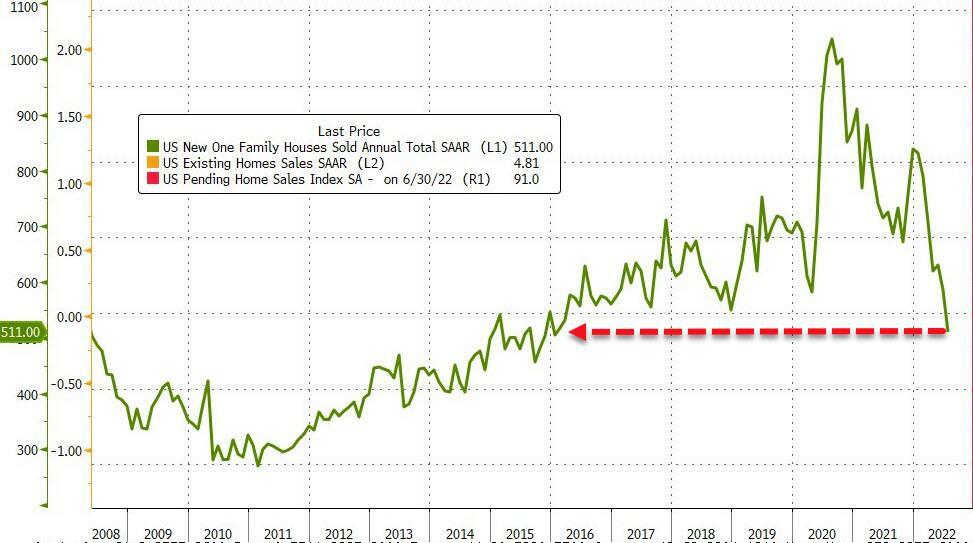
Home Partners isn’t the first Wall Street institutional investor to back away from the US housing market, which reached a frenzied bubble during the first half of the year, a bubble which has since popped with both new and existing home sales collapsing at near record rates. As we reported last month, Invitation Homes, American Homes 4 Rent, and KKR’s My Community Homes are among landlords that have slowed purchases during a period of high home prices and rising financing costs.

Mynd Management, a real estate platform that helps investors find, buy, lease, manage, and sell residential investment properties, advised institutional clients to dial back acquisitions and wait for housing prices to readjust to the interest rate shock. In an interview, Mynd's CEO Doug Brien told Bloomberg that market conditions could improve in the fall as "buying opportunities" emerge. He said, for the time being, "let's tap the brakes and watch the markets."

Only instead of tapping the breaks, they were slammed full force...