Search This Blog

Saturday, June 12, 2021

Blackrock And Other Institutional Investors Buying Entire Neighborhoods At Huge Premiums

 As the real estate market continues to break records, a cabal of institutional investors has been tossing gasoline on the fire - buying up properties hand-over-fist as middle-American renters watch their dreams of home ownership fade at the hands of pension funds and other financial behemoths.

A bidding war broke out for the Amber Pines 124-unit rental-housing community built by D.R. Horton.

"You now have permanent capital competing with a young couple trying to buy a house," according to real estate consultant John Burns, whose firm estimates that in many of the country's hottest markets, roughly one 20% of homes sold are bought by someone who never moves in.

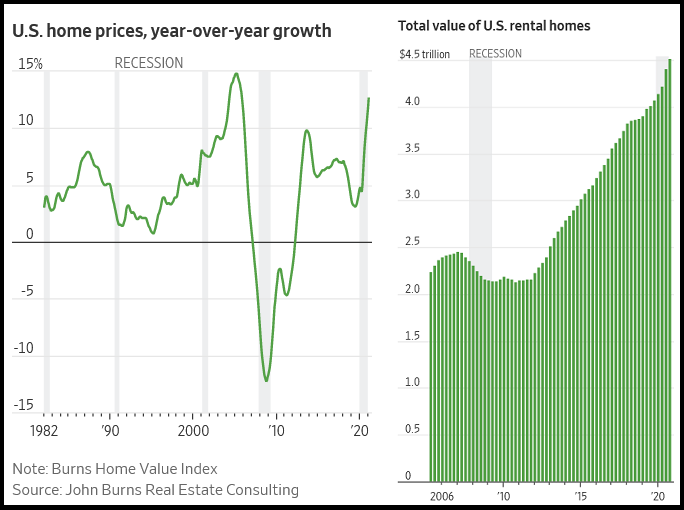
"That’s going to make U.S. housing permanently more expensive," said Burns, who thinks home prices will climb as much as 12% this year, on top of last year's 11% rise.

"Limited housing supply, low rates, a global reach for yield, and what we’re calling the institutionalization of real-estate investors has set the stage for another speculative investor-driven home price bubble," his firm concluded - finding Houston to be a favorite location for investors, who have accounted for 24% of home purchases in the area.

The coronavirus pandemic sparked a race for home-office space and yards. Occupancy rates reached records and rents are rising with home prices. The ecosystem of companies that service, finance and mimic the mega landlords is booming.

Burns counted more than 200 companies and investment firms in the house hunt: computer-assisted flipper Opendoor Technologies Inc., money managers including J.P. Morgan Asset Management and BlackRock Inc., platforms such as Fundrise and Roofstock that buy and arrange for the management of rentals on behalf of individuals and builder LGI Homes Inc., which now reports wholesale home sales to bulk buyers in its quarterly results. -WSJ

In one example, a bidding war broke out over a D.R. Horton complex in Conroe, Texas - after the homebuilder put the entire subdivision up for sale. After a "Who's Who of investors and rental-home firms flocked to the December sale," the winning bid of $32 million came from an online property-investment company, Fundraise LLC, which manages over $1 billion for around 150,000 individuals, according to the Wall Street Journal.

D.R. Horton ended up booking roughly twice what it typically makes selling houses to middle-class homebuyers according to the report.

"We certainly wouldn’t expect every single-family community we sell to sell at a 50% gross margin," said CEO Bill Wheat at a recent investor conference.

https://www.zerohedge.com/economics/wealth-redistribution-blackrock-and-other-institutional-investors-buying-entire

N.Y. Senate Advances Bill To Fund Conversions Of Distressed Offices, Hotels To Affordable Housing

 New York lawmakers are pushing forward with new legislation that will pave the way for hotels and office buildings in the city to be converted into affordable housing as part of a state government attempt to ease the housing crisis.

The bill, called the Housing our Neighbors with Dignity Act, passed a Senate committee vote Wednesday and is expected to go to a full vote by the end of the day on Thursday. The law would provide for the Housing Trust Fund Corp. to pay for the investments, The Real Deal reports.

“New York has seen a decades-long affordable housing crunch exacerbated by the COVID-19 pandemic and ensuing economic devastation,” Senate Deputy Majority Leader Michael Gianaris, a sponsor on the bill, said in a statement Wednesday. “This legislation is a good way to tackle the dual problems of distressed properties and lack of affordable housing. I am thrilled this is passing, and that we have a funded program that will provide real relief going forward.”

State-approved nonprofits would run the permanently affordable buildings, which would have to have at least half of the units allocated to homeless people, TRD reports. None of the apartments would be allowed to be rented to people who earn more than 80% of area median income. Some $100M was set aside for hotel and office conversions in April's state budget.

Real estate leaders are skeptical of the government initiative, with several office landlords telling Bisnow earlier this year they weren’t in rush to give up on their buildings as offices, despite slow market conditions. Most owners wouldn't be in a position to make use of the bill.

"This is a good first step, but the bill's effectiveness will be limited by the availability of state funding. It also does not enable residential conversion in buildings where residential use is not currently permitted under applicable zoning and housing codes," Kramer Levin Land Use partner Elise Wagner said in a statement. "There is still a need for legislation that would enable the conversion of distressed hotel and commercial properties into mixed-income housing developments by private developers."

Prolonged closures and a shortage of tourists have meant widespread furloughs and layoffs. As of mid-April, there were 116 hotels still temporarily closed in New York City, according to lodging research firm STR, and six had officially shut forever. Many have begun tentatively reopening in the last few months, but industry experts predict more permanent closures to be announced. There has been little momentum in turning recently shuttered properties into housing thus far.

https://www.bisnow.com/new-york/news/construction-development/state-moves-pushes-ahead-with-law-to-switch-distressed-offices-and-hotels-to-affordable-housing-109202

Thursday, June 10, 2021

Future Apartments to Get “One Home Office Larger” as More Renters Work from Home

 After a decade of shrinking apartments, renters are set to receive the extra space they need. 36% of cities are currently building larger apartments than before with most of them (51%) upsizing 2-bedroom apartments.


Full- or part-time work-from-home is here to stay for the foreseeable future, compelling many people to make room in their homes for a more permanent workspace. The need for more space is particularly crucial in apartments, where there isn’t typically much space to spare to begin with. Fortunately, apartment developers are noticing this rising need and their response is already reflected in current projects that are under construction.

In fact, out of the 92 cities in which we analyzed apartment floorplans in buildings under construction, 36% are already trending toward larger apartments compared to what was built in the past 5 years, Yardi Matrix data reveals. Specifically, these larger apartments increased by nearly 50 sq. ft., on average — a generous space for an apartment, especially nowadays when more people are working from home. On a more granular level, 1-, 2- and 3-bedroom apartments are expanding in size in almost half of the cities analyzed, with the latter adding a whopping 105 sq. ft. to its average size. 1- and 2-bedroom apartments are also registering increases of 28 sq. ft. and 39 sq. ft., respectively.


Experts confirm that this upsizing trend is linked to how renters’ priorities have shifted because of the pandemic.

“The pandemic and work-from-home has made people more conscious of the space in which they live and work,” said Doug Ressler, manager of business intelligence at Yardi Matrix. “The pandemic has significantly accelerated issues on designers’ minds well before 2020. These issues involve the rise of the home as a workspace, and a deeper emphasis on health and well-being.”

New Apartments Are About “1 Small Home Office” Larger

How much larger will the new apartments be? Well, the average increase in apartment size in the locations that are already building larger units is 48 sq. ft. — just enough for a small home office, a bathroom or some other type of living space that can provide a lifestyle upgrade for renters spending more time at home. This is a wind of change in apartment construction — especially in urban areas — and it’s setting the stage for new trends in living preferences following the pandemic.

Alex Valente, Senior Vice President for High Street Residential, says that in order to target renter demand for more space, his team intentionally designed larger apartments for Llewellyn, their recently completed 318-unit multifamily community in Los Angeles.

“At the time of design three years ago, this approach went against the grain of other developments in Downtown LA. The pandemic and resulting work-from-home model has only accelerated this trend and increased demand for more space. In addition to Llewellyn’s units being on average 20% larger than competitors, the unit mix is made up of 65% two bedrooms. This was done to allow renters to share the cost of living with a roommate or utilize a separate and private work-from-home space”, said Valente.

Daryl Spradley, Senior Vice President of Charles Wayne Consulting, Inc. says that while some places experience an upsizing trend, it’s still too early to know for sure whether it’s an effect of the pandemic or not. He argues that this growth in size is triggered by developers who are addressing “renters by choice” and “digital nomads” — people with high income who choose not to buy, but to rent, due to various reasons linked to lifestyle, such as mobility.

“The number of people that earn over $100,000 a year is significantly higher than it was 2 or 3 years ago. Those are renters, but obviously renters by choice because they can go out and buy a house”, Spradley said.

Spradley adds that most such renters in his city — Orlando, FL — are likely digital nomads who tend to stay for a year, rent, find a co-working space and then move on to another city.

Everett, WA Apartments Getting Additional 267 Square Feet

Analyzing all buildings under construction where apartment size data was available, we identified projects in 33 cities out of 92 which are already expanding floorplans to build more spacious apartments compared to what they built in the past five years. On average, the space added ranges from 267 extra square feet in Everett, WA to one more square foot in West Palm Beach, FL. 

It’s also worth noting that these are just the cities where floorplan size information was available as of May 2021 for projects under construction. As such, it’s quite possible that the trend will be confirmed in even more locations as more data becomes available and developers have more time to adjust their construction plans.

Everett, WA — home to a Boeing factory — is the trend leader, with the largest apartments under construction compared to those built in the previous five years. It’s not only airplanes that are taking off here, but apartment sizes, as well. Apartments under construction in Everett will be a whopping 267 sq. ft. larger — which also happens to be the length of a Boeing 747 wing. When delivered, these new apartments will have an average size of 1,195 sq. ft., compared to just 928 sq. ft., which was the average size of apartments completed in the last decade.

Meanwhile, other cities are also building larger apartments for rent: Kirkland, WA with 211 extra square feet, Scottsdale, AZ with 208 more square feet and Midland, TX with 182 additional square feet, on average.

Moreover, 27 of the 33 locations are urban areas, which indicates a sudden demand for larger city apartments to address the new reality we live in, following a long-standing trend of building smaller apartments.

Even some large cities like Chicago are on the list after consistently reducing the size of rental apartments for years. With an additional 38 sq. ft. of space in its under-construction apartments versus the last 5 years, Chicago might be on track to offering more space to its renters.

In Texas, larger apartments are being built in seven cities: Midland (182 sq. ft.), McKinney (98 sq. ft.), Leander, San Antonio, Irving, Lewisville and Houston. The state was also ranked as one of the best for teleworkers, according to a recent study, so renters working from home can look forward to finding larger apartments available in the near future. Florida is also well-represented, with four cities showing this trend: Sarasota, Orlando, Pompano Beach and West Palm Beach.

Cities Where Largest Apartments Are Being Built

Everett, WA is leading here, too, as its under-construction apartments measure an average of 1,195 sq. ft. — the highest among the cities analyzed. Not far behind is Scottsdale, AZ, home to a population of 251,000, with an average apartment space of 1,139 sq. ft. Athens, GA, a college town 70 miles away from Atlanta, is planning on delivering the third-largest apartments, at 1,132 square feet.

The surprise within the top group is Morrisville, NC, a small community 14 miles outside of Raleigh that is currently building the 10th-largest apartments, at 1,004 sq. ft., on average.

But why are these relatively small cities building the largest apartments? It all comes down to demand. According to Craig Jones, president of MBK Rental Living, there is a “residential recalibration” from urban areas to more suburban locales, where residents can find not only larger accommodations, but also quality community amenities and outdoor spaces.
 

“Choosing where to live used to be more about proximity to the office. But now, with work-from-home and all of the delivery options available to residents, lifestyle has become more important”, Jones said.

Click here to see a list of the top 20 cities that are building the largest apartments.

Populous cities like Orlando, FL, Oklahoma City, OK or Charlotte, NC are also set on delivering more spacious apartments, with average apartment sizes of 981 sq. ft., 977 sq. ft. and 1,010 sq. ft., respectively. One reason for Orlando’s prosperous apartment market might be the fact that it’s appealing to digital nomads, experts say. The average age here is 37 years old, which is about five years younger than the average for the entire state. 

Represented by six of its cities, Florida is leading the way in building the largest apartments, with Sarasota planning to deliver apartments measuring 1,007 sq. ft., the sixth largest among all cities analyzed.

Cities Where The Trend is Taking a U-Turn After Downsizing for a Decade

Notably, 21 of the cities we analyzed that were previously building smaller apartments in the second part of the decade (2016 to 2020) compared to the first (2011 to 2015) are now adapting to renters’ needs for more space and currently building more spacious apartments.

Almost all of the cities in the top five that are now building larger are medium-sized cities in urban areas with populations of less than 600,000 residents.

Kirkland, WA — located on the eastern shore of Lake Washington — is adding the most square footage to its under-construction apartments: an additional 211 square feet compared to the second part of the decade.

Scottsdale, AZ is next with 208 extra square feet, followed by Midland, TX, with 182 square feet more — both great cities for renters looking for larger apartments.

Furthermore, all of these 21 cities are building apartments measuring more than 821 square feet, with Scottsdale, AZ and Athens, GA planning to deliver the largest apartments, at 1,139 sq. ft. and 1,132 sq. ft., respectively.

Methodology

RENTCafé is a nationwide apartment search website that enables renters to easily find apartments and houses for rent throughout the United States.

To compile this report, RENTCafé’s research team analyzed apartment construction data, for projects completed between 2010 and 2020 and compared it to projects that were under construction as of May 2021. Apartment floor-plan size data was available for under-construction projects in 92 U.S. cities. The study is based exclusively on apartment data related to multifamily buildings containing at least 50 units.
 

For the completed apartments data, cities with fewer than 1,000 units or fewer than four properties/buildings were excluded. For the under-construction data, cities with fewer than 300 units or fewer than 2 properties/buildings were excluded.

Apartment data was provided by our sister company, Yardi Matrix, a business development and asset management tool for brokers, sponsors, banks and equity sources underwriting investments in the multifamily, office, industrial and self-storage sectors.

https://www.rentcafe.com/blog/rental-market/apartment-size-increase-in-the-u-s/
Tuesday, June 8, 2021

Americans are moving, but there’s ‘notable reversal’ in types of homes they choose

 Over the past year, many Americans chose to take advantage of their newfound ability to work from home and move. This trend may be contributing to the record home price growth that’s occurring across the country, but at the same time, people who’ve moved are seeing a financial benefit, according to a new report from Zillow.

By and large, Americans chose bigger — and less expensive — homes, particularly if they moved across state lines. Zillow’s analysis looked at data from North American Van Lines, a trucking company based in Ft. Wayne, Indiana. This was “a notable reversal of trends from prior years,” Zillow economist Jeff Tucker said in the report.

The average home value in the ZIP codes that movers left was $419,344, versus $392,381 for the ZIP codes they relocated to. That represents a difference of roughly $27,000.

But a cheaper home doesn’t mean a smaller one. While the average size of the homes movers left behind was the largest since Zillow Z, +0.39% ZG, +0.68% began tracking this data in 2016, the average size of the new homes people chose was even larger. The average difference in size, according to the analysis, was 33 square feet.

“Clearly, it seems the nation’s interstate movers were particularly motivated to get more house for less money in 2020,” Tucker wrote. “And most did so in the tried-and-true American way: By moving to the suburbs.”

Separate research has shown that there was significant out-migration from major cities, but in most cases people moved to a “donut” of suburbs around those cities, rather than relocating across the country. Researchers argue this trend suggests that most Americans expect that they will have a hybrid work setup in the future, where they split their time between the office and working from home, rather than fully being remote.

Overall, Zillow argues that a “Great Reshuffling” is happening “as Americans rethink where they live and seek to decouple their home location from their office location as telework opportunities grow,” Tucker wrote.

This is allowing Americans to get the most bang for their buck in the housing market, rather than needing to sacrifice affordability or space in the name of living closer to urban centers.

In the long term, this trend could lead to home prices becoming more even across the country and lead to less concentration of wealth in certain cities, Tucker said

https://www.marketwatch.com/story/americans-are-moving-but-theres-a-notable-reversal-in-the-types-of-homes-theyre-choosing-11623170996.


Monday, June 7, 2021

Over 60% Of Workers Seen Back At NYC Desks By Sept.

 Most workers are still not back at their desks in the financial capital of the world, but employers are increasingly planning for a significant return to the workplace in the fall — no doubt welcome news for the troubled office sector.

The total share of office-based employees expected to return by the end of September of this year is now at 62%, per a Partnership of New York survey released Monday. That marks a 37% increase from estimates in March, when that figure was hovering at 45%. Right now, just 12% of Manhattan employees are at the office, a small jump from 10% back in March when the partnership last ran the survey.

“It’s the vaccine factor,” Partnership of New York President and CEO Kathryn Wylde said. “Clearly people are feeling a lot better about returning to the office … We’ve been trying hard to encourage people to get vaccinated and feel confident that subways are clean and that New Yorkers are abiding by safety protocols. We’re very pleased, we just need to continue to drive towards more people being vaccinated.”

Companies are also figuring out exactly when they will return in greater numbers. Back in March, 14% of employers said they didn’t know about their return, now just 3% do not have a clear estimate on when their employees will be back.

Still, a vast majority of those surveyed — some 84% — said employees remain wary of mass transit and that remains an obstacle. The anxieties, however, are less about cleanliness than before and are now about personal safety.

Larger firms are returning at a slower pace, of those surveyed with more than 5,000 employees just 8% are back. By comparison, 24% of companies with fewer than 500 staff have come back.

The numbers fluctuate from industry to industry. Tech firms are now predicting 40% of employees to be back by the end of September, whereas financial services now predict 61% of employees to be back by the end of September.

Tech firms have actually downgraded their expected return — in the last survey, it was at 51% of employees, overall. Financial services, on the other hand, have upped their expectations for the return; back in March, the survey suggested 50% would be back by the end of September.

One thing is certain, however. Many employers are not expecting workers to return five days a week. A total of 71% said they will have a hybrid schedule. Plus, employers seem to be coalescing around the concept of the three-day office schedule, with 63% saying they will set three days as the requirement.

The return to office, and how it will look when and if it happens, has been a dominant issue for real estate for the better part of a year. While the real estate industry has been quick to bring workers back, and in many cases publicly called on other employers to do the same, few companies have followed suit.

While it appears the lagging return is most acute in major hubs like New York City, where restrictions were lifted at a slower pace than in other places around the country, it seems to be a national issue. Still, recent developments have many expecting a swift New York City recovery. 

Mask mandates have been lifted, and last month Mayor Bill de Blasio announced that New York City schools would be run from the classroom only this coming fall, which many in the real estate community described as a confidence boost for the office market.

https://www.bisnow.com/new-york/news/office/nyc-workers-are-coming-back-to-their-desks-in-higher-numbers-this-september-109156

Sunday, June 6, 2021

Building Your Dream Home Has Never Been More Expensive

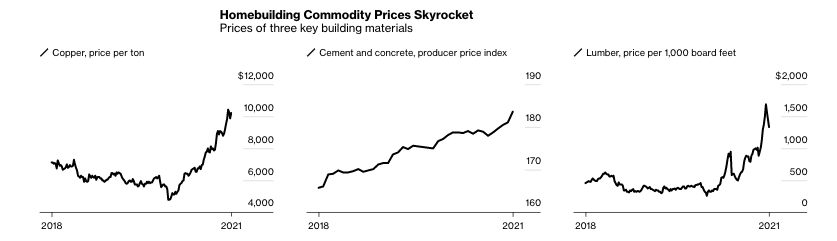
 Surging construction costs to build a new home is not sustainable and is becoming a pain in the arse for homebuilders and prospective homebuyers. From concrete to lumber to copper pipes to paint and even appliances, costs have surged over the past year. 

Source: Bloomberg 

The housing boom sparked by the Federal Reserve during the virus pandemic was built on historically low mortgage rates (thanks to Powell) and accelerated by a combination of record-low inventory as city-dwellers moved to rural areas amid the remote-work phenomenon.

According to Zillow Group Inc, the past year has been the hottest real estate market since 2007. Economist Robert Shiller, the co-founder of the S&P CoreLogic Case-Shiller home price index, recently told CNBC that "in real terms, home prices have never been so high. My data goes back over 100 years, so this is something." 

Making matters worse is a shortage of materials as there is just too much demand from builders and not enough supplies due to supply chain disruptions. There's also the issue of not enough buildable land. All of this has manifested into dangerous inflationary pressures vibrating not just through the housing market but the entire economy that may force Federal Reserve to announce tapering at Jackson Hole. It wouldn't be surprising if MBS purchases from the Fed would be some of the first to be reduced. 

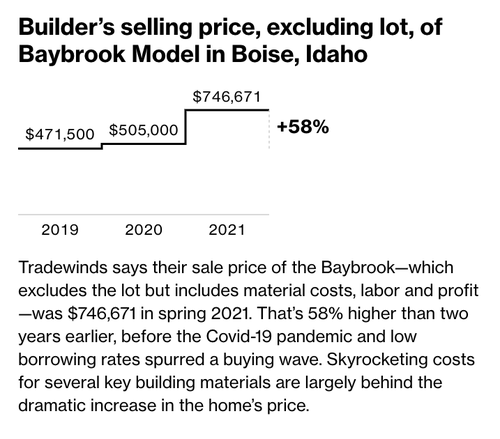
Bloomberg provides an example of surging housing costs in one of the hottest housing markets in the country: Boise, Idaho.

Steve Martinez, the operator of Tradewinds General Contracting Inc., said his company had to raise costs on some of its new builds to offset high raw material and labor costs. 

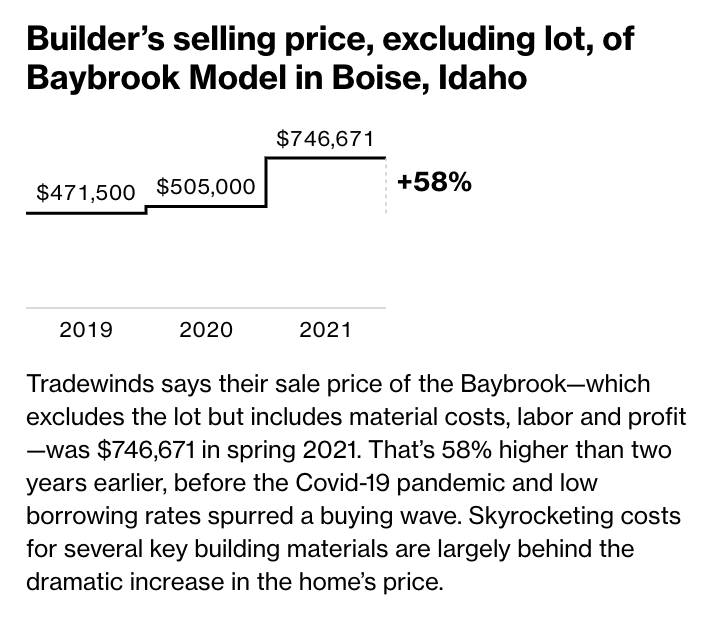
Martinez said the sale price of a 3,000 sqft, which excludes the lot but includes costs, labor, and profit, was $746,671 this spring. He said that's 58% higher than two years ago in 2019. These costs are primarily the reason why home prices are surging. 

Source: Bloomberg 

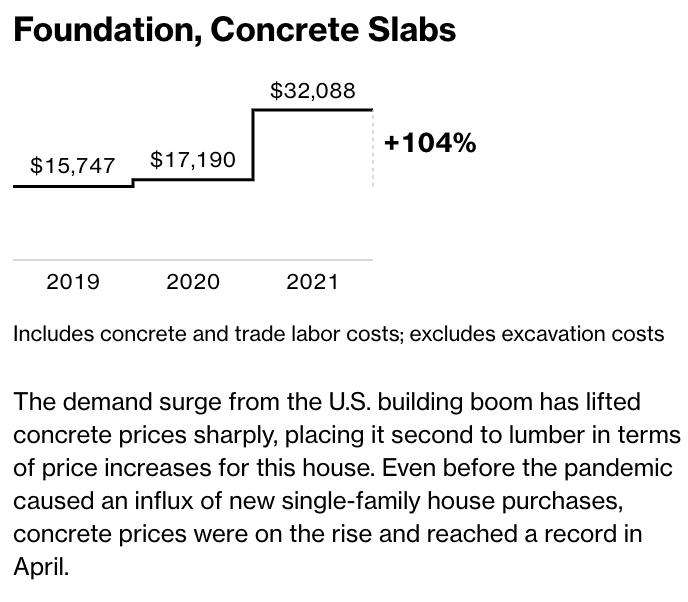
Foundation costs for the builder jumped 104% since 2019. 

Source: Bloomberg 

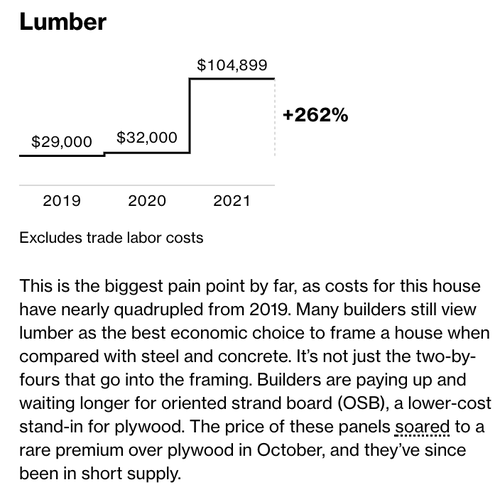
Lumber costs are one of the most significant issues for the builder. Prices have nearly surged 262% since 2019. 

Source: Bloomberg 

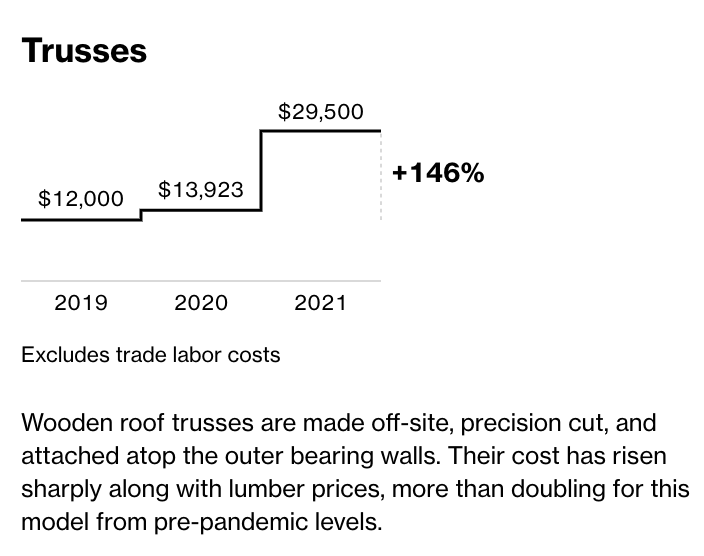
Timber roof trusses to frame a structure to support the roof have more than doubled since pre-pandemic levels. 

Source: Bloomberg 

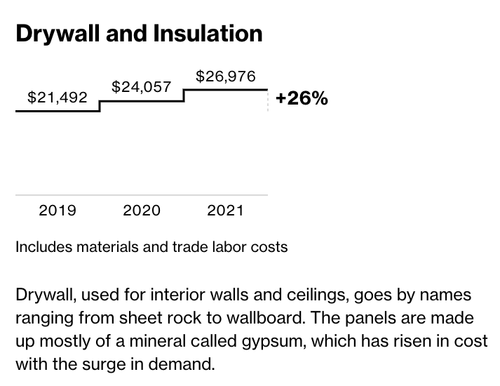
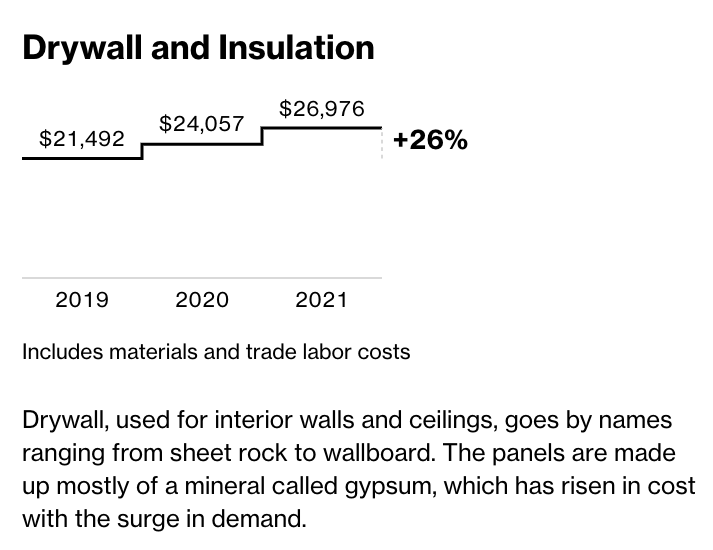
Meanwhile, drywall, used for interior walls and ceilings, has only risen 26% since 2019. 

Source: Bloomberg 

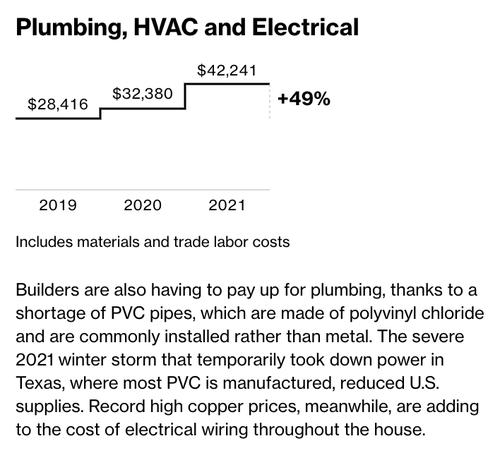
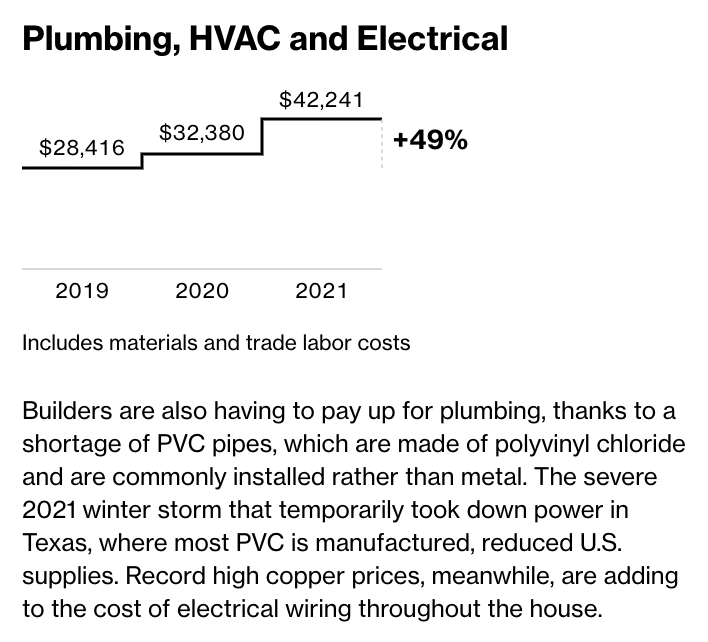
With plastic and base metal prices soaring, plumbing, HVAC, and electrical costs are up 49% since 2019. 

Source: Bloomberg 

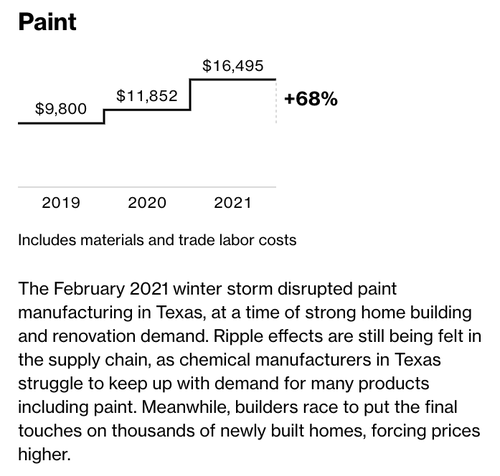
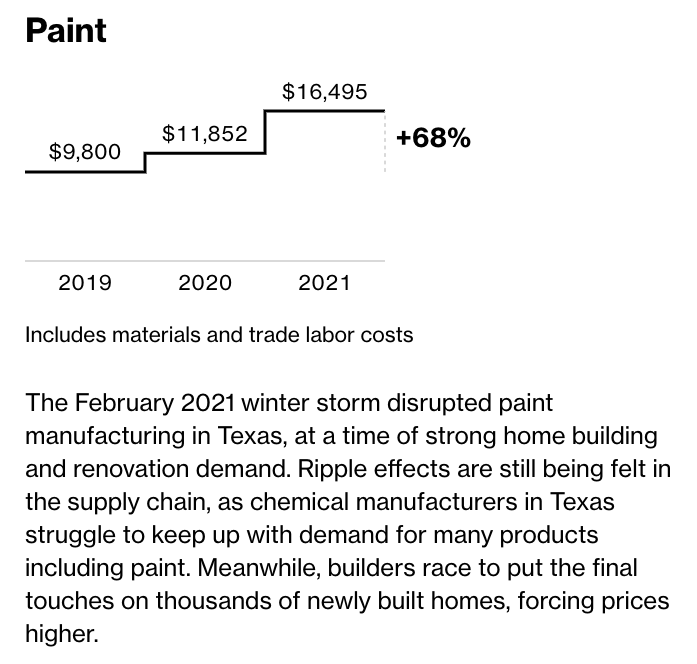
Interior and exterior paint have risen 68% since 2019. 

Source: Bloomberg 

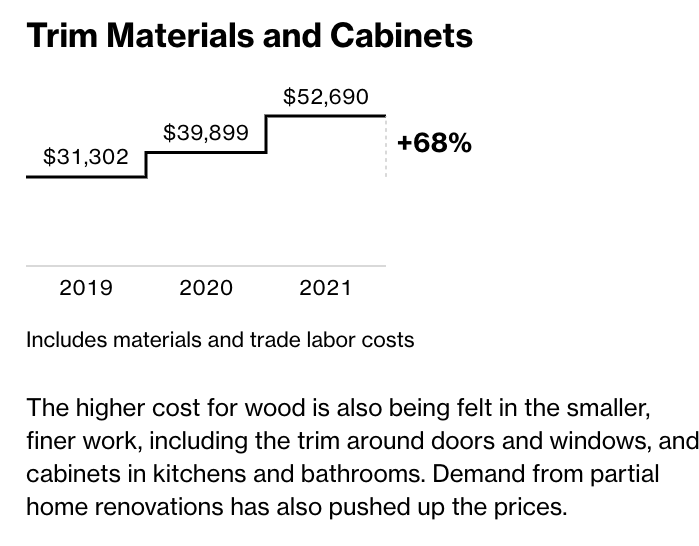
Custom millwork, such as trim around doors, paneling, and cabinetry, has surged 68% since 2019. 

Source: Bloomberg 

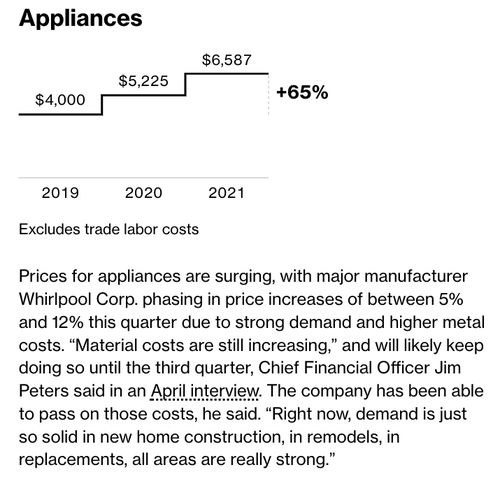
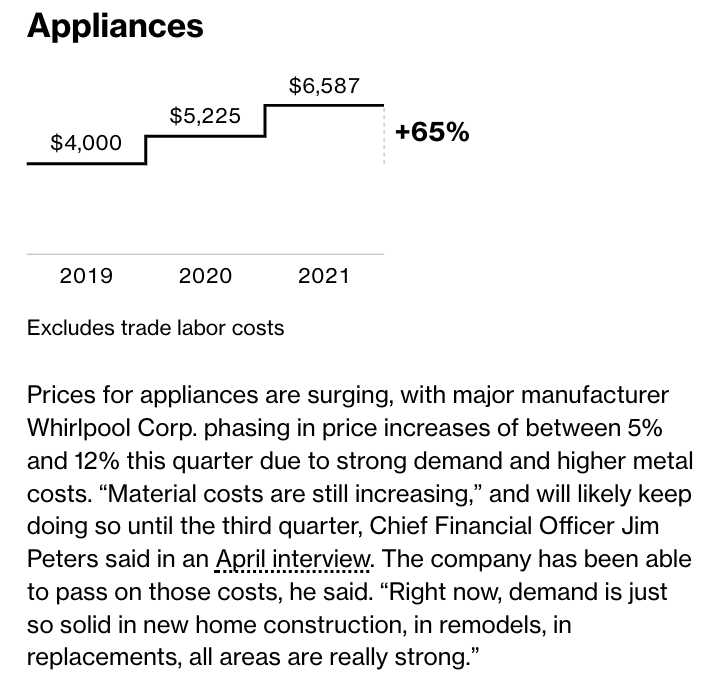
Appliances are up 65% from 2019 levels due to increasing demand and not enough supply. 

Source: Bloomberg 

Factor this all together, the Boise homebuyer purchasing a 3,000 sqft home from the builder is forking over $950,000, up 61% from 2019. 


The cost of building a home has rocketed higher in a post-pandemic world that could soon be an industry killer as housing affordability becomes a significant issue. This is why the Fed needs to get a hold of inflationary pressures by unleashing tapering. 

"This could be industry killing if things continue going the way they're going," said Martinez, who has had to tack on price increases during construction of anywhere from $40,000 to $100,000, primarily due to rising lumber costs. "We're putting projects off. We've got clients that are hitting their price ceiling."

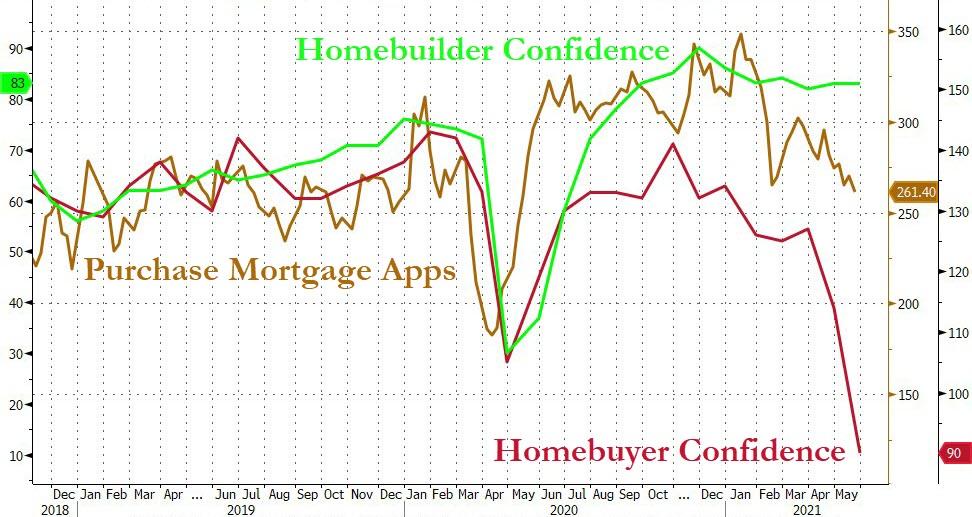
Record-high housing prices have already begun to dent homebuyer confidence as prices become unaffordable. 

It's time for the Fed to end their grand experiment in juicing the economy and let the price of everything normalize.

https://www.zerohedge.com/markets/build-your-dream-home-has-never-been-more-expensive

Saturday, June 5, 2021

Lumber Prices Slump As Historic Boom Hits A Wall

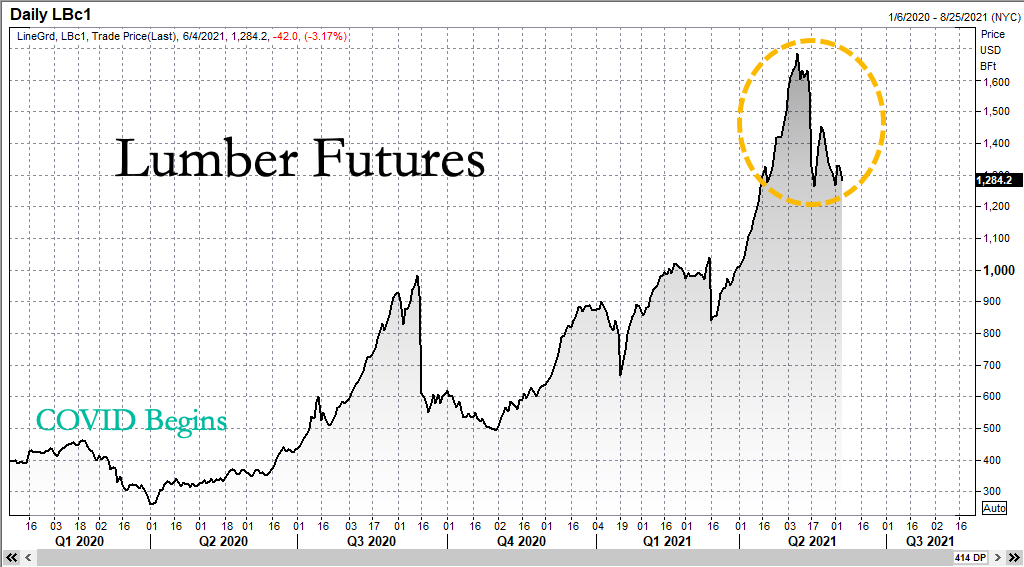
 Lumber futures on Chicago Mercantile Exchange fell -3.1% to $1,284.20 per 1,000 board feet, extending last week's first loss since January. For the last 18 trading sessions, lumber prices have come under pressure amid signs that an unprecedented rally may be waning. 

Citing data from trade publication Random Lengths, CIBC analyst Hamir Patel told Bloomberg that Western spruce-pine-fir prices decreased $130, or -8.1%, compared to last week's $1,470 per 1,000 board feet, and Southern yellow pine 2x4 lumber dropped $92, or -6.9%, to $1,236 per 1,000 board feet.

The decline comes alongside a drop in lumber futures, which have tumbled into a bear market, -25%, in recent weeks, from an all-time high reached earlier in May of around $1,711 per 1,000 board feet. 

This suggests that sawmills could be catching up amid the flurry of demand from North American homebuilders, along with supply chain issues, which created massive supply constraints, which propelled lumber prices to record highs. 

"Record softwood lumber prices amid an acute supply shortage appear unsustainable and may correct sharply from a level that's quadruple the 10-year average," Bloomberg analyst Joshua Zaret wrote this week.

But with lumber prices adding tens of thousands of dollars to new residential builds, some builders have paused or halted new construction. 

Rep. Bob Gibbs, R-Ohio, who serves on the House Oversight Committee's environment subcommittee, told FOX Business that increasing lumber prices are "just one of the many indicators that President Biden is failing American workers."

"Lumber prices are an issue that has many causes, from economic complications from the coronavirus pandemic to difficult trade issues with Canada. Biden has shown he is either unwilling or incapable of tackling these obstacles," Gibbs told FOX Business.

Last week, Patel told Bloomberg that even though home renovations are easing, lumber prices could maintain around the $1,000 handle through 2021. 

Despite the latest pullback, prices are likely to remain elevated until the Federal Reserve begins or at least signals that it will start to taper its $40 billion per month in mortgage-backed securities purchases.

https://www.zerohedge.com/commodities/lumber-prices-slump-historic-boom-may-be-easing