The New York State Senate has named Senator Michael Gianaris, a critic of Amazon’s $3B deal to come to New York City, to the Public Authorities Control Board that will likely have to approve the development plan for the e-commerce giant, the New York Times reports, citing the Senate. A spokeswoman for Gov. Andrew Cuomo, who could reject the selection, said, “This recommendation puts the self-interest of a flip-flopping opponent of the Amazon project above the state’s economic growth. Every Democratic Senator will now be called on to defend their opposition to the greatest economic growth potential this state has seen in over 50 years.
Wednesday, February 6, 2019

Monday, February 4, 2019
Rent Control: Climate Uncertain
The rise of populism has shaken the politics of many states, including Illinois, and landlords here may begin to feel the effects.
The new governor, J.B. Pritzker, hails from one of Chicago’s richest families, but the billionaire businessman was lifted into office by a liberal wave in one of the nation’s bluest states, and in the era of Bernie Sanders and Alexandria Ocasio-Cortez, the 1990s-style centrism that once dominated the Democratic Party is out of step.
If Pritzker needs a way to prove his liberal bona fides, he could sign a legislative measure that would dump Illinois’ 20-year ban on rent control, an action he said during campaigning that he supported. The question would then be his attitude toward a new, and far more sweeping, proposal that would not only establish rent control, but transform the relationship between tenants and property owners.
“We’re going to fight both measures, and we’re going to beat both,” Chicago Association of Realtors Senior Director of Government Affairs Brian Bernardoni said.
The first bill, sponsored by state Rep. Will Guzzardi, a Chicago Democrat, is just one line of text that repeals the 1997 Rent Control Preemption Act, a law that bans municipalities from imposing restrictions on rental rates. It was first introduced a year ago and sent back to the rules committee, but he just reintroduced the measure, now known as House Bill 255, and is seeking co-sponsors.
“The economic situation of renters has become a lot harder, and the families I represent are facing real crises as they try to make the rent each month,” Guzzardi said.
The Logan Square neighborhood is part of his district, and it is now considered one of the hottest rental markets in the city. Construction crews are at work all over the neighborhood, often building new luxury housing too costly for most residents, he said.
“If a landlord has a three-bedroom apartment, and wants to nearly double it to $2K, there are currently no checks to stop this. It’s happening every day in Logan Square.”
The second proposed law was introduced last February by state Sen. Mattie Hunter, another Chicago Democrat.
In response, Senate President John Cullerton authorized a series of public forums around the state hosted by a bipartisan Senate committee on housing, which listened to hours of testimony from hundreds of advocates, landlords, tenants and business owners.
The original proposal was reworked over the past year. The plan to administer rent control through boards in each of the state’s counties was scrapped and replaced with six regional organizations, each with seven elected members who would implement, monitor and enforce rent control.
The new bill will also include a rule that landlords can only evict someone for good cause, such as nonpayment of rent, other breaches of a lease, or if an owner wants to take a unit off the market, among other reasons.
A version of this bill will soon be introduced in the House by state Rep. Mary Flowers, according to Rod Wilson, executive director of the Lugenia Burns Hope Center on the South Side, a nonprofit and part of the activist groups Lift the Ban Coalition and Campaign for Rent Stabilization in Illinois.
A Senate bill will also be introduced that mirrors Guzzardi’s effort, he said, and after a final report is produced by Hunter’s special committee, the more comprehensive bill will be reintroduced.
Whether any of this can actually pass the legislature and reach the governor’s desk is difficult to judge. Affordable housing advocates can remind the new governor about what he said last year on the campaign trail when asked about the various rent control proposals kicking around the legislature.
“Gov. Pritzker, while campaigning in both the primary and the general election, said in public forums that he supported repealing the Rent Control Preemption Act,” the Lawyers Committee for Better Housing Senior Attorney Frank Avellone said.
He is less sure about securing approval for the far-reaching proposal that emerged from last year’s public forums, and said that vision may be a multi-year effort.
Only California, Maryland, New Jersey, New York and the District of Columbia have rent control laws, according to the National Multifamily Housing Council. Massachusetts voters discarded rent control in 1994, but a similar effort in California failed in 2008.
Pritzker’s office did not return messages seeking comment on the rent control proposals.
“He’s got a lot on his plate right now, such as trying to get a new budget together, but if it gets to his desk, I believe he’ll sign it,” Guzzardi said.
Bernardoni wouldn’t offer an opinion on the legislation’s chances, but he refuses to be complacent. There are dozens of rookie lawmakers this year, he pointed out, and the federal investigations that recently engulfed powerful politicians like 14th Ward Alderman Edward Burke and 25th Ward Alderman Danny Solis, and perhaps touched Illinois House Speaker Michael Madigan, have further unsettled the political world, making it difficult to offer confident predictions.
“Two years ago, who would have thought Rahm Emanuel would just walk away from the mayor’s office, or that Ed Burke would disappear from the political scene?”
Avellone also finds the recent political change surprising, but exhilarating as well.
“Two years ago, there was no discussion of rent control at all, and now it’s on everyone’s radar screen,” he said.
NYC signs Willets Point, Queens, letter of intent
The de Blasio administration signed a letter of intent Thursday with a joint venture between the Related Cos. and Sterling Equities. The pact lays out a timeline for the development team to hash out the details on two potential scenarios drafted by a community task force for 17 acres to the east of Citi Field in Queens. One of the scenarios includes a hotel and soccer stadium, while the other is more traditional, presenting a mix focusing on housing and retail. In roughly a year, according to the letter, the city will decide which path to pursue and draft a final development agreement after soliciting public input.
“Yesterday’s decision to move forward with the joint-venture and pursue these options in a very meaningful way—with very serious milestones—is a really important next step,” said Alicia Glen, deputy mayor for housing and economic development.
“We are continuing to work with EDC to bring the revitalization of Willets Point to fruition and transform a long-contaminated site and vacant lots into a vibrant community,” a spokesman for the development team said in a statement.
Whichever development scenario is ultimately selected—or whether the city will terminate its agreement with the developers and do something else—Glen said that keeping momentum going is essential to creating a neighborhood around the greenlighted mixed-use project.
Saturday, February 2, 2019
Libraries, Studies, and Writing Rooms of 15 Famous Men

Just about two years ago, we wrote a post called 14 Famous Man Rooms, which offered a look at the rooms where over a dozen famous men wrote classic books, pondered big ideas, and tinkered with their inventions. Readers offered some really great additions in the comments, and we’ve come across more interesting, manly rooms in the interim, so we decided to put together a follow-up to that post. While the rooms in the former post ran the gamut from Frederick Douglass’ office to Frank Lloyd Wright’s drafting studio, this post focuses on libraries, writing rooms, and studies.
I don’t know about you, but visiting historical homes is one of my favorite things to do while on vacation. There’s something about being in the place where people lived and loved, the rooms where they paced anxiously, shed tears, and celebrated achievements, that really makes me feel connected to the past and to a man’s personal history in a way that fascinates and inspires me. If you can’t crisscross the globe this summer, come along with us for a tour through 15 rooms where famous men, both past and present, hatched and penned their influential words and ideas.
Rudyard Kipling’s Study
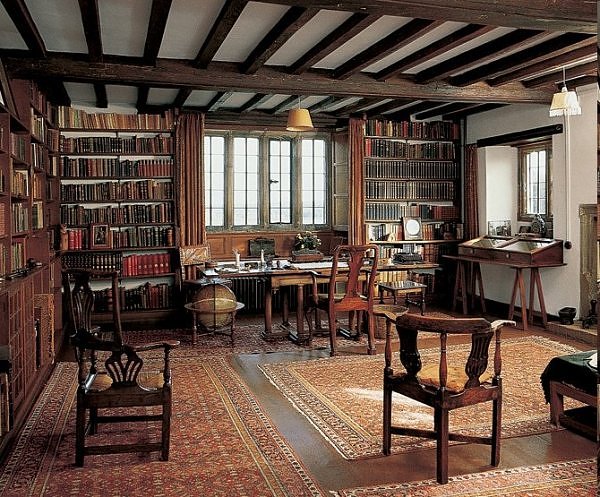
When Rudyard Kipling came upon the secluded, 17th century Bateman’s House in Sussex, he was immediately smitten. He wrote:
“We had seen an advertisement of her, and we reached her down an enlarged rabbit-hole of a lane. At very first sight the Committee of Ways and Means [Mrs Kipling and himself] said ‘That’s her! The only She! Make an honest woman of her–quick!’ We entered and felt her Spirit–her Feng Shui–to be good. We went through every room and found no shadow of ancient regrets, stifled miseries, nor any menace though the ‘new’ end of her was three hundred years old…”
The Feng Shui of Bateman’s was good to Kipling indeed. It was here in his study that he penned that manliest of manly poems–“If.”
William F. Buckley’s Study

If you were looking for William F. Buckley during his life, the first place to check was his study, which he converted from a garage. It was here, surrounded by mementos, books, and paintings (some of which he did himself), that he would toil on his columns and novels, and it was here that he was found dead when he passed away in 2008.
William Randolph Hearst’s Library & Study

Built in San Simeon, California by newspaper magnate William Randolph Hearst, Casa Grande, or Hearst Castle as it is now known, boasted 56 bedrooms, 61 bathrooms, 19 sitting rooms, 127 acres of gardens, indoor and outdoor swimming pools, a movie theater, tennis courts, an airfield, and the world’s largest private zoo. Hearst himself lived in the castle’s third floor Gothic Suite. The floor’s library (seen above) housed more than 4,000 books, along with 150 vases from ancient Greece.
Photo Sourcep
3,000 more books could be found in Hearst’s Gothic Study. The room served as a private library and office from which Hearst controlled his media empire and as an executive boardroom for discussing matters with his cohorts as well.
Be sure to also check out pics of the Hearst Castle’s billiards room, theater room, and indoor and outdoor pools — really unbelievable. This place is near the top of my to-visit list (Sagamore Hill — see below — currently holds the number one spot).
Roald Dahl’s Writing Hut
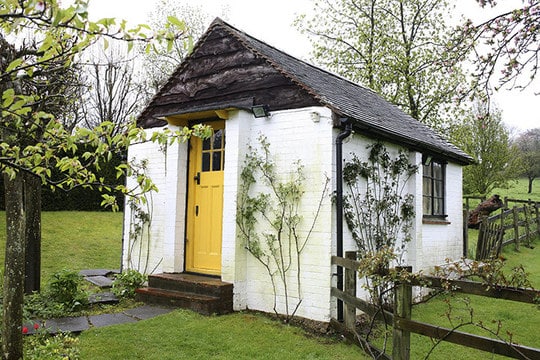
When Roald Dahl moved to Great Missenden in Buckinghamshire in 1965, he built a small writing hut (you can take a 3-D tour here) for himself. Dahl’s family has kept the hut much like it was when the author died, but even during his life it was a pretty dark, bare bones, ramshackle sort of place. No one could enter the hut but Dahl himself, and no one was allowed to clean it either; it reeked of tobacco and the floor was covered with pencil shavings and cigarette ash.
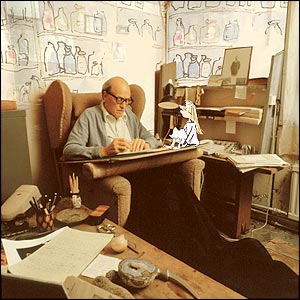
The solitude of his hut inspired Dahl’s creativity; he wrote all of his children’s stories from within its little walls. Here’s how Dahl described the power of the place:
“You become a different person, you are no longer an ordinary fellow who walks around and looks after his children and eats meals and does silly things, you go into a completely different world. I personally draw all the curtains in the room, so that I don’t see out the window and put on a little light which shines on my board. Everything else in your life disappears and you look at your bit of paper and get completely lost in what you’re doing. You do become another person for a moment. Time disappears completely. You may start at nine in the morning and the next time you look at your watch, when you’re getting hungry, it can be lunchtime. And you’ve absolutely no idea that three or fours hours have gone by.”
Sir Arthur Conan Doyle’s Study

Sir Arthur Conan Doyle lived in his Windlesham home on the outskirts of Crowborough in East Sussex for 23 years. When he died there in 1930, his request was to be buried in a garden next to a writing hut he had built on the property. But during his life, he actually preferred to write in the study on the first floor of his home. There he penned several of his famous Sherlock Holmes works, including The Poison Belt, in which he describes the view looking out from his study and across the Crowborough Common to distant Rotherfield.
Oh, and speaking of Mr. Holmes, he had a nice den too…
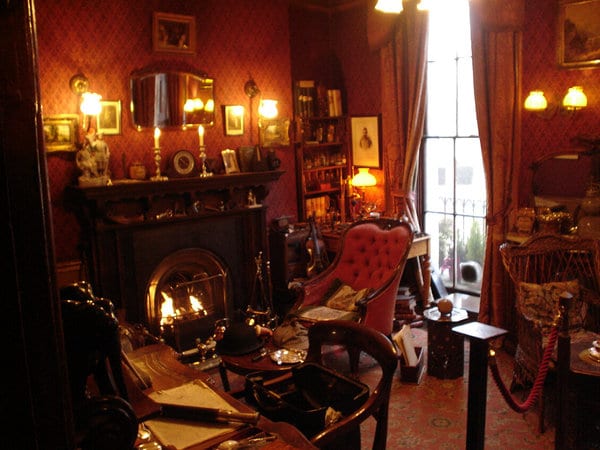
Sherlock Holmes’ Study
Sherlock Holmes is of course a fictional character, but that hasn’t stopped folks from recreating his office from the descriptions given by his creator.
There is one at the Sherlock Holmes Museum at 221B Baker Street:
And one at The Sherlock Holmes pub in Westminster:

Both look pretty cozy.
Jack London’s Study

Photo Source
When the stone mansion (“Wolf House”) Jack London was building on his Sonoma Valley ranch burned down in 1913, he built a tranquil, windowed annex onto the large “cottage” he and his wife Charmian had been living in for years. The study–in which he penned his final stories and novels–was adjacent to his “sleeping porch.” Now that’s a room you don’t hear much about these days, and one I would love to have, especially with this kind of view!

George Washington’s Study

George Washington’s study was built during the Revolutionary War as part of the expansion of his home. When the tired General returned to Mount Vernon in 1783, he was naturally called upon to entertain countless family, friends, politicians, and well-wishers. His study became the place where he could hide out and find solitude; no one was allowed in without an invitation. Here he could read one of his 884 books, oversee his estate, pen letters, and write in his diary. But he also used the room as a chamber for bathing and dressing. He would rise between 4-5 in the morning and make his way into the study via a private staircase that connected it to the master bedroom. In these two quiet hours before breakfast, he’d get ready for the day, review reports, and write letters. In the evening before bed, he’d be back in the study to discuss issues with his secretary or do some more reading before bed at 9 o’clock.
Neil Gaiman’s Writing Gazebo

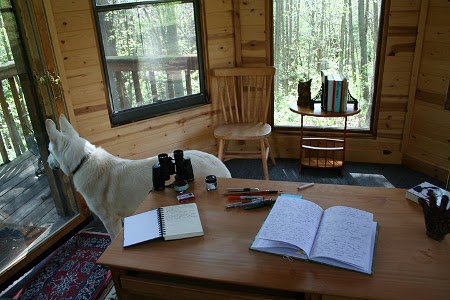
Here’s what contemporary author Neil Gaiman said about his enviable, Mark Twain-esquewriting gazebo in the book Shedworking:
“I had the gazebo built about 15 years ago, and go through phases of using it, and then I’ll abandon it for 5 years, then rediscover it with delight. I love walking to the bottom of the garden, and settling down to write.Nothing ever happens down there. I can look out of the window and some wildlife will occasionally look back, but mostly it’s just trees, and they are only so interesting for so long, so I get back to writing, very happily.There are heaters down there, because it gets cold here in winter, and blankets on the chairs, ditto, and I have to try and remember not to leave bottles of ink on the table as they freeze. It’s just out of reach of the house Wifi, too, which is a good thing.”
Winston Churchill’s Study

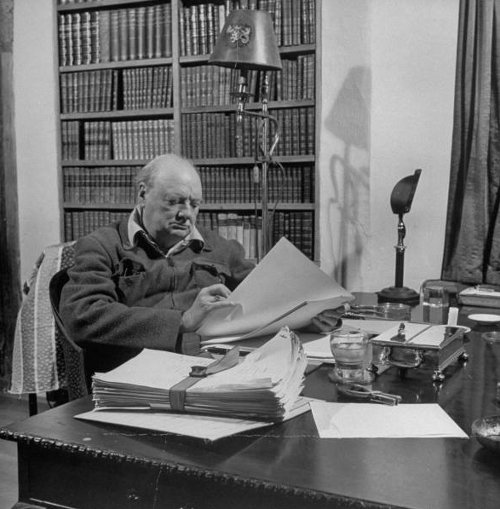
What is often overlooked about Winston Churchill is that his primary income — his only income when he was out of office — came from his writing. And he did the bulk of that writing, 50 books and hundreds of articles, from his study at Chartwell Manor, his main residence for forty years. With 20 foot ceilings crisscrossed with 11th century rafters, books spilling out from the bookcases and piled against every wall, paintings of Napoleon, Lord Nelson, and his wife, and a magnificent view of Chartwell’s picturesque gardens and lakes (which Churchill built himself), the study was the heart of the home, Churchill’s sanctuary, and the place he spent much of his time–often in the wee hours of the morning.
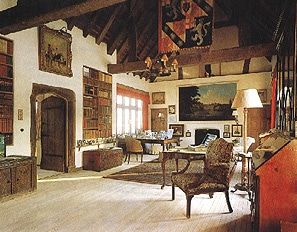
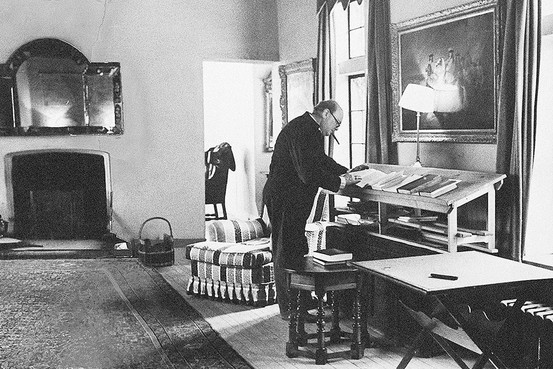
After Churchill’s favorite part of the day — a sumptuous 8:00 dinner, along with stimulating conversation and plenty of cigars, brandy, and port — Churchill would change out of his tuxedo and into a bathrobe and slippers before walking through the Tudor doorway of his study (which he called “the factory”) at about 10:30 or 11 pm. There he would pore over the galley proofs laid stacked on top of his upright table, sit and write on his mahogany desk, and dictate to his two secretaries who lived in residence on the property. After dictating 3-4,000 words, Churchill would dismiss his secretaries at about 2 or 3 in the morning and hit the sack.
Norman Mailer’s Apartment


Norman Mailer’s apartment did not really have a dedicated library; rather, the whole apartment was a library of sorts, with bookshelves sitting against many of the walls and volumes stacked into various nooks and crannies. Seen here as it looked a few years after his death, and having been, according to his son “slightly feminized,” the Mailer-designed apartment has a nautical theme, complete with galley-like rooms and gangplank-esque walkways that lead to neat loft areas. Mailer designed the unique apartment partly to conquer his vertigo, and in his younger years, he hung a hammock between the rafters, a trapeze from the ceilings, and rope ladders from the different levels.

Theodore Roosevelt’s Library & Gun Room
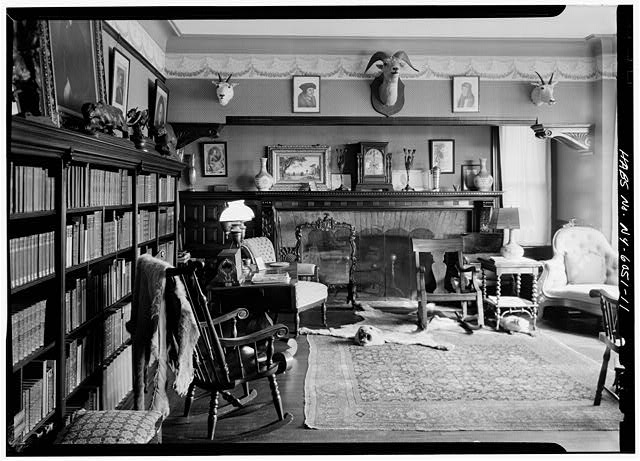
After Theodore Roosevelt’s Dakota cattle business failed, he came back East and built a home in Oyster Bay, NY. He called his estate Sagamore Hill, and he lived there until he died (with a stint in the White House, of course). It was where Roosevelt would go to relax, romp in the woods, and revitalize his man spirit. In addition to having a really manly trophy room, the home also included a nice library where TR would spend much of his time. Situated on the first floor of the home, it was decorated with animal skins from Roosevelt’s hunts, along with portraits of TR’s heroes.
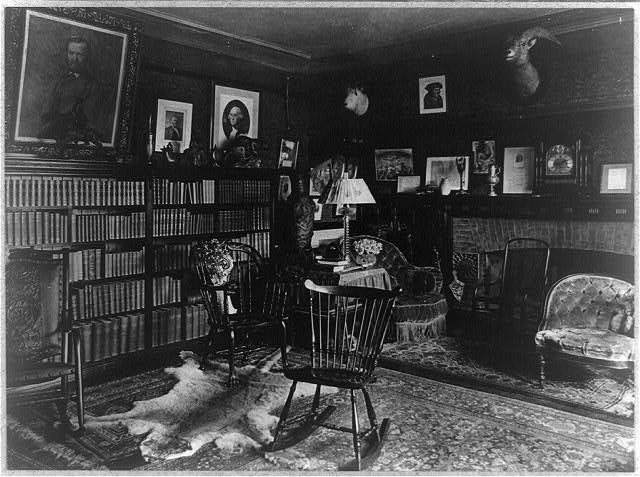
While he was president, Roosevelt would sometimes turn Sagamore Hill into the “Summer White House,” meeting with politicians and dignitaries in the library while Secret Service agents were stationed at the doors.
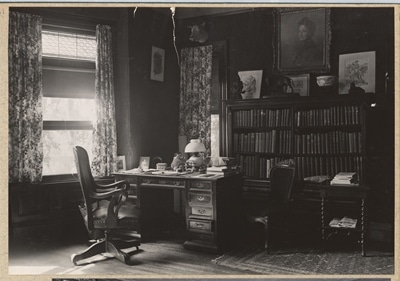
The library had also served as Roosevelt’s study before he married his second wife Edith, but because it had become a social center in the house and a place for entertaining guests, he and Edith decided to turn a room on the third floor into his “sanctum,” a hide out where he could write undisturbed (although his children could still often persuade him to take a break). Originally known as “the den,” Theodore Jr. imparted its lasting nickname, the “Gun Room,” so called because it displayed TR’s and his son’s hunting arms, which, sadly, you cannot see in the only photo I have been able to find of the room:
Jay Walker’s Library

If William Randolph Hearst had lived in the 21rst century and been a lot geekier, this is what his library might have looked like. Created by the founder of Priceline.com, Jay Walker, to be a tribute to the human imagination, the 3,600 square foot library consists of three eye-popping levels, which were inspired by M.C. Escher’s famous sketches of floating stairs. The platforms are connected by glass-paneled bridges that allow you to see the first floor of the library as you stand on top of it. The railings are also made of glass, etched and illuminated with images depicting the discovery of great inventions and ideas. The library houses thousands of eclectic and rare books and artifacts, including one of seven surviving Sputniks, books bound in rubies and diamonds, fossilized dinosaur eggs, and the napkin upon which FDR scribbled his plan for winning WWII.

The fascinating details and images of Walker’s library are too numerous to recount here, so I recommend checking out the articles here and here to learn more about it, and to get a better look, you can take a virtual tour in this video.
Darren Bush’s Shack

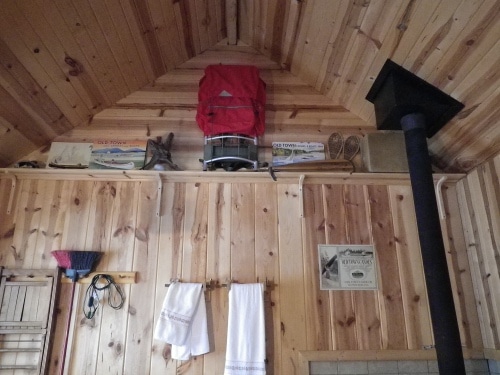
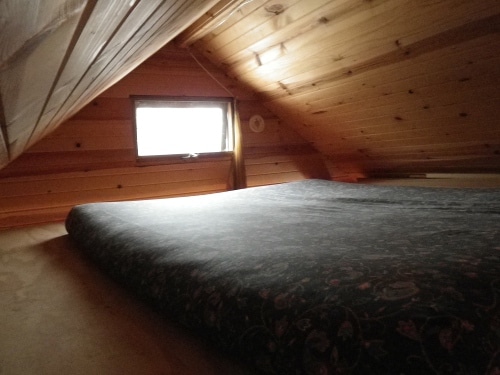
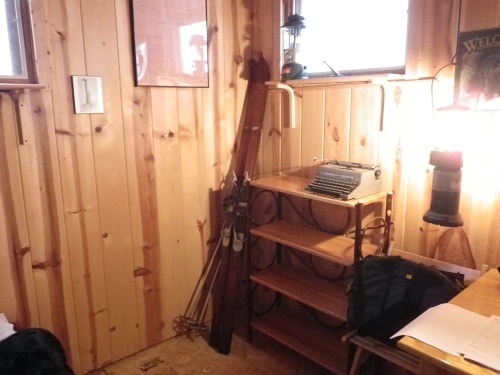
Okay, so Darren Bush isn’t famous in the traditional sense, but he’s famous around here as one of our contributing writers. I wanted to include the shack he built for himself, to give you some inspiration on what can be attainable even for the average Joe. Darren’s shack was inspired by the writing hut of author and conservationist Sigurd Olson, and he uses it for writing and getting away from it all. Here’s Darren describing how he built it with a friend:
“It took me about a year, start to finish, but it sat idle for six months while I scrounged parts (the windows, wood stove, chimney and some of the other stuff was recycled). Once we had the stuff, it was up and sheathed in two days. The roof took another few weeks working on it after work, as well as the siding.The inside was done over a few months, just an hour or so when I could get away. The furniture and stuff was scrounged, except for the table which was our old kitchen table refinished. The chair was picked off the curb and reupholstered, the rocker was a snowshoe kit I built, and of course the stove tools were custom made [Darren is into blacksmithing].”
I’ve been trying to convince Darren to write some posts on just how he built his shack — I’m sure some encouraging comments from readers could help sway him!
Here are some pics of the inside of the shack:

Brookfield Property a ‘hot property, cool price,’ Barron’s says
Brookfield Property is one of the world’s largest property owners with a high-octane strategy and lofty yield, and it comes at a depressed price, Andrew Bary writes in this week’s edition of Barron’s. Its partnership units (BPY) look attractive, and with a market value of $18B, Brookfield Property is the flagship real estate vehicle for Brookfield Asset Management (BAM), which rivals the industry leader Blackstone Group (BX), the report notes.
Finding a Financial Umbrella: How to Pay for Major Home Repairs as a Landlord
Covering the cost of a major home repair is one of the great challenges of home ownership — especially if you’re a landlord. Things can go wrong even in newly constructed homes, so it just makes sense to be ready for the unexpected. But there are some repairs, like a new roof or a new HVAC unit, that can be very difficult to pay for at a moment’s notice.
Of course, as the owner of the home, it’s your responsibility to your tenants to maintain a safe and healthy living space. Ideally, you would have the savings in the bank to address an emergency. In reality, 38 percent of people who are unable to cover even a minor repair job ($400 or less) with cash would choose to use plastic and pay off the amount over time, according to the U.S. Federal Reserve. However, since maintaining a strong financial position to a large extent depends on one’s ability to stay out of long-term debt situations, it’s important to find ways to cover the cost of home repairs as they arise.
Here are a few of the more common options for doing just that:
Educate yourself… and your tenants.
The more you and your tenants know about your home’s mechanical systems, the less likely you are to get stuck with an unnecessarily exorbitant repair bill. Read up on repair guides and check out YouTube videos to get a better idea of how things work, what really needs to be repaired, and when. Make a list of tasks you can perform yourself in and around the home. Then, set expectations for your tenants regarding tasks you expect them to take care of, like replacing the air filter or simply calling you as soon as they notice a problem. You may also want to consider hiring a contractor to perform preventative checks on all the systems in the home to catch minor problems and make minor repairs before they turn into expensive disasters.
Homeowners insurance
Homeowners insurance will cover the cost of repairing or rebuilding your house if it’s damaged or destroyed by natural disasters like lightning, fire, hail, or a hurricane. A standard policy generally won’t pay for wear and tear or earthquake damage, but always check the terms of your policy when facing a major home repair. If you have a home warranty policy, it may cover repair or replacement costs for things like major appliances and heating/cooling units. Encourage your tenants to invest in their own renter’s insurance, and protect both parties by explicitly stating what is covered in the event of damage due to a water leak, electrical shortage, or other home disaster in the rental agreement.
Home equity
Homeowners are often able to use the equity they’ve built up in their home to finance repair costs. This is usually done through a home equity line of credit, which is a better way to handle the situation since, in a sense, you’re borrowing from yourself. A home equity loan enables you to draw out money over a period of time, or you could refinance your home loan, which provides a one-time source of cash. Be aware that both options can take time to process and won’t be available if you haven’t owned the home long enough to build up equity. Some property owners choose to maintain an open line of credit at all times on another property specifically for this purpose.
Personal loans
Taking out a personal loan may seem like an undesirable option for someone trying to keep their debt under control, but it may be a good option for first-time landlords with no equity. A personal loan is generally preferable to using credit cards for home repairs, and they can be handled online, with no raised eyebrows or disapproving looks from a guy in a suit. You will need to have good credit because personal loans are generally unsecured (no need to put up collateral). If you’re able to secure a loan at a good interest rate, say 5 percent or lower, this could be your best option.
Repair savings fund
A rainy day fund is the most personally resourceful way to prepare for the unexpected. There are many ways to set aside a savings fund and contribute to it, even if you’re paying multiple mortgages each month, including converting credit card bonuses or reward points into cash, keeping your loose change in a large container, setting aside coupon money, and holding a garage sale. It takes some discipline, but the benefits of saving for an emergency situation are tremendous.
If you’ve ever faced an emergency home repair bill for a property you lease, you’re probably familiar with the fear that comes along with that phone call from your renter. But it doesn’t have to be that way, even if you’re new to being a landlord. Just be proactive. Regular maintenance can prevent major disasters, and having a plan to pay for unexpected expenses will keep your investment working for you, instead of the other way around.
2019 Predictions: 15 Prime Real Estate Locations Investors Need To Check Out
For those in the real estate market, staying up to date with current trends and market fluctuations is key to keeping a competitive edge. This also includes being aware of cities and regions that are expected to be prime real estate locations in the future — knowledge that is crucial to making sound investment decisions.
Within the real estate industry, there are already so many focal areas — such as commercial, residential and hospitality — that it can be difficult to know which locations are up-and-coming in the near future. To help you become aware of potential new real estate hot spots, 15 members of Forbes Real Estate Council offer their 2019 prime location predictions below.
1. Amazon HQ Cities
I’ve watched Long Island City in Queens for many years now, and now that Amazon has announced it’s moving half of its second headquarters to the neighborhood, prices have surged. Investors and buyers looking to get bargains in this area need to move quickly as we anticipate prices will only rise. The same can be said of Crystal City, Virginia where the other part of Amazon’s HQ2 has landed. – Elizabeth Ann Stribling-Kivlan, Stribling & Associates
2. Mid-Size Growing Cities
Amazon has lit investors’ fires in NYC and DC, and rightfully so. If you’re not already there, it’s too late. The real opportunities are where most aren’t looking. Mid-size cities with growing populations are fine targets. The best opportunities are right now flying below the radar. Think Oklahoma City, Des Moines, Indianapolis, etc. Low prices, strong economies, and growing population are key. – Roger Blankenship, Flipping America
3. Opportunity Zones
Investors will be pouring capital and their investors’ equity into Opportunity Zones in an effort to defer and eliminate capital gains from non-like-kind investments in 2019 and beyond. The influx of long-term capital into these lower-income neighborhoods will provide for long-term growth and a lot of news. – Blake Janover, Janover Ventures
4. Cities With Migration Inflows
Of course, the cities where real estate investors are looking to update will be the cities Amazon picked for its HQ2 — these will experience some construction growth. However, cities that are experiencing migration inflows will also see construction investments in 2019. These include cities in the Pacific Northwest, Denver, central Florida and Arizona. – Nathaniel Kunes, AppFolio Inc.
5. Atlanta, Georgia
In Atlanta, the quality of life is high relative to the cost of real estate. You can live a luxurious lifestyle at an affordable price, from a real estate perspective. There are also key pockets in the city going through gentrification, which is a great opportunity for investors to win some strong equity gains. – Ali Jamal, Stablegold Hospitality LLC
6. Los Angeles, California
Our property management platform tracks listings in cities worldwide and in 2018, we witnessed substantial growth of our Los Angeles clients along with their number of listings. In 2019, we’ll see investors capitalize on LA’s opportunity for growth as it’s a hub for both urban short-term rentals and traditional vacation rentals. -Vered Schwarz, Guesty
7. Charlotte, North Carolina
Charlotte is well-positioned to continue its solid performance in 2019. High job growth and a favorable supply and demand environment will support continued rent growth. Affordability and a high quality of life attract a highly skilled workforce, positioning Charlotte as the go-to place for national and international corporate relocation. – Guy Zipori, Skyline AI
8. Manhattan And The Hamptons
Manhattan will remain a competitive market. The influx of megamansions has created a surge in activity for investors who are looking for private locations in highly sought-after areas, such as the West Village. The Hamptons will also remain one of the top destinations based on the scarcity of available pinnacle properties. The Hamptons has proven to investors that their home will accrue in value. – Cody Vichinsky, Bespoke Real Estate
9. Nashville, Reno, And Portland
The hype around the Amazon HQ announcements will continue to drive interest in NYC and Virginia, but places like Nashville, Reno, and Portland are much more interesting. These areas have benefited from people moving from high-cost areas, and with each respective city’s unique offering (entertainment, craft food scene, proximity to Lake Tahoe), they have more to offer than just lower costs. – Brew Johnson, PeerStreet
10. Colorado
Colorado is one of the fastest-growing states in the nation and has become a bastion for business with a booming tech and startup community. Colorado has high tech wages, low office lease rates, and low home prices, which equals a trifecta of success for real estate investment. – Garratt Hasenstab, The Mountain Life Companies™
11. Texas
Commercial real estate flourishes where job growth is strong. Most of the recent surveys show job growth to be strongest in the south, most notably Texas. Two cities with large job growth are Dallas and Austin, Texas. Orlando, Nashville, and Charlotte are also high on the list. My suggestion is to embrace boots and barbecue and invest in Texas. – Tom Burns, Presario Ventures
12. Sunbelt Region
The best multifamily real estate investment opportunities are going to be in the Sunbelt region, in mid-size to smaller Tier 2/3 cities with strong population and job growth. These will continue to prove resilient as they attract talent and growing families and offer a higher quality of life than traditional urban centers. Keep an eye on cities like Greenville, South Carolina; Raleigh, North Carolina; and Granbury, Texas. – Yousif Abudra, BENA Capital, LLC
13. Warm-Weather States
Companies and employees look for the area that has lower tax rates, good schools, and a great climate. Therefore, tourist states promote these positives. Investing in Texas, Florida, Arizona and generally California are excellent due to climate. Floods, fires, hurricanes come and go. People have a short memory as to the havoc they produce. Most desire warm-weather lifestyles. – Rita Santamaria, Champions School of Real Estate
14. The Midwest
As late as we are in the current cycle, margins are getting pretty slim on the coasts and in major cities. Investors are seeking opportunities in secondary and tertiary markets to augment returns, and the Midwest still has a ton of opportunity. I think we’ll continue to see an influx of capital to Midwest markets. – Marc Rutzen, Enodo Inc
15. The South And Southeast
We do an annual survey of our national network of residential real estate investors and based on the latest responses we see a market slowdown coming in high-priced homes in areas with high tax rates. The most promising areas for residential real estate investors are the South and Southeast where there is high demand for entry-level homes (which home builders are failing to provide). – Jeremy Brandt, Fast Home Offer
Subscribe to:
Posts (Atom)