Search This Blog

Thursday, March 24, 2022

America’s Tomorrow City

 José Miró Cardona’s six-week tenure as prime minister of Cuba ended when Fidel Castro began unleashing firing squads on his political enemies. Two years after Cardona’s break with the Communist government, he ended up, as have countless other Cubans since, in Miami. It was Miró Cardona whom the U.S. State Department tapped to lead the Cuban Revolutionary Council (CRC), a collection of anti-Castro exiles formed in 1961 and tasked with spearheading the Bay of Pigs invasion. In Miami, this group of doctors, lawyers, and politicians devised a wild scheme to launch an amphibious invasion of Cuba and catalyze a popular uprising against Castro. Few of the renegades of Brigade 2506, as the group came to be called, had military experience. But they were products of the conspiratorial style of politics native to Latin America, where revolutions and counterrevolutions are dreamed up in haste and where experience and expertise are of little importance.

To Americans today, the Bay of Pigs seems the stuff of fiction. But Miami’s Cold War–era exiles had imaginations that could outrun reality, and their romantic ideals survived the plot’s spectacular failure. In subsequent decades, anti-Communist groups would use Miami as a launching pad for a series of bombings and assassinations on U.S. soil. Having once embraced the city’s counterrevolutionaries, Washington would have to dispatch federal agents to Miami to quell anti-Castro agitation. But federal forces failed to stop the institutionalized embrace of la lucha (the struggle) in Miami. When Eduardo Arocena was charged in 1983 with trying to assassinate the Cuban ambassador to the U.S., mayoral candidate Xavier Suarez donated to his legal defense fund. Suarez’s lackluster poll numbers jumped, and he won a close election.

Now, Francis Suarez, son of Xavier and the current mayor of Miami, has hatched his own conspiracy, though a far more benign one—aimed not at Havana but at San Francisco and New York, and not at counterrevolution but economic transformation. With the help of disaffected tech investors and hedge-fund managers, Suarez has put together a twenty-first-century version of Brigade 2506 to dislodge the coastal enclaves’ grip on the U.S. tech economy.

“Miami post-1960 is shaped by exiles from Cuba and Venezuela traumatized by an ideology that promises the world and delivers misery,” Suarez tells me. “That’s where this story begins.” New Miami indeed resembles Old Miami in certain ways. Those who fled socialism have a deep appreciation for the work of entrepreneurs, which contributes, in Suarez’s telling, to the region’s business-friendly environment.

It began with a tweet from technology investor Delian Asparouhov in December 2020, during the height of the pandemic’s first winter: “ok guys hear me out, what if we move silicon valley to Miami.” Echoing a mantra of California venture capitalists, Suarez replied: “How can I help?” In the ensuing weeks, Suarez built a hype machine to lure startups and investment funds from coastal metros to Miami. On Twitter and via back channels, the mayor engaged in informal exchanges with billionaires and pseudonymous followers alike. He began livestreaming “cafecito” talks with local entrepreneurs and, in a characteristic move, invited Elon Musk to City Hall to discuss building subterranean tunnels in Miami.

Suarez’s pitch was simple. Along with paying zero in state and local income taxes, transplants to the city would enjoy the services of a responsive government that encourages innovation. Miami offers an expedited electronic-permitting process and a host of incentive programs such as Follow the Sun, which provides up to $150,000 in grants to local companies. Florida has codified the contractor status of drivers for rideshare apps such as Uber.

San Francisco, by contrast, charges a Sugary Drinks Tax, a Traffic Congestion Mitigation Tax, and a Cigarette Litter Abatement Fee, atop the 14.8 percent in state and local income tax levied on top earners. California has tried several times to classify gig workers as employees. And if Golden State lawmakers can’t kneecap a company, they might go after its executives. Last year, for example, San Francisco’s board of supervisors condemned the naming of a hospital after Mark Zuckerberg, following a $75 million donation to the institution from the Facebook founder. Not long before, a San Diego assemblywoman posted “F-ck Elon Musk” on Twitter.

Longtime Silicon Valley figures gave Mayor Suarez a hand in recruitment. One was Keith Rabois, an early employee at PayPal, former COO of payments company Square, and partner at the legendary VC firm Founders Fund. Rabois made his fortune in the Bay Area but started searching for a new home during the pandemic. Miami was his choice. Over coffee at a Cuban café, he told me that Covid-19 marked a breaking point in an already-strained relationship between San Francisco and the tech sector. The city’s “absurdly restrictive” Covid policies, he says, “were completely irrational and anti-science and pushed a lot of people to escape.”

Rabois sees San Francisco’s status as a tech hub as a historical accident, the consequence of a clustering of angel investors in the South Bay in the twentieth century. “Sand Hill Road is the most boring place on the planet,” he says. “The only reason it mattered is there was a certain set and concentration of investors who had a slightly different risk/reward profile than anywhere else in the world at scale.”

Rabois used his Twitter megaphone to exhort entrepreneurs and investors to join him in Miami. “All success is path-dependent,” he says. “You found a company, then you will it into existence. In Miami, we did the same thing.” The social-media blitz wasn’t preplanned; before becoming the face of Miami tech, Rabois says, he had not even met the mayor. But he saw an opportunity with Suarez, and even agreed to teach workout classes at a local Barry’s Bootcamp to generate buzz for the city.

Convinced by Rabois’s pitch, tech investors Shervin Pishevar, David Blumberg, and Jon Oringer also left San Francisco for Miami. And when New York City emptied out during the pandemic, a significant number of investors and bankers decamped to South Florida. Forced to conduct business from home, financiers chose the tax-free tropics of Palm Beach and Miami. Financial firms such as Icahn Enterprises moved parts of their offices to South Florida, while Goldman Sachs announced its intention to do so; others opened de facto branches there, with employees working remotely.

The hype around Miami set off a flywheel that seemed to bring a new business to the city every week. SoftBank launched a $100 million fund dedicated to the Magic City, and Microsoft, Spotify, and TikTok all announced plans to open South Florida offices. A total of $1.1 trillion in assets under management have moved to the city since the campaign began. Venture-capital deal volume in the greater Miami area hit a record $1.9 billion in 2020, up from $800 million the previous year.

The sense of excitement is palpable. Miami Tech Week, a spontaneous April gathering of investors and entrepreneurs, morphed from an informal meet-up into a Who’s Who of tech. Asparouhov tells me that Founders Fund had initially planned a small gathering for its portfolio companies but that a series of promotional tweets “memed the conference into existence.” “The local ecosystem globbed onto it, the mayor did a ‘cafecito’ event, and a bunch of other venture firms decided to host parties that week as well,” he says.

One investor thus turned hype into something tangible, in what is fast becoming the Miami way. With larger cities still restricting in-person gatherings, Miami offered a chance to meet tech fellow travelers face-to-face. Following the event, cryptocurrency investor Balaji Srinivasan waxed poetic: “Miami Tech Week shows that politicians have a new path to power, demonstrates a new way for citizens to exert influence over governance, proves that Silicon Valley has finally achieved its destiny of decentralization, and indicates that the era of startup cities is now underway.”

South Florida may seem an unlikely venue for techno-futurism. Its economy depends largely on real-estate speculation and tourism, as well as a large number of retirees, who bring in a steady stream of Social Security, Medicare, and pension payments. It’s an economic model seemingly at odds with the small-government vision favored by the city’s largely libertarian tech crowd.

And Suarez’s startup city project has not been without its detractors. Critics on the left see a starry-eyed utopianism that serves the interests of capital at the expense of real people. Skeptics point out that the state lacks a university on par with Stanford or MIT, though the University of Miami does boast an entrepreneurship center to support startups. Journalists have derided Suarez, a Republican, as unserious.

But the incumbent cities that Miami wants to compete with have worn out their welcome for many. Silicon Valley, where our nation’s best and brightest perfect ad-targeting algorithms by day and dodge muggers by night, hardly resembles the place where Apple and Intel were founded. “The Californian Ideology”—a term coined by two British academics to describe the freewheeling early 1990s ethos of Silicon Valley—rested on a “profound faith in the emancipatory potential of the new information technologies.” The Valley’s tech entrepreneurs once aspired to “create a new ‘Jeffersonian democracy’ where all individuals [would] be able to express themselves freely within cyberspace.” Now Big Tech firms devote mammoth resources to content moderation, sanitizing their platforms at the behest of advertisers and politicians. Mounting cash balances at the largest tech firms suggest a dearth of ideas. The Valley’s Big Tech companies pay well, of course, but for those looking to be at the forefront of technological innovation or hoping to work with people who truly “think different,” the consumer-Internet giants increasingly look like dead ends.

Likewise, the hedonistic and high-flying image of Wall Street that pervades popular culture is mostly dead in New York’s overregulated, overtaxed financial sector. Freshly minted Ivy League graduates could once place exotic, multimillion-dollar bets in their first year at an investment bank. Now they spend as much time in compliance workshops as in the capital markets. For better or worse, the next Jordan Belfort will not be a penny stockbroker.

Miami offers not just low taxes and a friendly regulatory environment but a culture comfortable with risk. Those seeking novelty can find it in South Beach nightclubs, where overpaid twentysomethings brush shoulders with cocaine kingpins, and in the city’s startups, which look to build a decentralized Internet instead of enterprise software tools. Free from the regulatory hurdles of ordinary finance, a young coder in Miami can play the volatile cryptocurrency markets by day, spend $2,000 on bottle service by night, and fit in perfectly.

Early this year, Suarez introduced a resolution to put bitcoin on Miami’s balance sheet—an unacceptably risky move for cash-strapped cities like New York and San Francisco. The mayor himself has disclosed personal holdings in cryptocurrencies and regularly sings their praises. In September, Miami embraced a project called City Coins, which issues digital tokens tied to municipalities. Investors can now bet on the Miami token while generating revenue for the city’s coffers.

Suarez argues that crypto comes naturally to Miami, whose exiles have firsthand experience of hyperinflation. His constituents, he says, value a currency system that is “not government controlled, and not susceptible to the things that have always created problems with currencies, whether corruption, mismanagement, or excess government spending.” Suarez sees ballooning federal spending as a risk to the dollar’s utility as a store of value, no less so because it can be “manipulated” by federal authorities. Meantime, authorities in other states are beginning to crack down on digital currencies: a recent order from New York’s attorney general shut down two crypto platforms.

Miami newcomers are attracted by politics and policy alike. Cryptocurrency investor Nic Carter, who left Boston during this past summer, describes Miami as a “sanctuary, one of the most politically free cities in America.” “There’s a huge number of Cubans and Venezuelans here who completely disdain and hate socialism,” he says. “That’s incredibly refreshing when the rest of America is undergoing some sort of socialist awakening.”

At a dinner I attended in the city’s Brickell neighborhood, a crypto entrepreneur placed two AR-15 magazines on the table—a gift, he explained, for a friend who later joined us. Young investors spoke of the inevitable collapse of the U.S. financial system due to the Federal Reserve’s reliance on money-printing to fund federal deficits. When I visited the team at Swype, a cryptocurrency startup, they told me with certainty that their company would be the Apple of the decentralized Internet—the successor not only to Big Tech but also to the U.S. government as we currently know it.

Miami has long blurred the line between creator and crook. At a restaurant in Coral Gables, you never know whether the man at the next table, clad in a custom suit and impossibly large Rolex, is a diplomat or a money-launderer. The city is home to both crackpot counterrevolutionaries and seasoned political pros. In the same way, the Miami tech movement involves both serious investors and smooth-talking hucksters. It’s not always easy to tell them apart.

Is the Miami vanguard launching the next Bay Area, then, or the New Economy version of the Bay of Pigs? The uncertainty is the point. Suarez’s campaign to lure businesses can be criticized, but it seeks to break free from the risk aversion that increasingly constrains contemporary American life. For entrepreneurs dreaming up new currencies, new Internets, and new economies, Miami is America’s city of the future.

Blackstone Calls It Quits On 1740 Broadway, Hands Keys To Lender

 Blackstone is giving up on one of its Midtown Manhattan office buildings, the latest sign yet that distress is beginning to hit the office sector.

One of the world's largest owners of real estate, Blackstone has turned over the keys of 1740 Broadway, a 26-story office tower a block from Carnegie Hall, to the special servicer on its $308M commercial mortgage-backed security, Commercial Observer reports. 

Deutsche Bank originated the loan in 2015 as part of a single-asset, single-borrower CMBS deal and enlisted special servicer Green Loan Services to manage the financing deal. Blackstone has extensive Manhattan holdings, and the decision to hand the keys to Green Loan Service is "a one-off occurrence," a source close to the deal told CO. 

Blackstone bought the 621K SF tower from Vornado Realty Trust in 2014 for $605M. It has lost two major tenants in recent years, with law firm Davis + Gilbert leaving for Rudin’s 1675 Broadway in 2019 and L Brands electing not to renew its 418K SF lease, instead moving to 55 Water St. in 2020. 

“This asset faces a unique set of challenges, and we are working diligently to find a solution that is in the best interests of all parties involved, including our investors and lender,” a Blackstone spokesperson said of the building. “The vast majority of our office portfolio comprises differentiated office properties, such as life science office and office properties benefitting from content creation tailwinds, and we are confident those properties will continue to outperform. We continue to be big believers in New York and cities like it that are hubs for innovation and talent.”

Blackstone's decision to cut its losses at 1740 Broadway echoes recent moves in Chicago, another office market suffering from macroeconomic shifts. Last week, two towers each spanning over 1M SF were on track to find themselves in the hand of lenders, according to CMBS tracking firm Trepp.

Trepp reported that the Brookfield Asset Management-owned, 1.4M SF 175 West Jackson Blvd. was taken over by its lender last Monday, then the next day reported that the special servicer on a $100M loan for the 1.3M SF 135 South LaSalle St. tower expected the borrower to hand in the deed in lieu of a foreclosure action. 

The future of the office market across the country is in a state of flux, with many employees electing to keep working from home at least of some of the time. In New York, Manhattan’s office availability rate hit 17.4% last month, a new record, according to Colliers. Since the pandemic began in March 2020, overall availability has increased by 74.1% and now sits at nearly 94M SF.

Many of those troubles will be most visible in the CMBS market; borrowers like Blackstone at 1740 Broadway took out large, single-asset deals, and the realities of the office market have cast doubt on many owners' ability to meet their obligations without putting significantly more cash into their properties.

"The problems going forward are going to come from primarily markets that have sizable amounts of dated properties that are not particularly desirable to big drivers of demand these days," Trepp Senior Managing Director Manus Clancy told Bisnow in January. "You’ll see episodes in New York, Chicago and other places where big buildings that back loans with nine-figure balances become distressed."

https://www.bisnow.com/new-york/news/office/blackstone-hands-over-keys-at-1740-broadway-blaming-unique-set-of-challenges-112343

NYC Investment Vets Launch Firm To Buy Up CRE's New Ugly Ducklings

 Two veterans in New York City’s commercial real estate market have stepped out on their own, in the hopes of scooping up properties where owners have given up hope.

Neil Helman and Gerry Davis have banded together to launch Collins Realty Partners, which they say will specialize in buying value-add properties for $10M or more within a 100-mile radius of Manhattan and along the Boston-D.C. corridor.

"We're the kind of guys that like to look for opportunities to increase cash flow and change things around, turn around buildings that maybe aren't doing what they wanted to do or in situations where maybe an existing ownership has said they've run it as far as they want to run it,” Davis told Bisnow in an interview this week.

Davis, who began his career as an architect and whose own real estate career also spans three decades, most recently spent 15 years as a principal at Alchemy Properties. He oversaw the development of more than 1M SF across more than 18 NYC projects at Alchemy, according to a release. He has also held positions for an NYC family real estate office and worked as a vice president at M&T Bank.

Helman was most recently a principal at Avison Young in the investment sales division, and he has helped broker the sale of almost $2B of investment-grade properties in New York City in his 35-year career, including Columbia Property Trust and Normandy's $205.5M acquisition of 250 Church St. in 2019.

Helman and Davis told Bisnow they are looking to acquire properties primarily in New York City and a 100-mile radius in the Tri-State area that have lost tenants, charge below-market rents or have deferred maintenance that make them suited for adaptive reuse. They have yet to make their first acquisition, and they said they don't have a total investment target.

“Office and hotels may have a life as adaptive reuse for residential, which we're very open to exploring,” Helman said. “That's an age-old story that's been done time and time again, successfully taking an office property and redeveloping it as residential.”

As employers contemplated a return to in-person work, many looked to trophy buildings and upgraded Class-A offices in an attempt to lure workers. But that trend has created an existential crisis for an increasing number of Manhattan's Class-B and Class-C office spaces.

Collins Realty also sees opportunity in embattled storefronts and retail locations, Davis and Helman confirmed to Bisnow.

“I think a lot about street-level retail, and how beaten down it is in New York City, especially right now,” said Davis, who believes that the aftermath of the pandemic will create a reset on retail rents in Manhattan that could create interesting spaces for Collins Realty. “I think maybe that's someplace that we might want to play in.”

Manhattan's retail spaces have struggled as landlords grapple with the coronavirus pandemic's effects on foot traffic. Leasing activity for offices and retail saw a modest uptick in the second half of 2021, but rents continued to decline in locations like Herald Square and Times Square, where stores rely heavily on foot traffic for revenue.

Retail distress in NYC has been severe enough that even Vornado — the largest owner and manager of street retail in Manhattan — announced last August that it was selling off five failing Manhattan retail assets at significant losses. 

Davis and Helman told Bisnow that they will rely on their long-running relationships in NYC real estate to pursue opportunities for value-add acquisitions currently present in the city's office and retail markets. They declined to name their investors, but said their years of industry experience has given them ample contact lists of high net worth individuals.

"We have the relationships in place to fund whatever actual equities required," Davis said. "Given that interest rates are shared or moving around, even with that, there is still capital out there."

https://www.bisnow.com/new-york/news/capital-markets/new-firm-launches-to-succeed-where-others-have-failed-112367

Wednesday, March 23, 2022

Foreclosures Up 700%. Red Flag for Housing Market?


  • Moratoriums prohibited new foreclosures from starting for nearly two years, creating artificially low foreclosure rates.
  • Now that these protections have expired, foreclosure numbers are seeing triple-digit growth.
  • Despite this, rates are still well below those in pre-pandemic times and are by no means a red flag for a correction.
  • January 2022 saw a massive jump in the number of foreclosure starts, with ATTOM Data solutions reporting 23,204 foreclosure filings, a 700% year-over-year increase, according to Black Knight. Rising foreclosure rates aren't great news for the housing market because they could be an indicator of distress. As foreclosures steadily rise, could this be the first red flag for a housing market correction?

    Today's foreclosure starts, while much higher than recent past, are still below pre-pandemic levels -- by a lot. In 2021, there were a total of 151,153 foreclosure filings for the entire year, which was 69% less than pre-pandemic levels in 2019. For the month of January, there were 56,251 foreclosures filed in 2019, 58% more than the number filed in January 2022.

    Foreclosure filings are continuing to rise month over month, with February 2022 seeing 25,833 new foreclosures, an 11% increase from January 2022, which is welcome news for distressed real estate investors. But the numbers aren't necessarily a red flag for the housing market.

    Mortgage delinquencies are the most telling sign for the rise or fall of future foreclosure filings. Right now, there is no reason to believe foreclosure starts will jump dramatically, given the national delinquency rate is sitting at a low 3.3% as of January 2022. Employment remains strong and the housing market is on fire, putting home equity levels at all-time highs. This means that the roughly 2 million delinquent households today have solid alternatives to avoid foreclosure.

    There is also a notable backlog of loans that were previously in forbearance that haven't been addressed. These are loans that are in some type of active loss mitigation or completed loss mitigation efforts but still remain past due, and the ultimate outcome of the loans, either foreclosure, repayment of debt, or a long-term loss mitigation solution like a modification, isn't known.

    Signs of distress are definitely there, but they're nowhere near alarming levels and at this time certainly aren't a red flag for a correction. The real estate market is still seeing fierce competition and high demand thanks to a housing shortage and low interest rates. The Federal Reserve has stated it will be raising rates to combat inflation, which could curtail the rapid growth the market is seeing. But for now, all signs point to the housing market staying red-hot.

  • A 7x jump sounds massive, but even a small uptick in foreclosures would have been a notable increase when compared to recent levels. Moratorium protections that prohibited lenders from initiating foreclosures during the pandemic in 2020 and 2021 resulted in the lowest number of foreclosure filings since this data has been tracked on a national level.

  • But just because today's numbers remain low doesn't mean things can't change. Inflation is a growing concern for Americans, as the cost of basic necessities like fuel, groceries, electricity, and property taxes quickly becomes more expensive. Budgets surely will tighten as a result, and it's very possible we could see delinquencies increase in coming years.

  • https://www.fool.com/real-estate/2022/03/22/foreclosures-are-up-700-is-this-a-red-flag-for-the/

Tuesday, March 22, 2022

NYC Hit By Surprisingly High Jobless Rate As Workers Fail To Return

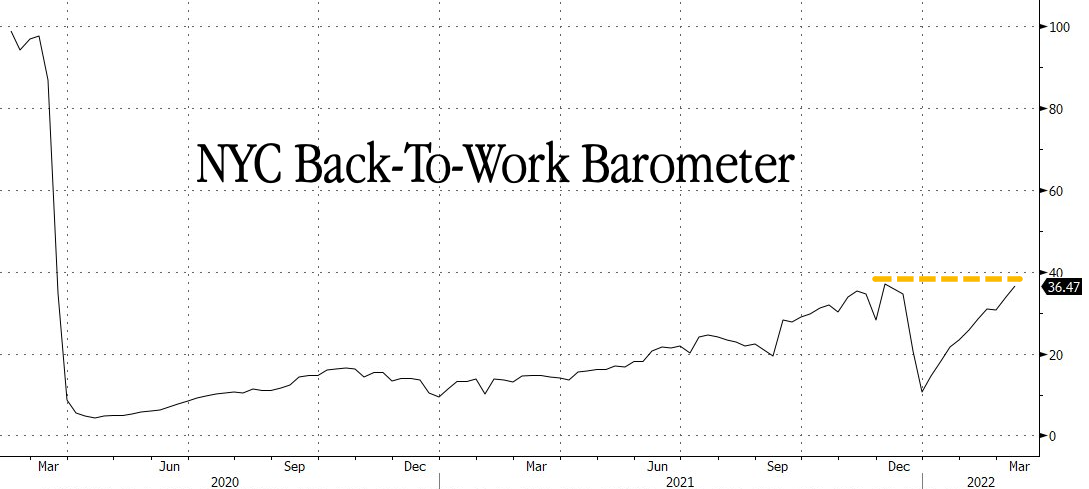
 The percentage of white-collar workers in New York City office buildings remains abysmal. Workers aren't returning, and it's crushing the local economy.

NYC's 7.6% unemployment rate is shockingly high compared with the rest of the country (nationwide average of 3.8%) as an economic recovery is slow to materialize, according to Bloomberg. There could be a muted recovery without five-day-a-week commuters because their impact on the local economy is substantial. 

Keycard swipes tracked by security company Kastle Systems show NYC offices are about 36% occupied, far below pre-COVID levels. Even as companies announced return-to-office dates, many implemented a hybrid work model that allows white-collar workers to work remotely part of the time. Some companies have entirely reduced their corporate footprint and enforced remote working for some employees. 

According to the latest survey by The Partnership for New York City business group, only 16% of top NYC firms say daily attendance in their Manhattan office was above 50%. The poll showed that about 75% of employers delayed return-to-office plans due to a spike in COVID infections year, and 22% said they don't have a timeline on when offices will be full again. 

On Oct. 29, 2020, we noted that NYC's recovery will be a "long slog" from here as the downturn will last well into 2023 and lag the rest of the nation. It seems we're right, and the source of a lackluster recovery is directly related to workers that aren't returning to offices. 

Mark Vitner, a Wells Fargo senior economist, said the city is "enduring a slower recovery because it is so dependent on the office and entertainment sectors." 

"Cities that were quicker to reopen following the initial lockdowns at the start of the pandemic have also tended to see stronger recoveries," Vitner said. What may have damned the metro area were public officials and their inability to lift health mandates that crippled the local economy, forcing tens of thousands of people, if not more, out of the area and to suburbia or Florida. 

Newly elected Mayor Eric Adams has argued that remote and hybrid work situations are crushing service-oriented businesses in the city that solely rely on white-collar workers, such as the food and entertainment industry. 

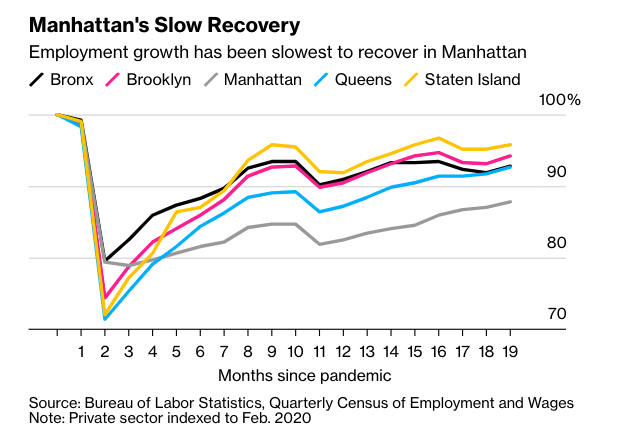
Quarterly Census of Employment and Wages data shows there are 275,000 fewer paychecks in just Manhattan compared to pre-COVID times. Manhattan jobs account for a whopping 57% of the city's overall economy. 

"Manhattan is an enormous economic and social driver," said Andrew Rigie, the New York City Hospitality Alliance executive director.

Manhattan's unemployment rate is the lowest among the boroughs. The Bronx has had the slowest employment growth. 

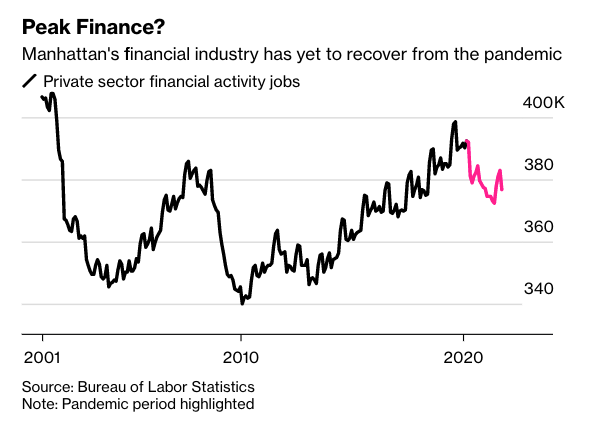
As firms fled Manhattan during COVID to places like Florida and Texas, the borough's financial industry has likely seen another peak in jobs. Also, factor in the increasing amount of automation in the financial sector, and the job situation in Manhattan looks even bleaker. 

NYC leads the way in lackluster employment gains.

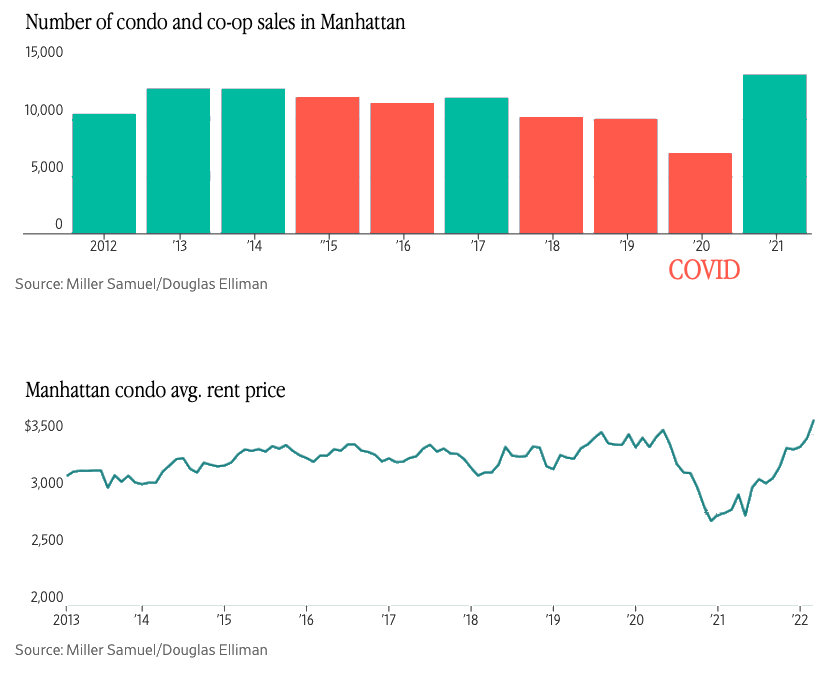
Meanwhile, the Manhattan housing market has been on fire as the number of sales spike and median rents soar. 

An economic revival in NYC will lag the rest of the country as long as remote work persists. So what happens to all the empty commercial-office buildings? 

https://www.zerohedge.com/personal-finance/what-vibrancy-nyc-hit-surprisingly-high-jobless-rate-workers-fail-return

Sunday, March 20, 2022

China Evergrande and Its Units Suspend Trading in Hong Kong

 Embattled Chinese real estate developer China Evergrande Group along with its other units suspended trading in Hong Kong Monday morning, according to exchange filings. 

Shares of Evergrande Property Services Group and China Evergrande New Energy Vehicle Group were also halted without giving any reasons.

The pause comes after Shenzhen-based Evergrande said in January that it aimed to present a preliminary restructuring proposal in the next six months. The firm has been at the center of a cash crisis among Chinese property developers following Beijing’s crackdown.

Investors are watching for signs of further asset sales as the group faces pressure from bondholders and offshore creditors in what’s likely to become one of China’s largest restructurings. The company has more than $300 billion in liabilities and is under pressure to pay suppliers and migrant workers and complete millions of unfinished homes.

On Sunday, local media reported that Evergrande’s onshore unit will sell its 30% stake in a Nanjing property company to Avic Trust Co. for an undisclosed sum. 

The company’s onshore unit separately said it received bondholders’ approval to delay coupon payments on its four billion yuan note, meaning the delay won’t trigger a default on the bond.

https://financialpost.com/pmn/business-pmn/china-evergrande-and-its-units-suspend-trading-in-hong-kong

Saturday, March 19, 2022

A Primer on Home Electric Vehicle Charging Stations

 Key Takeaways:

  • Developers are including charging stations in new multifamily buildings to future-proof their investment.
  • Even if they’re not installed in a new development, more builders are adding wiring to homes and buildings so charging stations can be added later.
  • Options and costs vary so the amenity warrants good research.

As more car manufacturers add electric vehicles to their fleets, those who own or lease them know the value of having a charging station in their single-family house, multifamily condo, or apartment building. 

And their popularity is only expected to grow. A recent report by Bloomberg New Energy Finance shows that by 2040, electric vehicles will make up the majority of new car sales worldwide and account for 33% of all light-duty vehicles on the road.

Another factor fueling numbers may be the increase in companies manufacturing charging stations, says Cassie Layton, senior director of marketing at El Segundo, Calif.–based EV Connect, a firm that develops software for the stations—what she calls the “brains behind the units.”

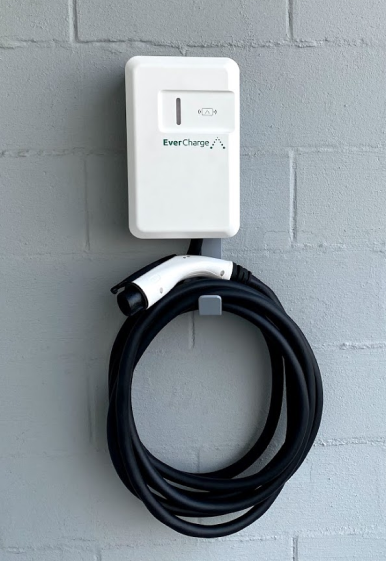
EverCharge electric vehicle charging station

©EverCharge

But exactly how important are charging stations to home buyers as they shop for their next home?

“It’s a plus but not a necessity—yet,” says real estate salesperson Stephanie Mallios, with Compass RE NJ in Short Hills, N.J., who works with buyers of single-family homes, townhomes, and condos. Many equate it to a hip amenity like a Nest thermostat, wine refrigerator, or yoga room, she says. “It shows the homeowners are cool, and that future buyers will have one less thing to do,” says Mallios, who built two charging stations into her own home’s garage.

At the same time, it’s wise to share with buyers that the amenity’s appeal may be greater with cohorts of certain ages and certain geographic markets. For example, in San Diego, salesperson Ayush Vats with Willis Allen Real Estate says he is seeing more first-time millennial buyers actively look for houses with charging stations.

It’s among the top five features 60% to 70% of these buyers want, in part because they own an EV or intend to purchase one in the next year or so, Vats says. But it’s also because of their ideology that they want to be green. As a result, he finds it’s easier to market a house with at least one station, he says. 

But Vats finds that if a house lacks a charging station but has everything else a buyer wants, it doesn’t kill the sale. Most stations he sees are located in a garage, but some are on the side of the house.

Architect Joshua Zinder, a managing partner at JZA+D in Princeton, N.J., is among those who think a station is a good investment. “The developers and builders we work with are considering support for EVs for all residential projects, both single- and multifamily,” he says.

Zinder also finds that EV-ready homes command a premium in most markets. He added to his home a charging station with a 110-volt outlet, providing an overnight charge for a range of 30 to 50 miles, which suits most of his day-to-day needs.

However, salesperson Jeff Rosenbloom, with Red Oak Realty, has found that buyers in his East Bay area of San Francisco rarely make a station one of their top five criteria. If a home happens to have green features, that’s good, but they’re not seeking them out, he says. “Maybe, they’ll add one once they own a house, but usually only if it has solar panels,” he says. 

When it comes to the multifamily housing market, charging stations seem to command a high level of interest, and more developers are including the feature or at least wiring buildings they’re constructing so they can be added. “It’s less costly to do so at the start of a project than as a retrofit,” says developer David Goldman, co-CEO of Chicago-based Belgravia Group, whose firm now designs all its multifamily buildings with stations. “It’s not even a question if we do it anymore,” he says. And Dranoff Properties, in Philadelphia, included four at its One Riverside project and will have eight at its Arthaus development.

Another reason developers are installing stations is that they’re relatively inexpensive at the time of construction as long as the building or home has the electrical capacity. Then, it’s the cost of the system, plus an electrician’s hourly labor charge.

However, in an existing building, installation costs more. Architect Jay Szymanski, a principal at The Architectural Team (T.A.T.) in Chelsea, Mass., says the cost to install a two-port charger in some urban areas can be as much as $20,000. That may include an upgrade in capacity for the electrical load, according to Seth Cutler, senior vice president of technical operations at EV Connect, who says the typical upgrade costs between $1,500 and $7,500.

Still, there are other reasons developers add them: In some municipalities and states, for example, it’s become a requirement that new buildings include some, says Layton. Keith Gillan, president of Maryland-based Murn Management, part of Murn, which also does development and construction for multifamily communities, says that’s the case in Howard County, Md.

Szymanski of T.A.T. says some cities and towns in Massachusetts are also mandating that developers include them in new multifamily properties, whether in Boston’s historic Beacon Hill, mixed-use rental complexes, suburban settings, or senior and assisted living buildings. “We’re now seeing projects where our team is asked to build in capacity and infrastructure for adding more stations in the future as well,” he says.

Manufacturers and utilities are also offering reimbursement incentives to make it enticing for building owners and homeowners to buy a station, though their programs differ, Layton says. Many developers take the attitude of maximizing savings for capital expenses and provide them to future-proof a building, she adds. “It’s also a way for them to gain a competitive advantage in the same way individual washer-dryer units do in many markets,” Layton says.

Even some homeowners who don’t yet own an EV gravitate to buildings and houses that have charging stations. “They want to know they can have one if they buy an electric vehicle,” Goldman says.

Calculating the number of stations needed for a multifamily building can require some experience and data. Goldman’s firm is installing 12 spots with EV stations in its Triangle Square Condos development in Chicago, which will have a total of 72 units. The designated EV spots will cost $30,000. But the building is being designed so its electrical system can handle more if needed, even though Goldman anticipates that only 5% to 10% of buyers will opt for one, based on prior developments.

Apartment building developers are hopping on the bandwagon. Gillan of Murn Management includes one station for every 20 apartments. “Younger renters aren’t willing to pay more to have one but expect it,” he says. “We include it as an amenity, not a profit center.”

When guiding home buyers or renter clients, advise them to do their research. The biggest differences between varied charging formats are the voltage and the connection interface, says Szymanski. “With this kind of new and emerging technology, it’s important for developers, owners, and operators to build in as much flexibility and adaptability as possible,” he says. Gillan says it’s also important to know what software a station uses, the rate at which it provides electricity, and how it’s billed.

https://magazine.realtor/home-and-design/feature/article/2021/11/a-primer-on-home-electric-vehicle-charging-stations