Search This Blog

Tuesday, March 5, 2024

Homebuyers need to make 80% more than in 2020 to comfortably afford a home

 Homebuyers now need to earn more than $106,000 to comfortably afford a home, according to a recent report from Zillow. 

That is a $47,000, or 80%, increase in income from 2020. However, wages have not kept up, with median income only rising 23% during that same time, according to Zillow. 

The real estate firm noted that the only major metros where a typical home is affordable for a household that is making $106,000 are Pittsburgh, St. Louis and Detroit.

As a result, buyers are often getting help from friends or family just to get into homeownership. They are also "house hacking," which is when either part or the entirety of a home is rented out for extra income, according to Zillow.

For many others, the "rapid rise in the price of homeownership over the last 4 years has been discouraging" and has led "many to drop out of the market altogether until conditions improve," Realtor.com senior economic analyst Hannah Jones told FOX Business. 

According to the Zillow report, the monthly mortgage payment on a typical U.S. home has nearly doubled, rising 96.4% to $2,188 since January 2020 for those who put down 10%. Mortgage rates at the time were near 3.5%. During Zillow's analysis at the end of February 2024, rates were about 6.6%.

Home values have also risen 42.4% since 2020, according to the report. 

In February 2020, a household would need to make about $50,000 per year to afford a median-priced home in the U.S., according to Jones. As of February 2024, this minimum recommended income was about $100,000, well above the national median household income, she said. 

Jon Bostock, CEO of national home improvement company Leaf Home, said there are sometimes hidden costs that are hindering buyers now more than ever.  

"What is also being missed is that property tax rates are going up, homeowners insurance are going up," he said. 

The other issue is that these homes have not been fixed in a while, which means buyers are also "going to have to incur the cost of doing repairs," he said. 

Given that there are not enough skilled tradespeople, the cost of repairs will also increase, Bostock said.

Not only is there a supply and demand crisis for the availability of homes, but also with the "skilled labor that can fix those homes up to the standard that someone would want to live in, all under the umbrella of it being affordable." 

The Bureau of Labor Statistics estimated that there will be 151,400 openings for construction laborers and helpers each year, on average, over the decade.

https://www.foxbusiness.com/lifestyle/homebuyers-need-make-80-percent-more-than-2020-comfortably-afford-home

Zillow Drops as Short Seller Highlights Industry Legal Pressure


  • Spruce Point is short Zillow stock, according to a new report
  • Short seller alleges that lawsuits, competition threaten firm

Zillow Group Inc. shares fell after short seller Spruce Point Capital Management said it was betting against the stock and highlighted challenges facing the company, including antitrust litigation targeting broker commissions in the US housing industry.

Spruce Point, founded by Ben Axler, said that shares could fall by 40% to 60% over the long term, arguing that the company’s core business model of selling marketing services to real estate agents is under pressure from multiple directions, according to a report released Tuesday. Lawsuits targeting how agents are compensated threatens to “dramatically” impact Zillow’s customer base, the report said.

https://www.bloomberg.com/news/articles/2024-03-05/zillow-drops-as-short-seller-highlights-industry-legal-pressure

Monday, March 4, 2024

China to Refine Real Estate Policies to Support Ailing Sector


  • Beijing will scale up subsidized housing to arrest slump
  • China will also increase loans to private businesses

China will refine real estate policies to provide stronger support for the ailing sector, as the property crisis drags into a fourth year.

The government will treat real estate companies equally regardless of their ownership, according to proposals outlined in a government work report to the National People’s Congress on Tuesday.

https://www.bloomberg.com/news/articles/2024-03-05/china-to-refine-real-estate-policies-to-support-ailing-sector


The Nuclear Boom Is Here: Uranium Projects Jump Back On Line As Price Soars

 It's been a long time coming, but the bulls are finally back in uranium. And with them comes the restart of multiple uranium projects that have been taken offline in the years while the commodity slouched in price. 

We have long stated here on Zero Hedge that nuclear power is an obvious win/win: it's clean, it's safe, it provides robust power and, most importantly to our liberal friends, it has minimal emissions. So why isn't it more prominent?

In the wake of the 2011 Fukushima nuclear disaster, uranium mining in the United States, particularly in Wyoming, Texas, Arizona, and Utah, experienced a significant downturn.

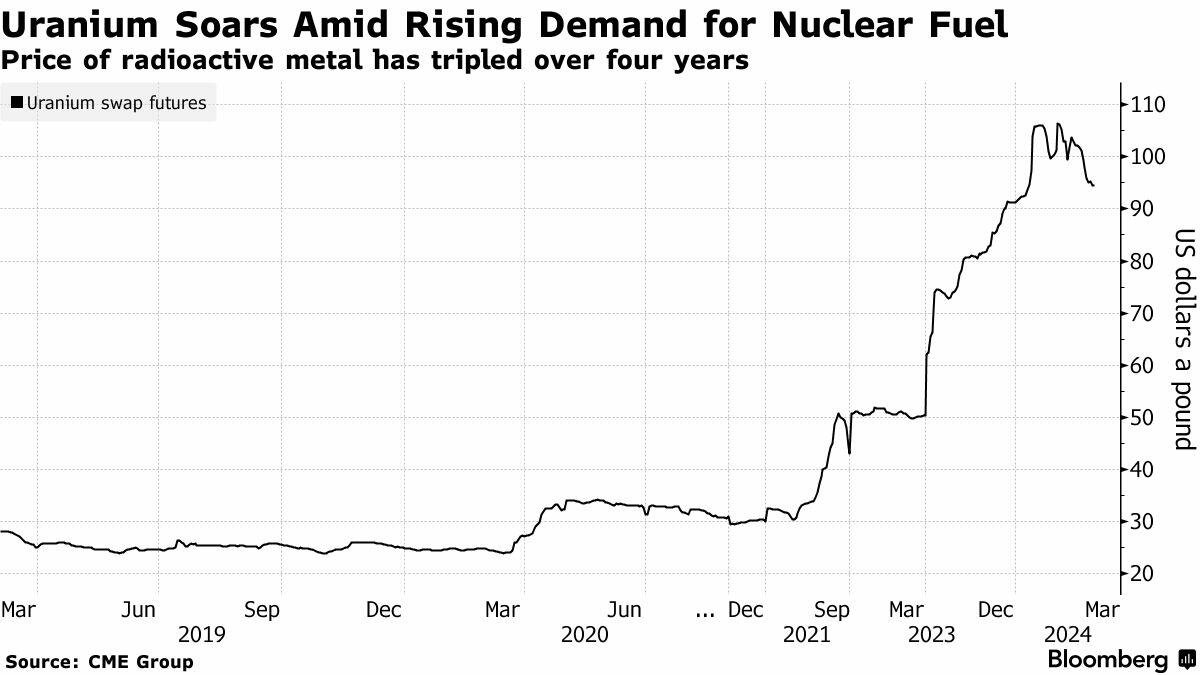
This decline wasn't helped by uranium prices plummeting and nations such as Germany and Japan moving away from nuclear energy. However, as global efforts to reduce emissions renew interest in nuclear power, and as leading uranium producers face challenges in meeting demand, prices for the metal have risen sharply, a new Bloomberg report says.

This resurgence in prices is offering previously unprofitable American uranium mines an opportunity to re-enter the market and address the supply shortfall.

According to the report, as the Prospectors & Developers Association of Canada's annual meeting takes place in Toronto, attracting thousands from the mining industry, uranium will be a key focus.

With participants including major uranium firms like Denison Mines Corp., Fission Uranium Corp., and IsoEnergy Ltd., the event highlights the growing importance of uranium in the context of climate change and nuclear power.

The International Atomic Energy Agency predicts a significant rise in uranium demand, foreseeing a need for over 100,000 metric tons annually by 2040, necessitating a near doubling of current mining and processing efforts.

Scott Melbye, executive vice president of Texas-based Uranium Energy Corp. said: “We’re in an old-fashioned, plain-and-simple supply squeeze. Demand is increasing again, with new reactors coming online.”

John Ciampagli, Chief Executive Officer of Sprott Asset Management added: “The industry is clearly trying to respond with smaller mines reopening, but when you have a mine that hasn’t operated for that long, it’s obviously not very substantive.”

Cameco has resumed operations at MacArthur River and Key Lake, the world's largest high-grade uranium mine and mill in Saskatchewan, Canada, after halting from 2018 to 2021 due to poor market conditions. 

The reopening of U.S. mines signifies a comeback for an industry that nearly vanished five years ago, with production plummeting to 174,000 pounds in 2019 from a peak of 44 million pounds in 1980. This decline was accompanied by increased reliance on uranium imports from nations such as Canada, Australia, Kazakhstan, and Russia.

Amid geopolitical tensions, particularly sanctions on Russia after its 2022 invasion of Ukraine affecting uranium shipments from Kazakhstan, the U.S. is motivated by both supply security and political reasons to boost its uranium production. The Uranium Producers of America suggests the U.S. will need to open 8 to 10 major new mines within the next decade to meet demand.

https://www.zerohedge.com/markets/nuclear-boom-here-uranium-projects-jump-back-line-price-soars

The End Of "Extend And Pretend"

 by Daouglas French via The Mises Institute,

The number of U.S. commercial foreclosures spiked to 635 in January 2024 from a low of 141 in May 2020 reports real estate data firm ATTOM. The January count was up 17% from the previous month and roughly twice as many as in January 2023. 

“Commercial property deals in the US are picking back up at deep discounts—and forcing lenders to face just how far real estate prices have fallen,” notes Sarah Holder on Bloomberg’s “Big Take” podcast.

Bloomberg commercial real estate reporter Natalie Wong detailed a New York office building at 1740 Broadway purchased and renovated by Blackstone at considerable cost and the company has walked away with the debt that's behind that building being marketed at a 50% discount. 

Ms. Wong said,

So you're seeing these massive discounts on these prominent buildings start to show up in the market, and it's a lot harder for, whether it's the investor or the lender, to tell the regulators that the value of a lot of their buildings haven't fallen greatly. And I—so I think this is starting to create more pressure. You know, a little bit of panic, too, from parts of, you know, the, the lenders that hold these loans. 

Pretending has become much harder. 

Problem real estate means problem banks. Bloomberg reporter Patrick Clark chimed in “we certainly hear people say over the next couple of years with commercial real estate debt as a catalyst, hundreds, if not thousands of banks are gonna go away, either because they go outta business or they need to be swallowed up or they need to join forces with another weak bank to survive.” (the combination of two weak banks does not make a strong on)

Real estate mogul Barry Sternlicht told Bloomberg “there’s a giant skeleton in the closet of the regional banks,” referring to commercial real estate loans. He made the point that “every piece of real estate is worth less when interest rates go up 500 basis points.”

Sternlicht stressed that there are no lenders for buyers who want to buy properties at deep discounts.

“Commercial banks are already nervous about their commercial office exposure,” he said. 

For some banks multifamily loans are the problem. Wolf Richter reports that 49 relatively small banks which average $1.3 billion in assets “had multifamily nonperforming loans (NPLs) that exceeded 5% of their total multifamily loans. At those 49 banks, the multifamily NPL ratio of 5% is far higher than the default rate [1.9%] of multifamily CMBS.”

CREDiQ reports commercial property distress is now 480% higher than in February last year.

“We are in a period of peak stress and expect the next two quarters to be challenging,” Arbor Chairman Ivan Kaufman told analysts on a call last week, reports Bloomberg.

The firm has “longstanding relationships with many quality sponsors that we’ve been working with to step in and take over assets that are underperforming and assume our debt and recap these transactions.”

Fitch Ratings doesn’t believe we are anywhere near peak stress. 

We expect any deterioration to play out for the banking sector over an extended period,” Fitch said.

“During the Global Financial Crisis, losses did not peak until almost two years after a peak in delinquencies, and problem loans have yet to peak for the sector.”

Extend and pretend may be coming to an end. 

https://www.zerohedge.com/markets/end-extend-and-pretend

Sunday, March 3, 2024

MBA opposes FHA program extension

 The Mortgage Bankers Association (MBA) has voiced opposition to the extension of the Federal Housing Administration (FHA) and Federal Financing Bank (FFB) Risk Sharing program, calling on the Department of Housing and Urban Development (HUD) to address high fees within existing housing programs.

In a statement released on February 29, MBA CEO Bob Broeksmit expressed concerns over the extension: “While we agree with the Administration that there is a desperate need for more affordable housing supply, extending the FHA-FFB Risk Sharing program is unnecessary, as it undermines the successful FHA Multifamily Accelerated Processing (MAP) program and creates unfair competition with the private sector.”

Under the current system, HUD MAP lenders are bound by stringent regulations, including a comprehensive underwriting guidebook spanning nearly 1,000 pages, adherence to Davis-Bacon split-wage requirements, and strict environmental standards. However, participants in the FFB program are not subjected to the same rigorous criteria, potentially compromising the safety of housing options for vulnerable populations.

Broeksmit proposed an alternative approach, suggesting that the administration should focus on enhancing existing programs to better serve lenders and borrowers.

He outlined several measures that could achieve this goal: “Reducing or eliminating more than 20 unnecessary and duplicative fees, increasing statutory loan limits, lowering multifamily mortgage insurance premiums and excessive escrow account requirements, and increasing the wind/named storm insurance deductibles would have more impact in developing more affordable rental housing.”

The MBA stated that it will continue to urge collaboration between the Administration, Congress, and industry stakeholders to develop more affordable and effective lending programs.

https://www.mpamag.com/us/mortgage-industry/market-updates/mba-opposes-fha-program-extention/479464

Saturday, March 2, 2024

In blow to Native Americans, US court approves land swap for Rio's Arizona copper mine

 A U.S. appeals court on Friday narrowly ruled that the federal government may give away thousands of acres in Arizona to Rio Tinto for a copper mine, upholding a previous ruling and rejecting an argument from Native Americans that the land should be preserved for its religious and cultural value.

The 6-5 ruling from the San Francisco-based 9th U.S. Circuit Court of Appeals essentially defers to a 2014 decision made by the U.S. Congress and then-President Barack Obama to give the land to Rio and minority partner BHP for the Resolution Copper project.

The decision comes amid the U.S. presidential election season, in which former President Donald Trump, who supports the mine, is likely to face off against President Joe Biden, who narrowly won Arizona in the 2020 election thanks to Native American votes.

The move is the latest blow to the Apache Stronghold, a nonprofit group comprised of the San Carlos Apache tribe and others who have long opposed the mine, which would destroy a site where Indigenous ceremonies have been held for generations but would, if developed, supply more than a quarter of U.S. copper demand for the renewable energy transition.

Three members of the Appeals Court had ruled for Rio and the land swap in 2022. All 11 members of the appeals court then said they would decide the case in what is known as an en banc hearing, held last March.

"This ruling is illogical and it's unjust," said Luke Goodrich, a Becket Law attorney who represents Apache Stronghold. The group intends to appeal to the Supreme Court and feels it has a strong case given how closely divided the appeals court was, Goodrich added.

The dispute centers on a federally owned land parcel in eastern Arizona known as Oak Flat, which some Apache consider home to deities and which sits atop a reserve of more than 40 billion pounds of copper, a crucial component of electric vehicles. If a mine is built, it would create a crater 2 miles (3 km) wide and 1,000 feet (304 m) deep that would destroy that worship site.

RELIGIOUS TENSION

In their 253-page ruling, the judges spared over whether a land transfer by the government could prevent some from exercising their religious beliefs.

The majority ruled that the land transfer would not be a "substantial burden" on the San Carlos Apache's religious rights because it would not reflect the government forcing the tribe to stop worshiping their deities.

The five dissenters argued that it would be impossible for the Apache to practice their religion if the place where they worship is destroyed.

The 2014 law that approved the land swap required an environmental report to be published in order for the land swap occurred, which Trump did shortly before leaving office. Biden unpublished that report in March 2021, though he was not able to permanently block the mine.

Meanwhile, Apache Stronghold sued to prevent the land transfer. It has now lost in three consecutive court hearings.

For the land transfer to occur, Biden would need to republish that environmental report. The White House was not immediately available to comment.

Vicky Peacey, who runs the Resolution project for Rio, said the company welcomed the decision and would continue to talk with tribes "as we seek to understand and address the concerns that have been raised."

https://www.saltwire.com/nova-scotia/business/in-blow-to-native-americans-us-court-approves-land-swap-for-rios-arizona-copper-project-100943991/