Search This Blog

Sunday, December 10, 2023

Trump Warns Of Business Exodus from New York Amid Fraud Case Fallout

 Former President Donald Trump has warned that if he loses his real estate fraud case in New York, businesses will flee New York.

"Businesses are watching this case," Trump told reporters outside a Manhattan courtroom on Dec. 6, adding "No business will go back into New York, no business will frankly stay in New York, some businesses are talking about leaving New York because of this action, this very serious action."

Trump and his organization have been accused of overvaluing his assets and exaggerating his net worth in order to obtain preferential terms from banks, insurers, and other entities. Earlier, the Trump-hating judge presiding over the case issued a summary judgment which found Trump and his company liable for fraud, with the ongoing trial addressing conspiracy, insurance fraud, and falsification of business records.

Trump, who's polling in 1st place as the GOP nominee for 2024 by a wide margin, maintains his innocence, denouncing the case as a politically charged effort to derail his presidential campaign. “If you look at the case, we did nothing wrong, there were no victims,” he insisted.

Trump's defense gained some support from a Deutsche Bank executive, David Williams, who testified that discrepancies in asset values between a client and the bank are not uncommon. Williams' testimony shed light on the banking industry's inner workings, revealing that Deutsche Bank, which loaned hundreds of millions to Trump, often adjusted clients' stated asset values and viewed these figures as subjective.

In a twist, Williams pointed out that the bank's lower valuation of Trump's wealth compared to his own figures was not alarming but rather a conservative measure. He emphasized that such adjustments were standard practice and part of a financial "stress test."

Last week, a Florida real estate agent testified that Trump's Mar-a-Lago property is worth at least $1 billion.

It’s something breathtaking. It’s something amazing to see,” he said of Mar-a-Lago, adding that he had valued it at over $1.2 billion in 2021. He also told the court that President Trump's company had actually undervalued Mar-a-Lago by about half.

The heart of the attorney general's argument is that Trump inflated his asset values by up to $2.2 billion for favorable loan terms, a claim Trump counters by highlighting the non-victimization of banks and the profits they earned from interest on loans extended to him.

As Trump's legal battle rages on, with him taking the stand and labeling the lawsuit a "witch hunt" and "election interference," and now - the former president warns that it will set a very bad precedent going forward for businesses operating in New York.


Thursday, December 7, 2023

Bidenomics Is Killing The American Dream Of Owning A Home

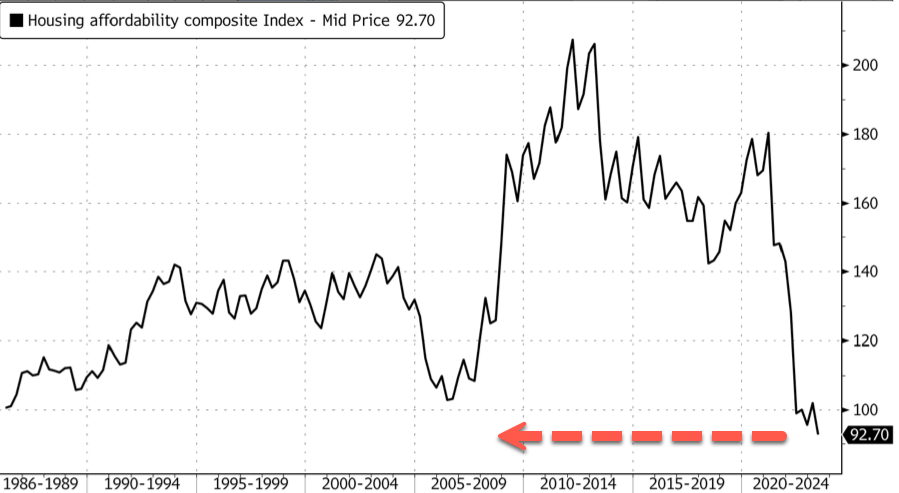
 Despite President Joe Biden’s proclamation that “Bidenomics is just another way of saying “the American Dream,” the numbers show that one critical part of that dream for millions of families – owning a home – is now more out of reach than at any time in history.

According to a report released earlier this year from real estate and property research firm ATTOM, “median-priced single-family homes and condos are less affordable in the third quarter of 2023 compared to historical averages in 99 percent of counties around the nation with enough data to analyze.” On average according to ATTOM’s data, new homeowners are now required to spend about 35 percent of their monthly income on a mortgage and other expenses related to owning a home – a number considered unaffordable by accepted lending standards, which call for that figure to be closer to 28 percent.

These increases are due in large part to a dramatic spike in interest rates under Joe Biden as a result of several trillion-dollar spending packages that have sent inflation soaring. For the week beginning December 4, the average rate on a 30-year fixed mortgage was 7.66 percent – more than 2.5 times the 2.77 percent interest rates when Biden took office.

In hard numbers, that means a family looking to buy a $400,000 single-family home (which is virtually impossible to find in many areas) can expect to pay about $1,000 more per month on their mortgage than just two years ago. From September of last year to September of this year alone, the median mortgage payment required for a single-family home increased by more than 50 percent nationwide.

In addition to interest rates reaching historic highs, housing prices have also shot up since Biden took office. In the second quarter of 2023, the median home price in the United States was $416,000 – a more than 25 percent increase from the end of 2020.

While people looking to become first-time homebuyers have been especially impacted by these soaring costs, Americans looking to buy another home have also found themselves in a tough spot. Families who have had more children and are looking for extra bedrooms or want to care for an ailing parent simply can’t afford to trade the three percent interest rates they locked in when Trump was in office for the 7.5+ percent rates available today.

The Biden administration and their allies in the media have been quick to blame rising housing costs on lingering supply chain issues and a supply crunch brought on by the COVID-19 pandemic. But Biden has also reversed many of former President Donald Trump’s regulatory reforms which led building costs to decrease, along with implementing new regulations forcing costs higher still.

Earlier this year, for instance, Biden’s Department of Energy released new “green” building codes that experts say will force builders to spend significantly more to comply with. Since January of 2021, overall construction costs for both residential and commercial buildings have increased by 29 percent.

The net result of all of these developments is that fewer Americans can afford a home at all, and those that can are having to make greater sacrifices to achieve their homeownership dreams.

One trend that has become particularly popular especially among young people is known as “househacking,” where homeowners rent out a portion of their home to afford payments. According to a new report from real estate marketing giant Zillow, more than half of Millennial and Gen-Z buyers “view the opportunity to rent out a portion of their home for rental income as ‘very’ or ‘extremely’ important” when purchasing a home.

While househacking is a creative way to make ends meet, it could also have other negative downstream effects. For example, it’s easy to see why young people who need to rent out part of their home would be less inclined to get married and start a family.

For prospective homebuyers, there aren’t many promising signs that relief is coming anytime soon, either. Redfin CEO Glenn Kelman warned in an interview on Fox Business that it seems “very unlikely” that interest rates will ease by the end of 2023.

As Kelman highlighted, the real danger may be that “so many people have stopped believing in the American dream.”

“One in five Millennials believe they will never own a home,” Kelman continued. “And if you don’t have that conviction that you’re going to get your piece, it’s really hard to invest in the long term. It’s really hard to believe that society is going to work out for you.”

This may be the true tragedy of the White House’s “Bidenomics” farce – not just that it’s making housing (and everything else) more unaffordable for the American people, but that it’s destroying the hope of millions that they will have an opportunity to achieve the American Dream at all.

https://amac.us/newsline/economy/bidenomics-is-killing-the-american-dream-of-owning-a-home/

Wednesday, December 6, 2023

Upstate NY pol threatens to back New Jersey lawsuit against congestion pricing

 An Orange County lawmaker is threatening to throw his support behind a lawsuit filed last month by the state of New Jersey trying to scrap the MTA’s congestion pricing plan.

State Sen. James Skoufis (D-New Windsor) is demanding the MTA make a carve out for his Orange and Rockland County commuters in the scheme that would put a $15 per day fare on entering Manhattan below 60th Street.

“If a major toll offset is not advanced for Orange and Rockland county residents, all of whom live in a transit desert, I will be supporting New Jersey’s lawsuit to strike down congestion pricing,” Skoufis said.

Skoufis’ concerns mostly fell on deaf ears at MTA’s board meeting Wednesday, as members voted nine to one on letting the fare plan go to a public comment period.

Nassau county’s rep was the only vote in opposition.

James Skoufis is threatening to support New Jersey’s lawsuit to strike down congestion pricing.Ricky Flores and Peter Carr/The Journal News

“Moving forward with these congestion pricing recommendations is a disgrace,” Skoufis said. “$30 for the ‘privilege’ of driving into Manhattan when my constituents do not have a mass transit alternative is outright theft.”

Rockland County state Senator Peter Harckam and Nassau County state Sen. Kevin Thomas are calling for offsets for their commuters as well.

“I will continue to push for reasonable exemptions and ensure the MTA does not lose sight of the unique needs of our region’s commuters,” Thomas said.

The comment period will include four public hearings throughout February and March. MTA officials hope to have the fares in place in May.

Gov. Kathy Hochul speaks at the congestion pricing rally at Union Square on Tuesday.ZUMAPRESS.com

Suburban MTA board members weren’t the only ones looking for carve outs in the plan. Members that represent Mayor Eric Adams and Westchester to exempt school buses from the tolls; the city representatives have asked that yellow cabs be exempted too.

Members based within the city want offsets for taxis and school buses too. MTA Chairman Janno Lieber casted doubt on how much the board would want to alter the proposal as it exists now.

“We look at it as something that in an ideal world we wouldn’t mess with too much,” Lieber said.

Gov. Kathy Hochul, who appeared with Lieber at an event celebrating the congestion pricing plan Tuesday, hailed the MTA’s vote to move it forward as a victory.

Congestion pricing would put a $15 per day fare on entering Manhattan below 60th Street.Christopher Sadowski
“Congestion pricing means cleaner air, better transit and less gridlock on New York City’s streets and today’s vote by the MTA Board is a critical step forward,” Hochul wrote in a Wednesday after the MTA’s vote

Proponents of congestion pricing frame it as providing a much needed boost to MTA’s coffers, opening up revenue to fund projects like the interborough express and finishing the 2nd Avenue subway.

https://nypost.com/2023/12/06/metro/upstate-ny-pol-threatens-to-back-new-jersey-lawsuit-against-congestion-pricing/

Sunday, December 3, 2023

Adams’ hotel-for-migrants money pit

 Even as he slashes public services, Mayor Adams is ramping up spending on migrants: This year alone, city taxpayers will spend $4.3 billion to shelter and provide other services to recent arrivals, a 48% increase from the spring estimate.

But what are we getting for all this spending?

The city has finally, begrudgingly handed over its contract for the Roosevelt Hotel, after months of delay — and the document offers more questions than answers. 

The Roosevelt Hotel, smack in Midtown, is Adams’ flagship migrant facility.

Open as a welcome center and shelter since May, it’s supposed to demonstrate how heroically the mayor is handling everything, even if President Biden won’t pick up the tab. 

Instead, it’s become a physical blight, with graffiti scrawled all over the back, dozens of illegal mopeds strewn every which way, metal grates everywhere, trash overflowing two giant containers placed smack in the street, blacked-out windows.  

There’s no evidence Adams ever sends a top deputy over to see what’s going on; the city’s security contractors run the place.

It’s really simple to assess how this mayor is doing. Take a walk over there, and ask yourself: Would Mayor Mike Bloomberg have allowed the Roosevelt, under city control, to fall into this mess? Would Rudy Giuliani? Would even Bill de Blasio?

It’s also a financial blight.  

The way in which the city inked its agreement for the Roosevelt’s 1,025 rooms is suspect.

The city didn’t have its homeless-services department sign the contract, even though it is, basically, a homeless shelter now. 

Instead, the city did the no-bid deal through its Health and Hospitals Corp., which, though funded and controlled by the city, isn’t a city agency but a separate company.  

This sleight of hand means the city can avoid sending the contract to the comptroller’s office for review, a basic checks-and-balances procedure. 

So what is the city paying for the Roosevelt’s 1,025 rooms?

The document HHC finally provided, after months of delay, blacks out the “per room per day” amount, citing the Roosevelt’s “trade secrets.”  

Such information, HHC says, “if disclosed, would cause substantial injury to the competitive position of the subject enterprise.”

For the same reason, HHC won’t even disclose how many rooms the city has contracted. 

This is absurd: To attract customers in normal circumstances, hotels routinely list their room rates publicly, both on their own websites and on travel-booking sites; customers freely compare the prices to get the best rate. 

Furthermore, the Roosevelt has no other hotel property in the city.

There is no possibility a potential large customer, such as a convention, can use the city’s data to argue for a similar price for a competing facility.

The Roosevelt has no trade secrets to protect in its room rates.  

The only reason to black out the amount is the city doesn’t want to be embarrassed by any difference between what it’s paying the Roosevelt and what the hotel charged in 2019 — often well below $200 a night, according to colleagues who stayed there for work trips. 

The city’s secrecy is particularly bizarre when the Pakistani press has reported the room rates: $200 the first year, $205 the second and $210 the third. (The Pakistani government owns the Roosevelt.)

Presumably, Pakistani reporters got this information from their own government, not from New York City — meaning Pakistan, which doesn’t have a free press, has been more forthcoming with basic information than the Adams administration. 

These rates are high considering the city itself, through separate contractors, provides services that would normally be paid for by the hotel, such as security, “guest” access and administrative work.  

Rooms aren’t cleaned every day but three times a week, another cost savings relative to operating a regular hotel. 

Finally, hotels often offer deals to long-term guests, not charging them the per-night rate. The city has gotten no such deal.  

New York City taxpayers also will pony up for all available rooms in the Roosevelt, “regardless of whether they are occupied.”  

We have no idea how many families are actually staying at the Roosevelt, what turnover looks like and how efficiently the city allocates rooms — the city could be paying for a half-empty hotel, and nobody would ever know. 

City Hall continues to beg Washington for billions of dollars in aid for migrants.

But why should Washington pay up when the city continues to try to obscure the most basic information on what it’s doing with its own taxpayers’ money?  

Nicole Gelinas is a contributing editor to the Manhattan Institute’s City Journal.

https://nypost.com/2023/12/03/opinion/mayor-adams-hotel-for-migrants-money-pit/

Saturday, December 2, 2023

Miami and Mexico City real estate titans team up to launch mega funds targeting Sun Belt properties

 Miami-based Eagle Property Capital Investments and Mexico City’s Promecap have made waves in the real estate realm by successfully raising a staggering $309 million for a dynamic investment fund specifically honing in on multifamily properties across the Sun Belt states.

The ambitious joint venture, announced via a press release, unveiled its intention to utilize this substantial fund to inject equity into the acquisition of approximately $883 million worth of prime apartment complexes, buildings and communities.

Their vision? Snapping up properties at discounted rates and implementing strategic repositioning to maximize their potential.

Rodrigo Conesa, the managing principal steering the ship at Eagle Property, alongside President Fernando Chico Pardo of Promecap, have wasted no time. Their collaboration has already secured a portfolio boost with the acquisition of 10 multifamily properties.

Notably, the partnership’s previous triumphs include the acquisition of three bustling apartment communities, totaling 850 units, nestled within the Dallas-Fort Worth area.

Miami-based Eagle Property Capital Investments and Mexico City's Promecap have teamed up to raise $309 million for multifamily properties across the Sun Belt states.
Rodrigo Conesa (left) and Fernando Chico Pardo (right)Eagle Property Capital

Eagle Property, with a track record since its 2011 inception, boasts 41 multifamily property acquisitions, encompassing over 10,000 apartments, predominantly strewn across Texas and Florida.

Meanwhile, Promecap, a heavyweight established in 1997, manages $3.3 billion in assets.

But Miami’s real estate frenzy doesn’t stop here. Joining the high-stakes game, Highline Real Estate, spearheaded by founder David Moret, recently unveiled a $350 million fund earmarked for distressed commercial real estate across the Southeast.

The fund aims to extend lifelines to landlords grappling with the sale or financing of office, retail, multifamily and industrial properties, alongside acquiring distressed assets.

Adding to the Miami flurry, 13th Floor Investments, under the helm of Arnaud Karsenti, set sail with a $300 million fund, eyeing burgeoning markets nationwide and distressed properties in South Florida and beyond.

https://nypost.com/2023/12/01/real-estate/joint-venture-raises-309m-targeting-sun-belt-properties/

Friday, December 1, 2023

Why Are Searches For 'Trailer Park Near Me' Erupting?

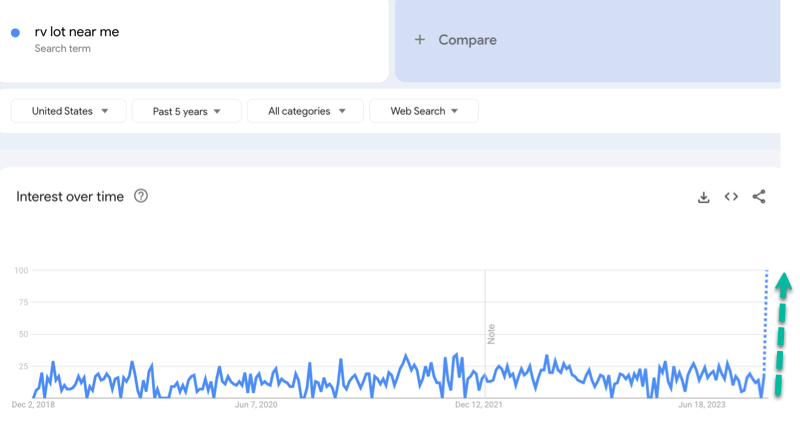
 The eruption in Google searches for "RV lot near me" has hit a five-year high. The reason for the surge remains unclear but could be attributed to the worsening housing affordability crisis ushered in by the failure of 'Bidenomics.'

Earlier this year, we noticed in several RV Industry Association's industry reports (read here) that new monthly shipments for "Park Model RVs," otherwise known as trailers, were outpacing last year's levels.

None of this comes as a surprise, as the worst housing affordability crisis in a generation has killed the 'American Dream' for many folks. 

The most vocal folks complaining about the era of unaffordability of everything have been Gen-Zers on the Chinese social media platform TikTok. These youngsters are experiencing voter regret after a president who could be their great-great-great grandfather pushed failed policies that have been nothing more than a financial disaster for them. 

They're also mad about owning nothing

"The thing about being in Gen Z is that, generally, we quite literally own nothing," PJ Yancey told Bussiness Insider. He said, "We're not homeowners; we don't own a ranch, a vacation home, any kind of property at all. If we're living on our own, it's in someone else's house or apartment."

So, the kid went out into the desert in California and bought a $200 plot of land. 

@peejsteadI love my dirt#offroad#crazy♬ 3 Stars - Jair Archive

The lesson youngsters need to learn is the government and central bank are responsible for your financial woes. And the search data plus mobile home industry data only confirms that Gen-Zer's standard of living has quickly deteriorated. Welcome to third-world style living. 

https://www.zerohedge.com/markets/why-are-searches-trailer-park-near-me-erupting

Chrysler Building's EU Co-Owner Goes Bankrupt

 Europe may be experiencing its most significant real estate meltdown since the global financial crisis. The abrupt ending of easy monetary policies and soaring interest rates have led the property and retail conglomerate Signa Holding GmbH to declare bankruptcy following its inability to secure funding. 

Bloomberg reports that Signa, also the co-owner of New York's Chrysler building, has assets upwards of $25 billion as of the end of 2022. It filed for insolvency in Vienna on Wednesday. 

"Despite considerable efforts in recent weeks, the necessary liquidity for an out-of-court restructuring could not be sufficiently secured," the company said.

Signa's current debt load totaled around $5.5 billion, according to creditor representative KSV1870. There are over 273 creditors impacted by the proceedings. 

"From today's standpoint, it's impossible to predict whether further companies of the Signa Group will file for insolvency and whether it will lead to a domino-effect," said Karl-Heinz Götze, the head of insolvencies at the group.

Austrian tycoon Rene Benko heads Signa, which has commercial real estate properties across Europe and is a co-owner of New York's Chrysler building. 

Austrian chancellor Karl Nehammer played down the collapse of Signa. He said, "What's really important is that all those who invested here, especially the banks, stay stable." 

Earlier this week, analysts at Austria's Raiffeisen Bank International, one of Signa's top creditors, warned that the fallout might spark further CRE turmoil if properties must be offloaded. 

"The aim is to continue business operations within the framework of self-administration," Signa said.

Bloomberg sources said Signa has been 'frantically' searching for $650 million in short-term liquidity, reaching out to Saudi Arabia's Public Investment Fund and Elliott Investment Management, among others. 

The crash of Signa comes as global central banks have likely concluded the most aggressive interest rate tightening cycle in a generation to tame hot inflation. Fed swaps show interest rate cuts are forecasted to begin as early as May. 

Furthermore, we don't need to expand on the CRE crisis as readers are well-informed about the rumblings this year. We leave you with a recent interview featuring Goldman's Allison Nathan and Scott Rechler, Chairman and CEO of RXR Realty. 

Rechler told Nathan that the crisis in the CRE space was just beginning.

Recall in March, when several regional banks imploded, we noted "Why Small Banks Are In Big Trouble: As Hedge Funds Pile Into The New "Big Short," The Next' Credit Event' Emerges." 

So what are the contagion risks with the implosion of Signa? 

https://www.zerohedge.com/markets/chrysler-skyscrapers-eu-co-owner-goes-bankrupt