Search This Blog

Sunday, October 2, 2022

Third Avenue: The land of 'leave-behind'

 New York’s office market is still trying to find its footing after the pandemic crushed it. While some newer buildings are attracting tenants anew, older buildings are being forgotten.

The stretch along Third Avenue from 42nd Street to 59th Street is becoming a stark example of the downside to the city’s ongoing flight to quality, Bloomberg reported. While Savills pins the city’s office vacancy rate at 19 percent, it’s 29 percent on the 17-block corridor — nearly doubled in the last four years.

A glaring issue is the area’s lack of new or refurbished buildings. Many of the properties were built between the 1950s and 1980s and feature no meaningful updates since their construction. As employers try to pull out all the stops to lure back their workers, companies are casting their eyes to newer buildings on Park or Madison Avenues, or on the Far West Side.

Savills vice chairman Nick Farmakis told the outlet waning interest has demoted Third Avenue to “leave-behind space.”

The future prospects of many of those properties don’t look good. At 655 Third Avenue, the availability rate jumped from 5 percent in 2017’s first quarter to 47.5 percent in this year’s second quarter. The building also scored very low in architectural firm Gensler’s analysis of possible residential conversions.

Other buildings in the neighborhood are on the verge of losing significant tenants, or are about to have loans mature without a stable base of income to make those payments. Residential conversions are being considered in the neighborhood, but zoning laws and physical details like floor plates complicate that possibility.

Third Avenue isn’t out on an island. An analysis published earlier this year from NYU’s Arpit Gupta and Columbia University’s Vrinda Mittal and Stijn Van Nieuwerburgh determined the city’s office stock would decline in value by 28 percent by 2029, overcome by the spread of remote work.

Still, there are some trying to save the corridor by giving new life to their properties on Third Avenue. The Durst Organization has spent $150 million renovating 825 Third Avenue, which saw its availability rate soar past 90 percent after Advance Publications left in 2019. /

The updated building is set to reopen its doors next month. Durst has signed three tenants to the renovated property, spanning 45,000 square feet of leases.

https://therealdeal.com/2022/09/26/third-avenue-the-land-of-leave-behind/

Winter is coming: Landlords face brutal heating season

 With temperatures dropping into the 40s in New York, landlords are cranking on the heat.

But given the rising cost of fuel, many already had the jitters.

There’s a lot of anxiety going into this heating season,” said Aaron Weber, an owner at Weber Realty Management, which oversees 400 apartments across Manhattan and Brooklyn.

Last winter, landlords were slammed by natural gas bills as high as 60 percent above the previous year’s levels. Utility providers such as Con Edison blamed a colder season and rising energy costs.

Since September 2020, the price of natural gas has more than quadrupled, surging to $8.81 per million British thermal units, a 16-year high.


Now, ahead of the official Oct. 1 start to the city’s heat season, which runs through the end of May, ConEd warns commercial heating bills could jump another 28 percent, and National Grid projects prices could climb by 30 percent annually as an even more frigid winter pressures already tight supplies.

For many landlords — particularly, rent-stabilized building owners already hammered by inflation — the price pop will mean fiscal pain. Some buildings may not have the reserves to survive the winter in good financial standing.

The long game

Landlords buy fuel in one of two ways: They lock in prices with multi-year contracts or pay market price each month.

Those entering the heating season mid-contract are in the best shape to weather recent price hikes.

Zachary Kerr, whose portfolio spans 1,000 units in Brooklyn, is about 18 months into a three-year agreement for natural gas. He’s paying around 46 cents per therm, a price he signed up for in 2021.

The move paid off handsomely: Natural gas prices in September rose to $1.08 per therm, according to National Grid.

But for owners with expiring contracts, the price jump will be a big budget hit.

“For owners who are coming out of contract, it’s like, how do you cope with that?” Kerr said.

Lose-lose

Landlords on month-to-month plans likely won’t fare much better.

Weber, for example, arranges gas service for the owners of nearly 30 buildings. As a result, he opts to pay that monthly market price.

His management firm views gas contracts as a gamble with someone else’s money. “It’s like you’re betting in the casino that prices are gonna go up,” he said. “So if prices go down, we just look like assholes.”

Sometimes they do go down. During the fracking boom of the 2000s, natural gas prices plummeted. But few are predicting that now. Heading into heating season, natural gas futures have been exceptionally volatile, reflecting great uncertainty about what gas will cost in the coming months.

That means landlords without contracts risk a huge jump from one month to the next. For rent-stabilized building owners, who cannot raise rents to compensate, increases have become unsustainable.

“If gas prices stay the same, it’s a problem. If gas prices go up even more, it’s a major problem,” Weber said.

Rent dearth

Come October, owners of stabilized apartments can bump the rent 3.25 percent on new one-year leases and 5 percent on new two-year leases.

But that won’t offset rising operating costs, which include utility expenses, a report last week by the landlord group Community Housing Improvement Program found.

When the Rent Guidelines Board penciled out the revenue boost owners would need to keep pace with costs, it estimated that fuel prices would dip by 1.7 percent. The board made a similar prediction last year, forecasting that fuel prices would grow by 0.1 percent and owners would need a 2 percent rent hike to keep pace with costs.

But the board voted for a half-year freeze last year, followed by a 1.5 percent hike. Fuel costs rose 19.6 percent during those 12 months, CHIP found.

“One of the things the board discussed before the vote was, ‘Well, we don’t need a larger increase because fuel costs are going to decrease,’” Kerr said. “But that didn’t happen.”

This year, CHIP estimates owners' gas expenses — about 7 percent of their overall costs — will run about $150 annually per unit.

Add that to jumps in interest rates, maintenance and insurance, and CHIP expects the average stabilized building owner will have annual operating income of $293 per unit — not enough to cover repairs.

If a boiler blows mid-winter, for example, a replacement runs $172,600, the state estimates. It would take a 50-unit building nine years to save up for the swap, the report finds.

Oil premium

The 15 percent of city buildings still running on oil heat — typically, older properties offering affordable housing — face even more dire straits.

Over the course of the last heating season, prices for No. 2 heating oil surged over 127 percent from October to mid-May.

Weber said in January it cost about $6,034 to fill the tank of an HDFC co-op in Morningside Heights. By March, it cost $10,650.

“That was out of the blue,” Weber said. “We did not budget for that when we started the year.”

Luckily, a co-op owner in the building sold a unit, triggering a 5 percent flip tax.

“That saved them. They would have run out of cash if they didn’t have this flip tax income,” Weber said. “The timing was extraordinary.”

But the building likely won’t be able to swing another big price jump, the manager said. About 40 percent of its income goes toward fuel and most of the rest pays the mortgage.

Weber floated that the property could increase maintenance fees. “Otherwise, they’ll default on their mortgage,” he said.

“Record-breaking cold”

Owners are also bracing for higher delivery fees. If a cold snap sets off a spike in demand, utility companies will charge a premium for transportation, a CHIP spokesperson said. The Farmer’s Almanac is projecting “potentially record-breaking cold” and greater than average snowfall for the Northeast.

Last February, Kerr paid $8,252 for the gas to heat one of his properties. Delivery fees were another $7,700.

“It’s not cheap,” Kerr said.

Couple those variables with the rising cost of doing business and for many owners, particularly smaller and rent-stabilized landlords, the months ahead are looking long and dark.

Even those who locked in prices for this winter know their comfort is temporary.

“I'm very fortunate going into this year that I'm going to be okay, on the gas side,” Kerr said. “But I don't know what's going to happen in a year and a half when my contract expires, and that worries me.”

https://therealdeal.com/2022/09/26/winter-is-coming-landlords-face-brutal-heating-season/

Saturday, October 1, 2022

NYC’s Financial District now blighted with spiking crime, vagrants

 Once one of the hottest neighborhood in NYC, the Financial District is now simply a dumpster fire, residents and workers told The Post.

In early September at least four trash fires were set along Cliff, William and Water streets. They were quickly extinguished, but the crime and filth blighting this once-sleepy neighborhood, bound by Chambers Street, the West Side Highway, the Battery and the East River, have only worsened.

Emboldened crooks and vagrants have been robbing and assaulting locals without restraint while businesses are regularly looted by brazen shoplifters.

“It’s gotten more outlandish,” Keith Ruiz, 29, a concierge at 71 Broadway, said about criminal activity in the neighborhood. Perps “come down to Wall Street because they know where the money is. … It’s all money-driven crime.”

Pisillo Italian Panini co-owner Antonella Silvio stores a baseball bat below the counter of her store to combat crime.
J.C. Rice

NYPD data for the 1st Precinct, which includes the Financial District, shows major crimes have increased 50% this year, compared to 33% citywide. Burglary is up 70%, robbery 15%, felony assault 16%, and rape 55%.

Crimes in the past year include:

  • A Queens woman randomly slashed an 82-year-old doorman in the head with a machete on Stone Street and Broadway before blinding him with bear spray in September.
  • A 19-year-old slashed and robbed an 84-year-old man on Exchange Place near Broad Street in August, taking off with his watch and cell phone.
  • A man unsuccessfully tried to steal a woman’s French Bulldog worth thousands of dollars and in the process slammed her head into the revolving glass door at 61 Broadway in July.
  • A man swiped the cash in the register at Pisillo Italian Panini at Nassau and Ann Streets while the staff was in the back of the restaurant in April, causing co-owner Antonella Silvio to store a baseball bat below the counter.

“I’m hoping that the new mayor can do something more for the police, but it seems that nothing’s moved yet,” Silvio said.

Even some luxe buildings have become hotbeds of drug deals and other unseemly activity.

Ashley Weil, a 28-year-old beauty buyer, said a neighbor in her John Street building was pistol-whipped for telling new tenants operating an unlicensed tattoo parlor on her floor that their music was too loud. After more than a year of complaints from several neighbors, the raucous residents were finally evicted this summer.

“What happened in our building was alarming,” Weil said. “I never imagined anything like that would happen in FiDi.”

The New York street sign showing Wall Street outside the New York Stock Exchange.
Emboldened crooks and vagrants have been robbing and assaulting locals without restraint in the Financial District.
Getty Images/iStockphoto

At the TJ Maxx on Wall Street, where racks can be stocked with $250 Balmain t-shirts and $600 Gucci sweaters, one employee complained about a surge in merchandise theft during the pandemic, often by the same crooks. Police data shows 911 calls to the location are up to 40 through Sept. 22, compared to 20 in 2021 and 14 in 2019.

“There’s a homeless guy who sings on the street,” said the 57-year-old employee. “He comes here and takes T-shirts and underwear — free!”

Lawyer Thomas Kenniff, a Republican who ran and lost against soft-on-crime Manhattan DA Alvin Bragg last November, attributed the spike in crime to lower foot traffic in the neighborhood alongside lax bail laws.

In early September at least four trash fires were lit up along Cliff, William and Water streets.
In early September, at least four trash fires were lit up along Cliff, William and Water streets.
What was once a hotspot to live in NYC, the Financial District has become a hotbed for crime.
Although the fires were quickly extinguished, the crime and filth blighting the Financial District only continues.
TJ Maxx
911 calls from TJ Maxx in the area are up to 40 through Sept. 22.

“The office buildings in Manhattan are less than half full from everything I’ve observed, and that creates fertile soil for homelessness or criminals who feel that they have an area of operation,” Kenniff said.

Unhinged hobos in particular have been terrorizing locals throughout the neighborhood.

Masud Khan, 22, who works at a Dunkin Donuts on Fulton Street, said that an angry beggar smashed a co-worker’s nose earlier this year with the store’s plexiglass protector, while resident Anthony Sabella, 37, said that he witnessed a man masturbating “onto the emblem of a Mercedes Benz.”

Unhinged homeless people have been terrorizing locals throughout the neighborhood.
J.C. Rice

“It’s becomes a free-for-all,” said Adam Weiss, CEO of AMW PR. “I don’t remember this neighborhood before having such bad presence.”

An NYPD spokesperson declined to comment on the surge in crimes in the neighborhood, except to say that numbers are up citywide. The department noted that in the 1st Precinct, all arrests are up 28.1% this year, including 12% for robbery, 43% for grand larceny, 100% for burglary, and 7% for felony assault.

https://nypost.com/2022/10/01/nycs-financial-district-is-now-blighted-with-crime-vagrants/

US housing recession is already here


The stimulus-fueled surge in prices looks to be over

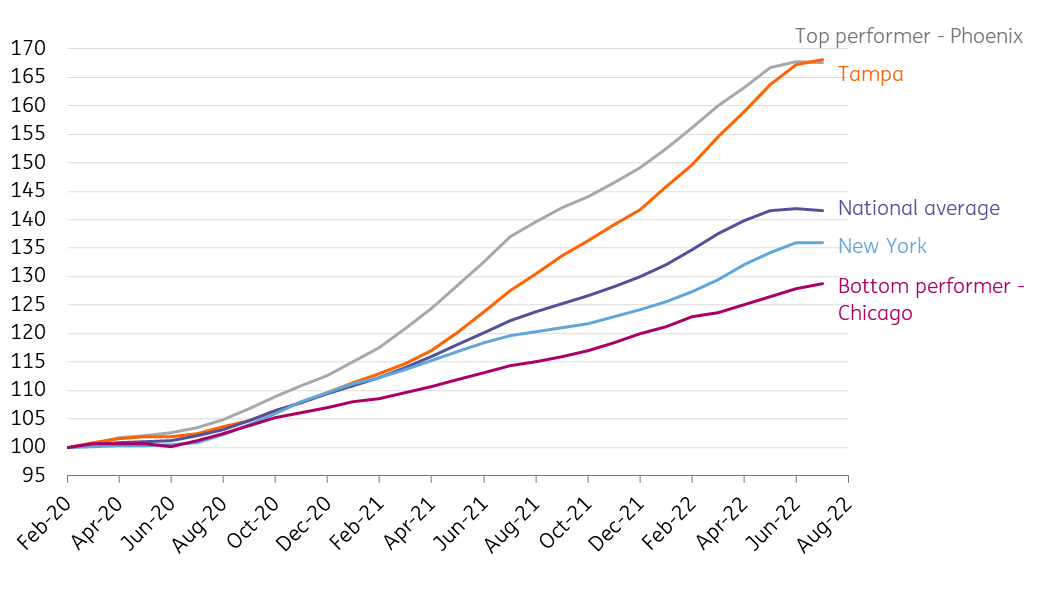
House prices nationally have increased more than 40% since the start of the pandemic as massive fiscal and monetary stimulus fueled demand for homes. Working from home has also opened more opportunities of where to live, yet at the same time, supply was limited with new construction slow to catch up.

Some hot spots in the south and west of the US have experienced prices gains of more than 60%, but even the weaker performers in the north and east of the country have seen price rises in excess of 25%.  However, the demand momentum appears to be rapidly fading with affordability, amidst record prices and rising borrowing costs, the key issue. Supply is picking up too with a July month-on-month fall in prices, the first in over ten years, likely to be the start of many.

S&P Case Shiller Home price indices Feb 2020 = 100

Source: Macrobond, ING
Macrobond, ING

Affordability is stretched to the limit

Rapidly rising house prices are typically associated with larger mortgage borrowing. The average new mortgage taken out for a home purchase did rise to $450,000 between January and April, but this has subsequently declined to a $413,000 average for May-September 2022, not that far above the $403,000 average for the whole of 2021. This indicates homeowner equity has been rising significantly as a proportion of the funds used to make a home purchase.

Yet the challenges for first-time buyers to save for a deposit are mounting, especially with surging inflation squeezing spending (and saving) power. Falling equity markets and tumbling bond prices are further hampering new buyers’ ability to build enough for the required deposit. Homeowners looking to trade up are in a better position, already partially owning an asset whose price is moving in the same direction, but it certainly isn’t easy.

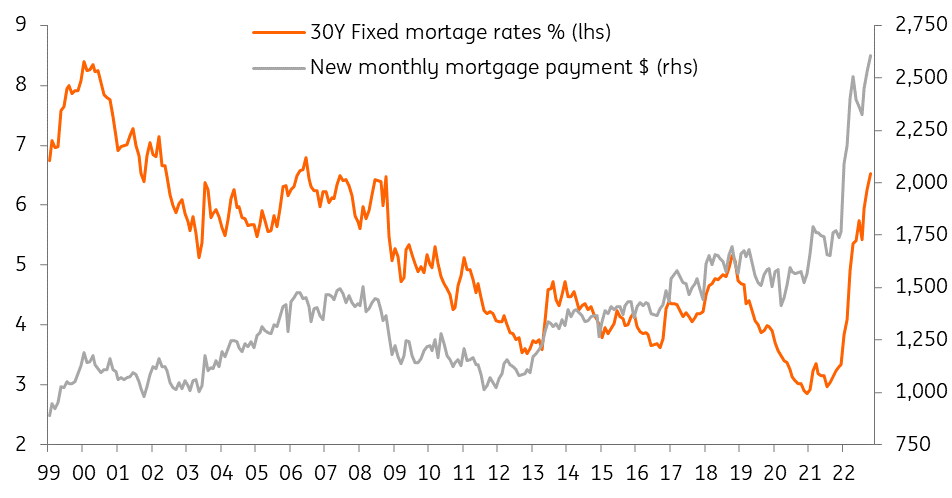
The typical 30Y fixed mortgage rate has risen from below 3% in November 2021 to 6.52% as of last week

Then there is the cost of financing a mortgage. The Federal Reserve has been raising interest rates swiftly since March as inflation continued to surprise to the upside. We expect them to raise the Fed funds target range to 4.25-4.5% by year-end from the current 3-3.25% level. This increasingly hawkish message from the Federal Reserve has resulted in longer dated Treasury yields moving sharply higher, which in turn has been the catalyst for the typical 30Y fixed mortgage rate rising from below 3% in November 2021 to 6.52% as of last week.

The combination of higher borrowing at higher interest rates means that the monthly payment on a new 30Y fixed rate mortgage at the prevailing average mortgage size and the prevailing mortgage interest rate has risen rapidly. It was $1,550 per month at the start of the pandemic when the typical mortgage size was $350,000 at 3.4% fixed for 30 years. Today it is over $2,600 based on a 30Y fixed rate mortgage for $411,700 at 6.52%.

On an annual basis this equates to 43% of the median pre-tax household income. By point of reference the typical new annual mortgage payments for a home purchase equated to 26% of median incomes in the fourth quarter of 2019 and 37% at the peak of the housing bubble in 2006.

30Y fixed rate mortgage rates and new monthly mortgage payments ($)

Source: Macrobond, ING
Macrobond, ING

Demand is capitulating and transactions are slowing

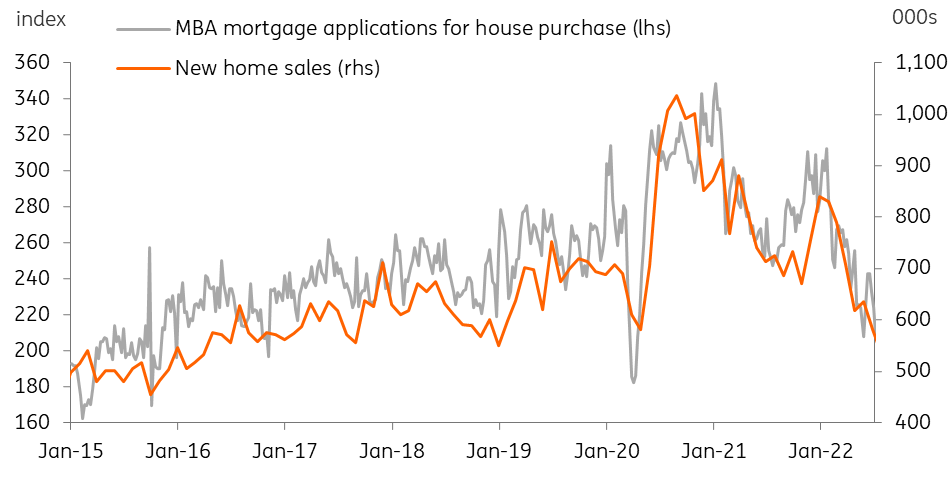
With fewer people able to raise the money required for a deposit given inflation and financial asset price falls and then fewer people still who can afford the required monthly mortgage payments, it is little surprise that mortgage applications for home purchases have fallen more than 30% year to date. This is already translating into falling new home sales, although it must be said that the appetite of cash buyers has declined at similar rates with the proportion of cash-only transactions for new homes holding steady at 30%.

Admittedly, the new home sales number did jump 29% MoM in August as the chart below shows. It may be a late wave of buyers trying to beat the hike in interest rates or buyers taking advantage of discounts from builders since year-on-year new home price growth slowed to just 8% YoY, the slowest increase since November 2020. This could be the case of institutional investors who pay cash and are interested in taking advantage of high rents to get a financial return. However, we don’t see this as sustainable as institutional investors would normally account for only 10-15% of home sales with individual buyers by far and away the main driver of housing activity, Moreover, local governments have been pushing back against corporate landlords in many states – favouring policies to promote home ownership – while falling prices may also make the metrics less attractive for investors.

Mortgage applications for home purchases and new home sales

Source: Macrobond, ING
Macrobond, ING

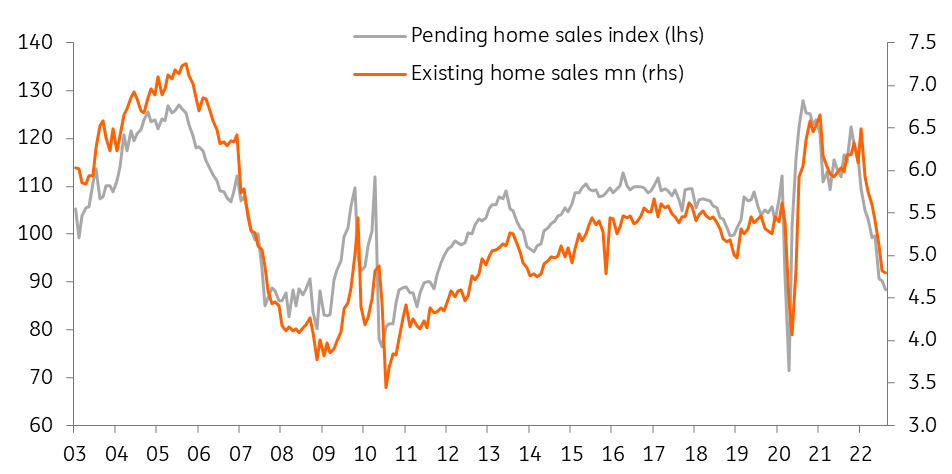
Existing home sales, which account for a greater proportion of total sales are following a similar pattern, with transactions down 26% since last November. Aside from the initial dislocation caused by the pandemic, this is the weakest transaction number since 2012 and is on a par with where we were following the bursting of the 2005/06 housing bubble.

Pending and existing home sales

Source: Macrobond, ING
Macrobond, ING

Supply is on the rise

New residential construction was slow to respond to the pick-up in demand in 2020 with Covid restrictions limiting activity in the initial phase of the pandemic. Next came surging commodity costs while a lack of available workers created challenges and put-up costs. Housing starts and building permits did eventually accelerate, hitting 16-year highs at the start of 2022.

Housing starts and building permits

Source: Macrobond, ING
Macrobond, ING

However, the National Association of Homebuilders Builders’ sentiment index has fallen for nine straight months as the plunge in demand combined with elevated costs to create a challenging environment. They are then faced with the problem that the slowdown in sales at a time of strong construction means that the inventory of new homes for sale has risen 64% since the third quarter of 2020. Builders are not typically in a financial position to keep their homes unoccupied, hence why prices are coming under pressure as they look to sell inventory.

Inventories of new homes

Source: Macrobond, ING
Macrobond, ING

The story isn’t as dramatic in the market for existing homes, although inventory for sale has risen 50% since February to 1.28 million homes with it set to take 3.2 months to clear the backlog of homes for sale at the current rate of transactions. This is up from 1.6 months in January, but we remain below the 5.4-month average of the past 20 years.

Where this supply of existing homes is coming from is not exactly clear. With rents having risen rapidly we are unlikely to be seeing many people switching from home ownership to the private rental market while low unemployment and mortgage defaults don’t point to forced sellers. It may well be that with prices having risen so rapidly we are starting to see people who have investment properties looking to sell or there may be some people looking to downsize to smaller cheaper homes. Then of course there could be people looking to sell their home to give themselves more flexibility as future cash buyers in a weakening market.

The Fed wants a correction

So far, we have only had one monthly fall in house prices but with more supply coming on the market at a time when demand is weakening rapidly implies that prices fall further. Fed Chair Jerome Powell accepted as much in the press conference following the latest 75bp rate hike on September 21st. He warned that “we probably in the housing market have to go through a correction”, adding that “there was a big imbalance between supply and demand, and housing prices were going up at an unsustainably fast level. So, the deceleration in housing prices that we’re seeing should help bring prices more closely in line with rents and other housing market fundamentals – and that’s a good thing”.

The Federal Reserve’s forecasts indicated interest rates will be raised further with policy held in restrictive territory to constrain inflation, so there is likely to be more pain ahead for the housing market. With the US 10Y within touching distance of 4% and likely to break above we should be braced for the 30Y fixed rate mortage to soon approach 7%.

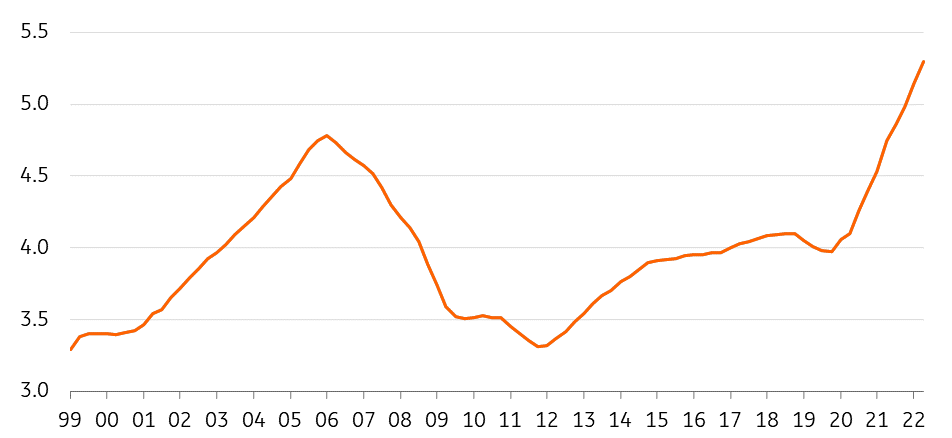
Housing valuations look very stretched right now. The median price for an existing home is 5.3 times the median level of household incomes, higher than even at the peak of the housing boom of the mid-2000s. To get us back to the long-run average house price-to-income ratio of around 4 on a three-year horizon would imply prices falling peak-to-trough by around 20% while assuming nominal incomes rise 3% in each year.

Ratio of existing home prices to median household income

Source: Macrobond, ING
Macrobond, ING

Recessionary forces are intensifying

Falling transactions and falling home prices will intensify the recessionary forces buffeting the US economy. Weaker housing transactions leads to weaker activity elsewhere with construction at the forefront. On a GDP basis, residential fixed investment accounted for 4.7% of all economic output over the past 12 months. Back in the previous housing boom in 2005/06 it peaked at 6.7% before dropping below 2.5% in 2010/11 during which time the volume of residential investment output fell 59%.

There will be knock-on effects for realtors, mortgage brokers and real estate lawyers, together with movers and packers. Then there is the strong correlation between the performance of the housing market and key retail sales components such as furniture and home furnishings, electric appliances and building supplies as people look to upgrade and refresh in a new home.

Aside from the direct spending consequences, rising interest rates in an environment of falling home prices are never a good combination for consumer sentiment and will add to the chances of a retrenchment in broader consumer spending.

Negative equity and financial risks are lower than in the Global Financial Crisis

Undoubtedly many people who have bought over the past 18 months will be exposed to the risk that the value of their home falls below what they paid and may, in some cases, erode all of the equity they have in their home. In such an instance we have to expect that some homeowners cease servicing their loans, particularly if the US economy does enter a downturn and unemployment starts to rise. This will result in banks becoming more reluctant to lend with lending standards tightening, exacerbating the strains in the housing market.

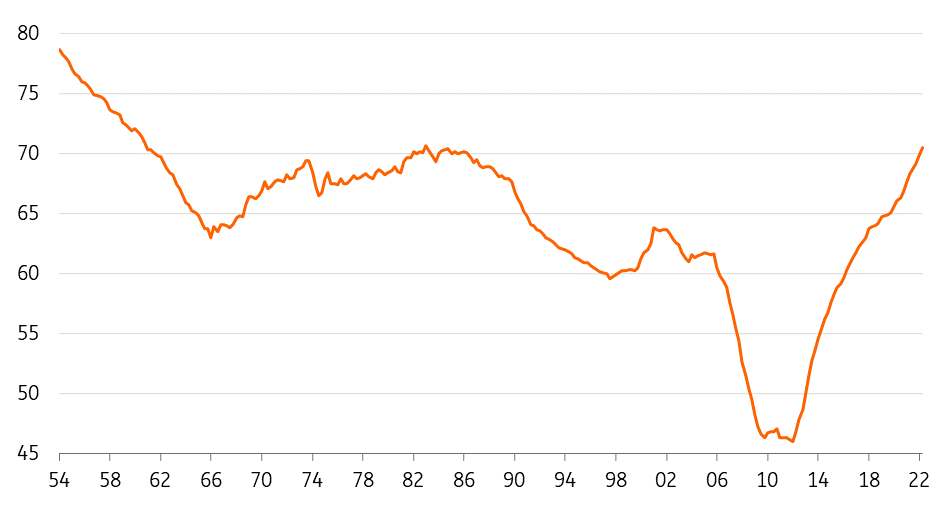
However, the broader risks appear to be small. Household balance sheets are in a healthy shape with household assets having doubled to $163tn since their pre-Global Financial Crisis peak while liabilities have risen less than $5tn over the same period to stand at $19tn. Moreover, the proportion of equity that homeowners have in their property is 70.5%, the highest since 1983, while in 2005/06 it was only 62%.

Homeowners' equity in real estate as a proportion of household real estate value

Source: Macrobond, ING
Macrobond, ING

With financial regulations having been tightened significantly since the Global Financial Crisis the risk of catastrophic loan losses and major strains on the US financial system, even under a scenario of 20%+ price falls appears small. Furthermore, with the labour market in a strong position with two job vacancies currently available for every single unemployed American, we remain confident that businesses will be reluctant to implement major job losses, fearing that a swift economic rebound could mean firms having to hire back staff at much higher wage rates amid intense competition.

Housing downturn opens the door to lower inflation and lower interest rates

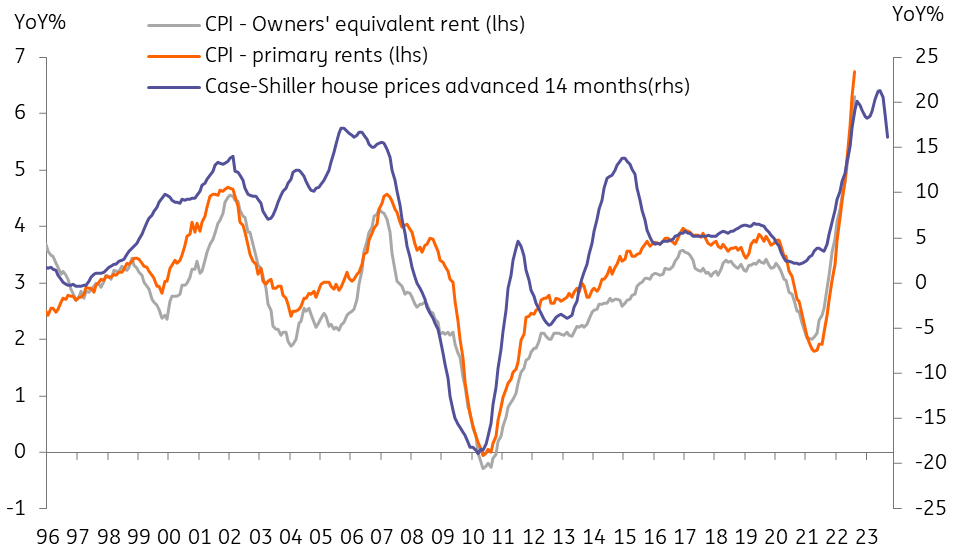
A housing market downturn will weaken the US growth story, but it is also important to remember it will dampen inflation too. Shelter is the largest component of CPI with a one-third weighting via the primary and owners’ equivalent rent components. As the chart below shows there is a lag of 12-16 months between movements in house prices and the shelter components of CPI – rents are typically only changed once a month is one reason.

US house prices suggest a turning point in shelter components of CPI

Source: Macrobond, ING
Macrobond, ING

It suggests we may be soon getting to a turning point in the annual rate of change in these key CPI rent components, which if so, can meaningfully depress consumer price inflation through 2023 and likely contribute to getting the US inflation rate back towards 2% by the end of 2023. While the Federal Reserve is downplaying the possibility, we are firmly of the view that interest rate cuts will be on the table in the second half of 2023.

https://think.ing.com/articles/us-housing-recession-is-already-here/