Search This Blog

Thursday, September 1, 2022

It’s Open Season on Jews in New York City

 The attack that sent 31-year-old Yossi Hershkop to the hospital was an unmysterious crime, the opposite of a stone-cold whodunnit. Security cameras recorded clear video of a group of four men approaching Hershkop’s car, with two of them repeatedly punching him through the driver’s side window while his 5-year-old child sat in the back seat. Another camera recorded the license plate and model of the attackers’ getaway vehicle. The assault took place around 3:40 p.m. on July 13, 2022, on a busy street in Crown Heights. Hershkop believes his assailants were identified later that evening.

In an ideal world, a victim’s personal background would be irrelevant to whether their attackers are arrested and prosecuted. But at least in theory, Hershkop is someone with enough of a profile to keep the police and prosecutors focused on his case. The young Chabad Hasid is an energetic yet shrewdly understated local political activist—the kind of person who knows the total number of newly registered voters in Crown Heights off the top of his head, or who you might WhatsApp when you need to reach a particular City Council member later that afternoon. He also manages a large urgent care center in Crown Heights, a position of real civic significance during New York’s COVID nightmare. Hershkop is also a personal friend of mine, although even people I am not friends with should expect the police to move quickly when they’re able to easily identify the people who bloodied them on camera in broad daylight in front of their child.

The police did not move quickly. No arrests were made during the two weeks after the attack, a span in which the getaway car got ticketed in a totally unrelated incident, Hershkop says. On July 27, an exasperated Hershkop tweeted: “No arrests have been made, despite the assailants’ vehicle having been seen all over the neighborhood. My son still has a lot of trauma from the incident & we now Uber instead of walk whenever we need to go out.” Perhaps not coincidentally, the first arrest in the case was made the day after that tweet, some two weeks after the attack. The first suspect was released on bail after the judge ordered a bond of $10,000, significantly less than the district attorney had requested, according to Hershkop. Hershkop is confident that after a long period of delay, the NYPD is now making efforts toward arresting the second individual who physically attacked him.

“This was a perfect opportunity for them to do the right thing,” Hershkop told me. “Nobody was saying this isn’t a big deal and we shouldn’t make an arrest. Everybody was on the same page here.” As he explained, “it was an assault on a 5-year-old caught on camera. I didn’t think I’d have to fight for justice.”

Perhaps the attack, which stemmed from a seemingly innocuous dispute over a parking space—a common enough occurrence in a densely populated place like Crown Heights, and one that almost never ends with anyone in the hospital—was just too fraught of an event for the police to want to handle too aggressively. Maybe someone feared that drawing additional attention to a group of young Black men attacking a prominent Orthodox Jew would threaten to inflame tensions in a neighborhood with a long but mostly improving (and generally misunderstood) history of racial division.

Maybe, but maybe not: Overload in the New York court system, increasingly lenient prosecutors and judges, and a police department in which officers are quitting at a growing clip, all make it easier for even open-and-shut cases to languish, and for people at every level of the system to find excuses not to resolve them.

The dysfunctional handling of public order takes different forms across the city, and across the country: Philadelphia is experiencing record murder rates; San Francisco experimented with decriminalizing certain forms of property crime, at least until its pro-reform district attorney lost a recent recall election. As with various other recent American traumas, the ambient disorder has its own distinct characteristics as far as Jews are concerned. In a study released this past July, the New York-based group Americans Against Antisemitism found that of the 118 adults arrested for anti-Jewish hate crimes in New York City since 2018, only one has been convicted and sent to prison.

Earlier this month, an Orthodox Jew from Baltimore named Aryeh Wolf was gunned down in broad daylight as he attached solar panels to the roof of a building in a gentrifying neighborhood in southeast Washington, D.C. As with Hershkop’s attack, Wolf’s murder was a motiveless crime in which the motive was obvious. To the killer, Wolf and the trendy new technology he was installing might have represented the growing penetration of outsiders, further distilled by Wolf being the ultimate of outsiders: the proud religious Jew. So far, no one has been arrested. The Washington police still consider the motive in the crime to be unknown.

In New York, street harassment, minor assaults, and even full-on beatings of visible Jews are almost a banality now, too frequent over too long of a period to be considered an active crisis, even in the communities most affected. The city reported a 76% year-over-year rise in hate crimes during the first three months of 2022—attacks on Jews more than tripled, accounting for much of the spike. When reached for comment by email, the NYPD’s public information office stated that the Hate Crimes Task Force has made 44 arrests related to attacks on Jews so far in 2022 compared to 33 in all of 2021.

The report from Americans Against Antisemitism only dealt with incidents in which the NYPD found enough evidence of a bigoted motive to refer the case to the department’s Hate Crimes Task Force. Not every potential bias-related attack on Jews reaches that threshold, though. In Hershkop’s case, the assailants used no antisemitic language and had no connection to any extremist networks. The question of whether the attackers would have responded with similar brutality to a parking dispute involving a member of any other ethnic or religious group is considered too hypothetical for the New York criminal justice system to handle. The NYPD’s Hate Crimes Task Force was not involved in investigating the attack on him, Hershkop told me.

Israel Bitton, executive director of Americans Against Antisemitism and one of the co-authors of the report, said the study aimed “to answer a simple question: Are there consequences for anti-Jewish hate crimes?” The document gives a clear answer: “In the majority of trackable cases, prosecution has been effectively nonexistent.” Some unknowable number of the 118 anti-Jewish hate crime suspects whose cases showed up in the state’s WebCrims database since 2018 were sent to state psychiatric institutions for an unknown period of time, instead of being criminally charged, Bitton explained. Fifteen took plea deals, although the study found no evidence that any of these agreements involved jail time. In 23 cases, the charges were dropped. The only conviction was for a relatively high-profile incident, in which the suspect choked and beat a visibly Jewish man in his mid-50s while he walked home from Shabbat day services in Crown Heights.

Devorah Halberstam, a veteran anti-hate crime activist based in Crown Heights, co-founded a civilian review board that advises the NYPD on how to proceed with incidents that could be classified as hate crimes. The group has been meeting each month for the past year. She stressed that any failure to punish such attacks isn’t a problem limited to Jewish victims. In a widely publicized case this past January, a 62-year-old Asian woman was attacked outside of her home in Queens. She fell into a coma and died 10 weeks later. Halberstam said the killing was not prosecuted as a hate crime, even though it seemed to have no other motive besides hatred of Asians. “It’s not against the Jewish community. It’s not against the Asian community,” Halberstam said of the rarity with which hate crimes charges are pursued. “It’s the broader picture.” Halberstam blames the sparse number of guilty verdicts on the vagueness of New York’s hate crimes statute, leading prosecutors to drop hate crime charges in order to pursue lesser allegations that can be more easily proven in court. “If you make the guidelines stricter, they don’t have as much leeway to get out of it,” Halberstam said.

A backlog in the criminal courts further gridlocks the system. In early 2022, the state had over 47,000 open criminal cases, an increase of 15% compared to the start of the COVID pandemic in 2020. Americans Against Antisemitism found that there were nine anti-Jewish hate crime prosecutions in the city that had been pending for two years or more.

The Americans Against Antisemitism analysis only refers to incidents that generated police reports and entered the criminal justice system. Some unknowable number of attacks on Jews occur beyond any official awareness. “Most hate crimes are not even reported in the first place,” says Dov Hikind, founder of Americans Against Antisemitism, and a former power broker in the New York State Assembly.

Hershkop agrees. “Eighty percent never even got to the point of making a police report,” he speculated, referring to Jewish victims of bias incidents. “That’s how we’re artificially hiding hate crimes. People are so burnt out and so not believing in the system that they don’t even make a police report.”

Even the Jews who do report what are obviously identity-motivated crimes against them can be treated with a revealing indifference. In June, 26-year-old Yizchak Goldstein was sucker-punched on East 33rd Street near Park Avenue at around 1 p.m. Goldstein, who was visiting from Miami, was wearing a kippah, unlike his nearby cousin. The attacker didn’t run off. “He squared off to fight,” Goldstein said. “He wasn’t afraid of the cops—he literally joked to me, call 911 … he was so confident.” When Goldstein did call the police, he discovered that the assailant, who had disappeared down the crowded street at a walking pace, was right not to be worried. The officers told Goldstein that they could not treat the assault as a hate crime because the attacker didn’t say anything antisemitic to him.

That wasn’t all. “They said that even if we catch this guy he’ll be out in a few hours and that this happens every single day,” Goldstein recalled. But at least the police arrived quickly, he said, “and were honest and upfront with me.” Goldstein said the NYPD’s Hate Crimes Task Force never contacted him, and that he only heard from the department one other time, when an officer wanted to confirm the location of the attack about a month later. No suspect was ever arrested.

When asked about these statements and for an update on the case, the department’s public information office replied to Tablet by email: “There are no arrests and the investigation remains ongoing.”

Whether it’s because of a lack of confidence in the authorities, fear about the consequences of coming forward, or a somewhat fatalistic view of the inevitability of antisemitism, some number of the city’s Jews believe that crimes against them aren’t worth reporting. The Jewish community is not unique in this respect, either. A range of different types of crime, from hate crimes against Asians to sexual assaults on the subway to bodega robberies are believed to be dramatically undercounted. One popular explanation for the supposed disconnect between the 75% of New Yorkers who say they are concerned about violent crime and the official crime rate, which has risen only slightly, is that the city is in a state of undue panic, with a fearmongering media and cynical public officials driving a false perception of declining public order. Another, perhaps more plausible explanation for this discrepancy is that the official crime rate itself is an undercount, and that ordinary poll respondents have either seen or experienced crimes more frequently than the official numbers reflect.

The growing sense of chaos, of which the failure to punish antisemitic attacks is a possible symptom, exposes a tension within the current governing project in New York and beyond. Criminal justice reform is aimed at correcting real and longstanding inequities; at the same time, rising crime denies large numbers of law-abiding citizens, most of them women or members of minority groups, of their basic right to safety. In the case of hate crimes, which are one of the most extreme ways that human beings can express their bigotry, newfound sensitivity toward the accused, however justified, clashes with a societywide crusade against bias and racism.

When irreconcilable visions of equity are in conflict—when it’s a stark choice between punishing a criminal and protecting a targeted group, for instance—a bizarre inertia prevails. Homeless encampments will be made permanent with the help of well-meaning aid groups and public service agencies, as in Los Angeles and San Francisco; public drug use will be turned into a supposedly manageable feature of city life even as living conditions plummet, as in Philadelphia’s Kensington neighborhood. Focusing all of society’s attention on the scourge of bigotry, only to refrain from prosecuting a spiking number of hate crimes, is the inevitable default position when no one tries to reconcile the gaps between people’s everyday needs and ascendent notions of fairness. When nearly everyone’s apparent goal is to create as little friction as possible, and to avoid pushing too hard against the gaping contradictions in how our cities are now governed, the result is situations like Yossi Hershkop’s—and maybe Aryeh Wolf’s, too.

https://www.tabletmag.com/sections/news/articles/open-season-jews-new-york-city-hate-crimes

Mortgage rates climb to 5.66% after Fed pledges 'forceful' action on inflation

 U.S. mortgage rates rose to their highest level in two months this week after Federal Reserve Chairman Jerome Powell promised to deliver "forceful" action on inflation that he warned would cause economic "pain."


Mortgage buyer Freddie Mac said Thursday that the average rate on the 30-year loan this week rose to 5.66% from 5.55% for the week ending Sept. 1. The rate is well above the 2.87% recorded just one year ago.

The average rate on a 15-year mortgage – which is more popular among homeowners who choose to refinance – climbed to 4.98%, up from last week's 4.85. By comparison, the average rate on a 15-year mortgage was just 2.18% one year ago. 

"The market's renewed perception of a more aggressive monetary policy stance has driven mortgage rates up to almost double what they were a year ago," said Sam Khater, Freddie Mac's chief economist.

The interest rate-sensitive housing market has started to cool noticeably in recent months as the Fed moves to tighten policy at the fastest pace in three decades. Policymakers already approved a 75-basis point rate increase in both June and July and have signaled that another super-sized hike is possible in September.

Mortgage rates rose sharply during the first half of the year as the Fed began hiking rates, but have cooled in recent weeks amid growing fears about the state of the U.S. economy and the threat of a looming recession. 

However, Powell's comments during a keynote speech in Jackson Hole, Wyoming, last week renewed the specter of an increasingly hawkish Fed that is determined to wrestle inflation closer to its 2% goal, regardless of the potential economic fallout. 

"While higher interest rates, slower growth and softer labor market conditions will bring down inflation, they will also bring some pain to households and businesses," Powell said. "These are the unfortunate costs of reducing inflation. But a failure to restore price stability would mean far greater pain."

Combined with high home prices, the rapid rise in borrowing costs has pushed many entry-level homebuyers out of the market. 

A new report from Redfin last week showed that home sale cancellations soared in July to another two-year high as buyers retreated from the market. About 63,000 home purchase agreements were called off in July, equal to 16% of homes that went into contract that month.

The latest Freddie Mac average is based on its survey of lenders, which was conducted before the central bank's Wednesday meeting. Some rates climbed as high as 6% in the aftermath of the Fed meeting.

https://www.foxbusiness.com/economy/mortgage-rates-climb-5-66-after-fed-pledges-forceful-action-inflation

Amazon introduces seller storage service to tackle supply-chain woes

 Amazon.com Inc introduced a new service on Wednesday to help its sellers store bulk inventory and ease distribution to tackle supply-chain issues, the company said in a blog post.

The new service, called Amazon Warehousing and Distribution (AWD), is now available for sellers using Amazon's program which allows businesses to outsource order fulfillment to the company.

The sellers can use the pay-as-you-go service to store and distribute their inventory within Amazon's fulfillment network.

In 2023, Amazon will expand AWD to off-Amazon destinations as well. (https://bit.ly/3wJv7Ge)

"Amazon Warehousing & Distribution addresses critical supply chain challenges and helps sellers grow and manage their business while significantly cutting costs," Gopal Pillai, vice president of Amazon Distribution and Fulfillment Solutions, said in the blog post, without disclosing further details.

The development comes after Amazon said it has started slowing warehouse openings to rein in costs.

https://www.marketscreener.com/quote/stock/AMAZON-COM-INC-12864605/news/Amazon-introduces-seller-storage-service-to-tackle-supply-chain-woes-41674643/

California gas-powered car ban could fuel legal battle

 California last week approved the country’s most ambitious electric vehicle targets, with the state’s Air Resources Board voting to ban the sale of gas-powered cars by 2035. 

Now the question is whether Republican officials will be able to derail it in court.

Deborah Sivas, an environmental law professor at Stanford Law School, told The Hill that automobile manufacturers are already poised to make the changes outlined in California’s Advanced Clean Cars II rule, which was approved last Thursday.

“They’re going to electric vehicles — they’re just going faster or slower, depending on the philosophy of the company,” Sivas said. 

“Who would be opposed to this?” she asked. “Well, there’s the ideological opposition.”

The GOP counteroffensive could take various forms, but will likely include lawsuits arguing that California does not have authority to set its own standards, and efforts to further erode the federal Clean Air Act. 

California’s new rule, which follows a 2020 executive order issued by Gov. Gavin Newsom (D), would increase the proportion of emissions-free cars sold in the state annually, until that percentage reaches 100 in 2035.

California’s targets extend far beyond federal goals, and many states have expressed their intention to follow suit. While President Biden said last year that he hoped half of new vehicle sales would be electric by 2030, California’s rule would require 68 percent of sales to be electric that year.

But in order to move ahead, California needs to apply for a special waiver from the Environmental Protection Agency (EPA), as mandated by the Clean Air Act.

When Congress passed the Clean Air Act in 1970, it authorized California to set its own separate and stricter-than-federal emissions standards for vehicles.

Such action was deemed necessary due to historic smog that polluted the Los Angeles region.

But because the Clean Air Act includes a provision prohibiting states from implementing their own standards, California must apply for a waiver with the EPA for each new rule it wants to enact. 

The EPA must then approve that waiver unless the administrator determines that California’s reasons for applying are “arbitrary and capricious,” per the Clean Air Act.

“Congress wanted it to be easy for California to get a waiver, based on what local authorities felt in their judgment,” Sivas said. 

While the Biden administration is expected to accept California’s new application, red states could sue over that decision.

Further, a future Republican administration could revoke a previously issued waiver, as the Trump administration did for a waiver that was issued in 2013. 

Republicans are already expressing opposition to California’s rule, with U.S. House Minority Leader Kevin McCarthy (R-Calif.) calling it “bad and stupid.”

“I think that policy only harms people from the standpoint that government is going to dictate what you can buy. Here we are with people with that like minded opinion that they know best and want to control all,” he said last week, according to local news. 

Clues about how this may play out can be found in the conflict around that 2013 waiver, which the Biden administration reinstated in March. 

In May, the Republican attorneys general of 17 states filed a lawsuit accusing EPA Administrator Michael Regan of violating the Constitution’s equal sovereignty doctrine by granting California the authority to set emissions restrictions that are stricter than the national limit.

Ohio Attorney General Dave Yost, who led the lawsuit, previously said in a statement from last year that vehicle emissions standards should be set by the federal government. 

“As a practical matter, this is not a waiver of federal regulation — it is a delegation of federal authority to a state, and an improper one at that,” he said. 

While Sivas characterized the legal theories presented in the May lawsuit as “kind of questionable,” she said that there could be an additional lawsuit filed against any future waiver the EPA grants. 

“Some folks opposed to the rule could try to directly challenge it on various grounds in state court,” Sivas said. “But I think the most likely and the suit with the most teeth is going to be to challenge the waiver that gets granted. So that’s a federal suit.”

If a new waiver from the EPA entirely replaces the old one, then California could argue that the May lawsuit is moot, according to Sivas.

Nonetheless, that would not necessarily prevent the petitioners from demanding that the case be heard anyway — as it could address legal issues that might arise again in a future challenge, she explained.

“Those 17 states are looking to take down that whole provision of the Clean Air Act,” she said, adding that these states want to make it impossible to even issue such waivers.

“I would normally say, that case has a pretty slim chance,” Sivas added.

While she believes that the D.C. Circuit — the destination for any future such lawsuit — would reject the case, Sivas said this might not be true for those above them. Historically, it has been difficult to challenge agency decisions at the Supreme Court, but its recent rightward tilt complicates the issue, she explained.

“Given what’s going on at the Supreme Court — and this case will clearly go up right up to the Supreme Court — it’s hard to predict what that court might do,” she said.

Sivas highlighted a June decision where the Supreme Court restricted the agency’s power to oversee power plants.  

“They’ve not shown any inclination on these big policy type issues to defer to the agency,” she continued. “So I think it’s a big question mark.”

Margo Oge, who was the director of the EPA’s transportation and air quality office for nearly two decades, said new language in the Democrats’ recently passed Inflation Reduction Act puts the California waiver on stronger legal footing. 

In addition to investing nearly $370 billion to fight climate change, that bill labels greenhouse gases as air pollutants, meaning that it more explicitly enables the EPA to fight them. 

“There is a lot of strengthening of the Clean Air Act,” she said. “And it will protect, I think, California’s efforts.”

Jody Freeman, a professor of administrative and environmental law at Harvard Law School, said she did not expect car makers to join the GOP opposition, and added that California “leaning in like this is important because it lays down a marker.”

“It will be awkward for the auto industry to oppose it,” she told The Hill in an email, adding that manufacturers are currently pouring billions of dollars into electrification.

“And there is so much federal funding flowing to support both infrastructure and consumer demand,” Freeman said.

For the automotive industry, planning for vehicle fleets takes years, so even if the California rule is defeated companies may already be on a path to compliance. 

“It takes a long time — for about five years — to develop a solid plan,” Cynthia Williams, Ford’s global director of sustainability, told The Hill. “It takes time to build your supply chain in order to make sure that you have the right material to build the vehicles.”

Williams stressed that the company is committed to shifting toward selling a greater share of electric vehicles, even if California’s rule were to be overturned. 

“We plan to forge ahead with our plan despite who’s in office or who’s in a leadership position,” she said. 

Still, Freeman acknowledged that “there are likely going to be legal ebbs and flows as this policy unfolds.”

“The Biden administration will surely grant the federal preemption waiver needed to approve California’s rules, but a new administration could revoke it, and then we’d be back in the courts,” Freeman said.

Sivas also said there is bound to be pushback from other entities like the fossil fuel sector, which tends to have more political influence than the auto industry. 

https://thehill.com/policy/equilibrium-sustainability/3623268-california-gas-powered-car-ban-could-fuel-gop-legal-battle/

Bank of America announces measures to boost Black, Hispanic homeownership

 Bank of America has announced a new effort aimed at bolstering homeownership ​​opportunities in Black and Latino communities, with plans to offer zero down payment and zero closing cost mortgage options in certain neighborhoods.

The bank said the new options, announced this week, will be offered in Black and Latino neighborhoods in Charlotte, Dallas, Detroit, Los Angeles and Miami, as well other markets.

Bank of America says its effort, dubbed the Community Affordable Loan Solution, is targeted at helping “eligible individuals and families obtain an affordable loan to purchase a home.”

As part of the new rollout, the bank said the program will use “credit guidelines based on factors such as timely rent, utility bill, phone and auto insurance payments,” and will not require “mortgage insurance or minimum credit score.”

“Individual eligibility is based on income and home location. Prospective buyers must complete a homebuyer certification course provided by select Bank of America and HUD-approved housing counseling partners prior to application,” the bank said.

The announcement follows years of data documenting glaring disparities in the housing market.

Earlier this year, a report released by the National Association of Realtors (NAR) found the homeownership rate for Black Americans in 2020 was lower than it was a decade before, even as the nation’s overall homeownership rate saw a record annual increase.

Data from the Urban Institute also shows troubling racial differences in mortgage denial rates, with Black and Latino households bearing the brunt of the burden. According to the think tank, nearly a fourth of Black homebuyers were denied mortgages in 2020, compared to 18 percent of Latino households.

In a statement accompanying the bank’s recent announcement, AJ Barkley, head of neighborhood and community lending for the bank, discussed how homeownership, which advocates have described as a critical tool used to build wealth in America, can strengthen communities.

“Our Community Affordable Loan Solution will help make the dream of sustained homeownership attainable for more Black and Hispanic families, and it is part of our broader commitment to the communities that we serve,” Barkley said.

https://thehill.com/policy/finance/3624101-bank-of-america-announces-measures-to-boost-black-hispanic-homeownership/

Days After Phasing Out New Gas Cars, California Says "Avoid Charging EVs" Amid Grid Emergency

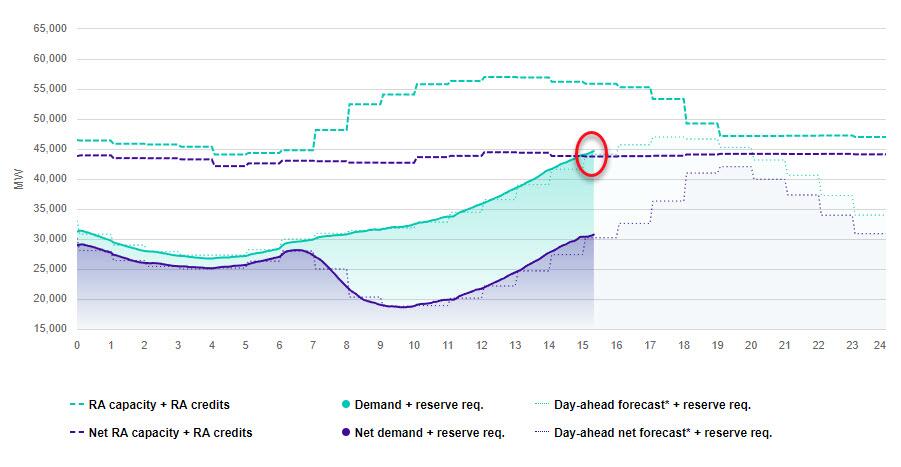
 Update (1820ET): Shortly after 1800ET, just as Californians begin to head home for the day, the California Independent System Operator issued a level-1 energy emergency alert shortly after tapping all its available power supplies.

Despite earlier warnings to reduce usage, Californians - in all their self-righteous virtue - decided to charge their EV anyway, pushing demand above capacity