Search This Blog

Wednesday, November 10, 2021

NYC eyes changes to controversial property seizure program

 The city is considering a series of changes to a controversial program that transfers distressed multifamily properties to developers.

Under the third-party transfer program, the city identifies apartment buildings with outstanding tax debt and hazardous violations and sells them to approved nonprofits and developers to create and maintain affordable housing.

The program has been criticized for disproportionately affecting homeowners of color and has been the subject of litigation involving low- to mid-income co-ops unable to keep up with back taxes or utility costs.

Council member Robert Cornegy will introduce a bill Wednesday that would replace the city’s program with another that has different definitions for “distressed.” For example, the measure sets new thresholds for the number of open hazardous violations that would qualify a building as distressed based on its number of units.

The proposal would also provide more options for owners to avoid having the city seize their properties and would exempt some owners, including those that own one- to three-unit properties or condo units and consider those properties to be their primary residence.

A separate bill, sponsored by Council member Fernando Cabrera, would require the Department of Housing Preservation and Development to add community land trusts to the list of developers eligible to take over properties.

On Monday, a city working group released recommendations for the program, including adjusting payment plan options for owners, increasing outreach to owners before the city initiates foreclosures and creating an “Owner Resource Center” to provide technical and financial support.

The group also considered other changes. Among the options that garnered the most support was a proposal to eliminate the program’s so-called “block pick-up requirement,” under which certain properties on the same block as one that is part of the third-party transfer program must then also be included in the program.

The group voiced support for reconfiguring eligibility requirements based on the individual annual tax liability of each property; a property would qualify when it owes more than one year’s worth of taxes (or three years, depending on the building type), rather than once it has owed taxes for one year. Such changes would also prioritize safety issues over financial obligations when determining whether a property is in crisis.

The working group also favored exemptions for owners of one- to three- family homes who are receiving tax benefits reserved for senior citizens, and suggested the city look into including community land trusts in the program, as Cabrera proposes. It also supported giving Housing Development Fund Corporation cooperatives, or HDFCs, the opportunity to return to the shared equity form of ownership after the property is transferred.

During a hearing by the City Council’s Committee on Housing and Buildings Tuesday, Elizabeth Oakley, a deputy commissioner of development at HPD, said the agency supported the working group’s recommendations but was still reviewing Cornegy’s measure.

She noted that HPD has some concern that the bill would “lead to selection of properties not appropriate for the program,” with insignificant tax debt, and that increased requirements to notify owners would be “practically infeasible.”

The third-party transfer program, created in 1996, is intended to take properties in disrepair off the hands of owners who can no longer afford to adequately ensure tenants’ safety. In January 2019, the de Blasio administration announced plans to potentially expand the city’s seizure authority, focusing on the “worst of the worst landlords with hazardous conditions that are not addressed.”

It targets buildings that are not eligible for the city’s annual lien sale, and like that program, has come under fire in recent years for disproportionately affecting owners traditionally denied opportunities to build wealth. Another task force is studying potential reforms to the lien sale, which is slated for Dec. 17 following several postponements during the pandemic.

https://therealdeal.com/2021/11/09/city-takes-aim-at-controversial-property-seizure-program/

Tuesday, November 9, 2021

Fed Warns That Chinese Property Implosion Could Roil U.S. Economy

 Chinese debt is now a significant risk to global economic growth and the U.S. economy, though not the only one.

Placeholder

In China, business and local government debt is large, and the financial sector’s leverage is high, especially at small and midsized banks. Adding to the risk, real estate valuations are stretched, according to the latest biennial Financial Stability Report, which was published by the Federal Reserve System on Monday.

"In this environment, the ongoing regulatory focus on leveraged institutions has the potential to stress some highly indebted corporations, especially in the real estate sector, as exemplified by the recent concerns around China Evergrande Group," the report says. 

Spillover from the real estate sector is a risk for the entire Chinese economy and, given the size of China’s economy and its trade linkages with the rest of the world, such stresses in China could strain global financial markets and affect the U.S. economy, the Fed warns.

Chinese debt isn't the only risk to U.S. growth cited in the report. Other wild cards include a possible deterioration of the public health situation in the United States, a sharp rise in interest rates and a slower-than-expected economic recovery in Europe.

Besides the sheer size of Chinese debt, another concern is assessing exactly how much of it there is, considering the various ways corporations and other entities can obscure their genuine debt loads, The Wall Street Journal reports. Evergrande’s net debt-to-equity ratio would be 177%, instead of the widely reported figure of 100%, if all its actual debt were counted, according to JPMorgan Chase. That extra total would include debt associated with commercial paper, joint ventures and other off-balance-sheet entities.

Evergrande isn't the only example of worrisome real estate debt in China. Shenzhen-based developer Kaisa Group Holdings missed a payment on a wealth-management product and plans to speed up asset disposals to meet its obligations.

Sinic Holdings Group Co. had its credit rating downgraded by S&P Global Ratings after failing to pay the interest and principal of a $250M bond. That followed a similar default by Fantasia Holdings Group Co. in October. Other Chinese developers, some with U.S. holdings, have recently sought to delay payments or otherwise mitigate their obligations.

Some investors see Chinese debt as an opportunity, however. Goldman Sachs Asset Management is now buying Chinese real estate debt, Bloomberg reports. The investor has been in the market for high-yield, dollar-denominated bonds issued by Chinese property developers, which are now trading at steep discounts.

"The breadth of distress that the market is now pricing [is] starting to look significantly out of alignment with the true extent of distress,” Angus Bell, a member of Goldman’s portfolio management team, told Bloomberg.

https://www.bisnow.com/national/news/economy/fed-warns-that-chinese-property-implosion-could-roil-us-economy-11084

Sunday, November 7, 2021

NYC retail has hit bottom: Roth

 New York City retail has bottomed out and will recover, but may never get back to where it was, according to Vornado’s Steven Roth.

The market is building a base from which to climb out of its worst crisis in recent memory, Vornado’s chairman and CEO said Tuesday on the company’s third-quarter earnings call.

“This is not going to be a rapid, V-shaped rebound,” Roth said. “It’s going to take years for this market to recover, and it may never recover to the peak of 5 or 7 years ago.”

In the meantime, Vornado remains a buyer of New York City retail real estate.

“We will buy the highest quality at very attractive prices, [but] there hasn’t been that kind of availability or offering yet,” Roth said. In fact, Vornado recently sold some retail space at a loss.

Executives on the call spoke of renewed business activity in the city’s retail corridors. Tenants that were “in a shell” for more than a year are back looking for space, even in tourist-dependent submarkets such as Times Square, president and CFO Michael Franco said. International tourism around the holidays will be “another shot in the arm for the city,” he offered.

“Now the transaction machine is working again,” Franco said, later adding, “We don’t expect it to snap back to 60 million [tourists per year] immediately. But the trendline from the city opening, and the attendance at sporting events and Broadway shows and other things is quite good and quite indicative of what we think is going to happen.”

Commercial rent increases are likely on the distant horizon, however.

“Activity has to happen before you start getting rental movement, and it’s going to take, I think, a decent amount of activity before that happens,” Franco said.

Vornado reported third-quarter adjusted funds from operations, plus assumed conversions, of $136.2 million, or 71 cents per share, up from $116.7 million, or 61 cents per share, from a year ago.

The company leased 111,000 square feet of New York retail space during the quarter at an average initial rent of $109.61 per square foot annually, bringing this year’s to 176,000 square feet at an average initial rent of $142.70.

Vornado sold five underperforming retail assets earlier this year, including two in Soho and three on the Upper East Side. The company expects to recognize a gain of $1.5 million from the Soho sales and a $7.9 million non-cash impairment loss on the Upper East Side sales.

https://therealdeal.com/2021/11/02/nyc-retail-has-hit-bottom-vornados-roth-says/

Saturday, November 6, 2021

Bezos Unveils Plan For Mixed-Use Business Park In Space

 Blue Origin, the spaceflight company controlled by Amazon mogul Jeff Bezos, and partners Sierra Space and Boeing are planning to build a commercial space station, Orbital Reef, that they characterize as a mixed-use business park in space.

Placeholder
A rendering of Orbital Reef's main module

The space station is planned to at first consist of a main module and attached other modules, according to the partners, and will be built and serviced using Blue Origin's reusable New Glenn launch system, Boeing’s Starliner spacecraft and Sierra Space’s Dream Chaser spaceplane. 

Though none of those vehicles has achieved Earth orbit yet — Bezos, actor William Shatner and others rode in New Glenn capsules in suborbital flights this year — the partners say Orbital Reef will be in space by the second half of the 2020s. The partners didn't provide an estimate of the cost of the space station nor a more precise timetable for its development.

The station is slated for low-Earth orbit at a bit more than 300 miles above the planet's surface, higher than the International Space Station's nearly 250 miles above the Earth.

Orbital Reef's developers say it will support as many as 10 people in about 830 cubic meters, which is roughly the size of the ISS. The station's goal is to offer research, industrial and other commercial customers such services as space transportation and logistics, space habitation, equipment accommodation and operations, including onboard crew, according to the partners. 

"Designed to open multiple new markets in space, Orbital Reef will provide anyone with the opportunity to establish their own address on orbit," Blue Origin said in a statement.

"Seasoned space agencies, high-tech consortia, sovereign nations without space programs, media and travel companies, funded entrepreneurs and sponsored inventors, and future-minded investors all have a place on Orbital Reef," the company said.

Also participating in the venture are Redwire Space, Genesis Engineering Solutions and Arizona State University.

Blue Origin and its partners aren't alone in planning a private permanent presence in low-Earth orbit. Last month, partners Voyager Space Holdings, Nanoracks and Lockheed Martin announced plans for their own commercial space station, Starlab, which they say will launch in 2027. Starlab is designed to measure about 340 cubic meters and accommodate four space travelers.

Starlab will include a large inflatable habitat, a docking node, a power and propulsion element, a large robotic arm for servicing cargo and payloads, and a lab for R&D and manufacturing.

Axiom Space is also planning a commercial station, Axiom Hub One. Earlier this year, the company raised $130M in a new round of funding.

https://www.bisnow.com/national/news/mixed-use/jeff-bezos-plans-mixed-use-development-in-orbit-110787

How To Care For Your Furnace

 With winter approaching, there's an important home maintenance task to complete that can help your home stay warm and cozy — making sure your furnace is in good shape.

Your furnace is one of the most important pieces of equipment in your home. It produces the warm air that keeps your house heated during the cold months and it works with the air conditioner to cool your house in the summer. The good news is that furnace maintenance is often relatively easy.

Here's what you need to know about caring for your furnace:

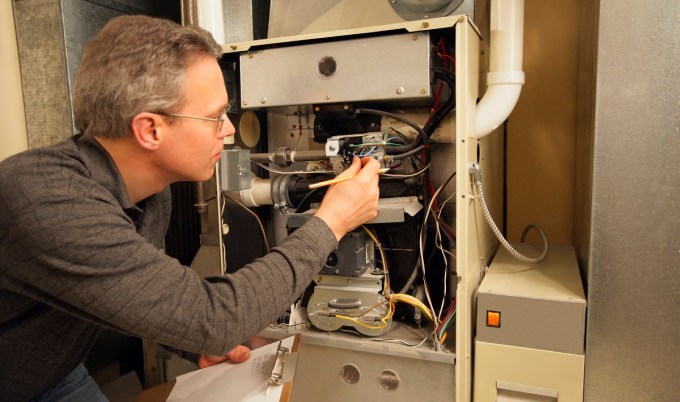
technician inspecting home furnace.

FURNACE MAINTENANCE YOU CAN DO

There is some routine maintenance you can do to help keep your furnace running safely and efficiently.

INSPECT AND CHANGE THE AIR FILTERS

ENERGY STAR suggests checking your furnace's air filter every month and replacing it when it looks dirty. A dirty filter can slow air flow and reduce efficiency, and the furnace may stop working if too much dust and dirt builds up inside. At a minimum, change the filter at least every three months, says ENERGY STAR.

Tip: Filters work best when they fit snugly — so make sure you're buying filters that are the right size for your furnace.

KEEP VENTS CLEAN AND CLEAR

Before you turn on your heating system for the season, remove vent covers from the floors, walls and ceilings around your home. Vacuum the covers and the opening of the ducts, says This Old House. Dust, pet hair, small objects (including toys) and even food can collect there. This can block air flow and cause your furnace to work harder.

Tip: Sealing leaky air ducts with metal tape or duct sealant can help improve the efficiency of your heating system, says ENERGY STAR.

INSTALL A CARBON MONOXIDE DETECTOR

As furnaces burn gas or oil to heat your home, they produce carbon monoxide, says the Centers for Disease Control and Prevention. Install battery-operated or battery-backup carbon monoxide detectors on every level of your home to help alert you if your furnace is leaking this dangerous, odorless gas into your home. Also, check the detectors regularly to help ensure they are in working order.

Tip: Change the detectors' batteries at least once a year. You can use the end of daylight saving time as a reminder to do this task.

FURNACE MAINTENANCE FOR A PROFESSIONAL

An annual tune-up by a professional is an important part of maintaining your furnace, according to ENERGY STAR, and it may help prevent costly furnace repairs down the road. A heating contractor will make sure that your thermostat is working correctly, the system is cycling on and off properly and will typically go through a series of checks and tasks, including:

  • Tightening loose electrical connections
  • Oiling all the moving parts
  • Inspecting all gas connections
  • Cleaning the burner
  • Checking for cracks in the heat exchanger

Tip: Call the contractor before temperatures take a dive, ENERGY STAR says, or you may find it difficult to get on their busy schedule.

After you've done all that, listen for any signs of trouble when your heating system is running. If your furnace is squeaking, rattling or otherwise making noise, it may be a signal that a part has come loose, another cleaning is in order, or a sign that your unit needs replacing. If you notice any strange noises, call a professional for help.

Your furnace is key to keeping your home comfortable during the cold months. Taking care of these routine maintenance tasks can help keep your furnace in good condition so it can keep you cozy all winter long.

https://www.allstate.com/tr/home-insurance/furnace-maintenance.aspx

Everything America Gets For $1.2T In Infrastructure Spending - Including The Crazy Stuff

 After Friday night's 11th-hour vote in the House resulted in the passage of the $1.2 trillion infrastructure bill - thanks to 13 uniparty Republicans who joined the Congressional Black Caucus in short-sheeting House Progressives - the Wall Street Journal and Forbes have published refreshers of what what America is supposedly getting out of the largest investment in infrastructure in more than a decade.

From 10,000 feet, investments span refurbishing aging roads, bridges and ports, replacing lead pipes, upgrading and hardening the nation's power grid, and of course - a healthy investment in 'infrastructure' to battle the ever-looming man-made climate change disaster that we're told will turn coastal cities into a modern Atlantis.

To help pay for the roughly $550 billion in new spending (nearly half is previously approved funding), more than $200 billion in unused coronavirus relief funds will be repurposed, along with $50 billion from a Trump-era rule on Medicare rebates, and another $50 billion from various states' unused unemployment insurance supplemental funds. Where the rest will come from? Tax hikes and IRS colonoscopies are slated to offset the upcoming social spending bill, assuming Democrats are able to slip both into the reconciliation bill that somehow passes muster for moderate Democrat Senators Joe Manchin (WV) and Kyrsten Sinema (AZ).

In truth, it isn't paid for at all.

Anyhow, drilling down - in addition to including controversial cryptocurrency tax reporting requirements, the infrastructure bill will invest in the following via Forbes:

Roads and bridges: Headlining the 2,702-page bill's spending, roughly $110 billion of new funds would go toward improving the nation's roads and bridges, and investments in other major transportation programs.

Public transit: The package also includes the largest-ever federal investment in public transit, allotting $39 billion to modernize systems, improve access for the elderly and people with disabilities, and repair more than 24,000 buses, 5,000 rail cars and thousands of miles of train tracks.

Amtrak: The legislation marks the largest investment in passenger rail since the creation of Amtrak 50 years ago, with $66 billion earmarked for high-speed rail, safety improvements, Amtrak grants and to modernize the rail route connecting Washington, D.C., to Boston.

Broadband internet: Tacking on to billions authorized by last year's American Rescue Plan, the infrastructure bill includes $65 billion to bolster the country's broadband infrastructure and help ensure every American has access to high-speed internet, with one in four households expected to be eligible for a $30-per-month subsidy to pay for internet.

Electric grid: Though many clean-energy measures were cut from the bill to satisfy spending-weary lawmakers, a $65 billion investment will help upgrade the nation's electricity grid, with thousands of miles of new transmission lines and funds for environmentally friendly smart-grid technology.

Electric cars, buses and ferries: In addition to $7.5 billion for the nation's first network of electric-vehicle chargers along highway corridors, lawmakers have shored up $5 billion for zero-emission buses (including thousands of electric school buses) and $2.5 billion for ferries.

Clean drinking water: Following high-profile water-supply crises plaguing cities like Flint, Michigan, the legislation includes a provision for $55 billion to replace all the nation's lead pipes and service lines, representing the largest investment in clean drinking water ever.

Great rivers and lakes: Among the bill's $48 billion for water infrastructure improvements, about $1 billion is slated to go toward the Great Lakes Restoration Initiative, a sweeping clean-up measure targeting toxic hot spots—or areas of heavy industrial pollution—around the Great Lakes region.

Airports: More than $25 billion has been allocated to help modernize America's airports—funds the Airports Council International says will help tackle more than $115 billion worth of project backlogs.

Road safety: The deal invests $11 billion in transportation safety programs, including a new program to help states and localities reduce crashes and fatalities in their communities, particularly among cyclists and pedestrians.

*  *  *

And now, the crazy stuff:

Continued via @Oilfield_Rando, with each tweet linking to relevant portion of the bill:

And more (click into thread):

Market Impact of the Closure of Zillow Offers

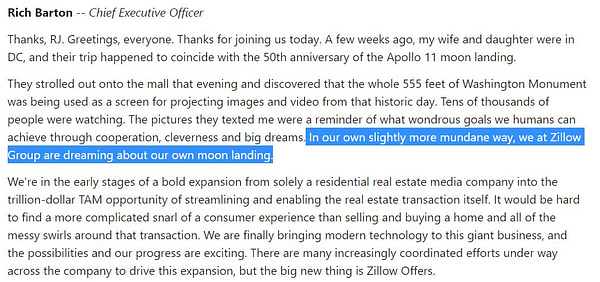
 Many people are discussing the Zillow’s business decision to discontinue Zillow Offers. This was a essentially a house flipping program. My question is what - if any - will be the market impact of the closure.

There are several other players in this segment - all with slightly different models - such as publicly traded companies OpenDoor, Redfin Now and OfferPad. Redfin will report Q3 results tomorrow (November 4th), and both OpenDoor and OfferPad will report Q3 results on November 10th. All three companies will be asked about Zillow’s decision. It will be interesting to hear if they are pulling back on volumes.

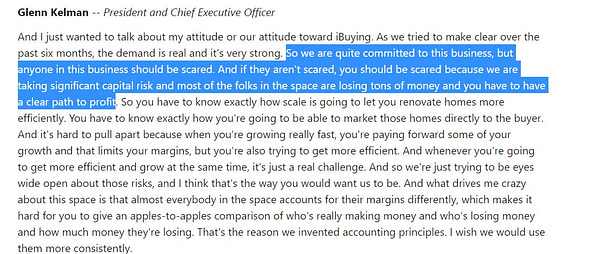
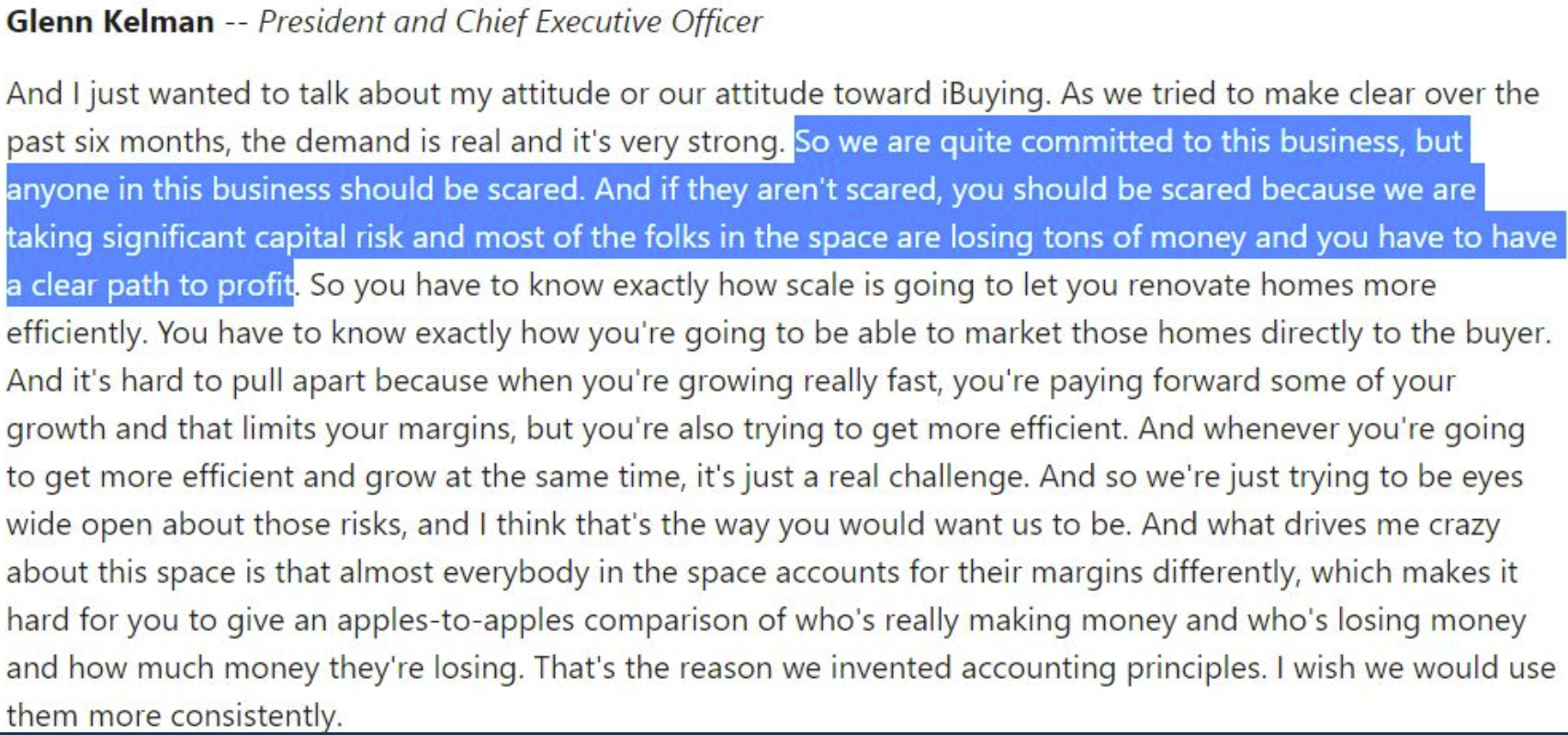
Redfin was much more cautious than Zillow when they entered the market, and here are some comments from Redfin CEO Glenn Kelman in 2019.

Impact on the Housing Market

First, it appears Zillow has around 7,000 homes that they will sell in the coming months, many at a loss. However, there will probably be around 1.6 million existing homes sold in Q4 Not Seasonally Adjusted (NSA). So 7,000 is a very small percentage, and with record low inventories (for September), this will not have an impact.

However we might see an impact on the demand side. Especially if the other iBuyers are scaling back their purchases (we will know more in the next week). This will have an impact at the margin, especially since it appears Zillow was buying, uh, some lemons, and boosting the price of less desirable homes.

One of the interesting comments during the conference call yesterday was that only 10% of potential Zillow Offers buyers accepted the Zillow offer. This suggests that many sellers were savvy, and many only accepted iBuyer offers above market. Economist Taylor Mar noted this (here is a discussion on the famous Akerlof paper: The Market for Lemons).

It is possible this will have an impact on buyer psychology, and make some buyers more cautious, but that is impossible to measure.

But the bottom line is inventories are very low, mortgage rates are still historically low, and demographics are currently favorable for home buying.

If the housing market slows - for whatever reason - I think the slowdown will show up in active existing home inventory. This is why I track local market inventory so closely every month. Some markets have seen inventories increase, but overall active inventory was at a record low for September.

We should get some local October inventory numbers soon.

https://calculatedrisk.substack.com/p/the-market-impact-of-the-closure