Search This Blog

Tuesday, December 25, 2018

Multistory Warehouses Come With High Cost, Operational Burdens

Overcoming last-mile delivery challenges in some of the most densely populated parts of the U.S. has pushed industrial developers to pursue multistory warehouses. A new report shows taller warehouses come with their own set of challenges.
“Quite candidly, the users are going to have to change the way they operate in these buildings to make it work efficiently,” CBRE Global Head of Industrial & Logistics Research David Egan said.
As e-commerce growth drives U.S. industrial demand, rental prices have gone up and companies have come up short looking for last-mile distribution centers close to urban centers.
The average U.S. land price for developing a single-story warehouse has doubled in the last five years to $30/SF, according to CBRE’s Going Up: Vertical Solutions In Industrial & Logistics report. Multistory warehouses are common in densely populated parts of Europe and Asian cities like Singapore and Tokyo, and the concept is coming stateside.
Developers like Prologis are now pursuing multistory warehouses in places like New York City, Seattle and the Bay Area. Amazon has also been reportedly building multistory distribution centers around the country in less dense areas like a Milwaukee suburb and a town outside Raleigh, North Carolina.
Not all multistory warehouses are alike. Shorter trucks that are common in Europe and Asia are conducive with tighter ramps found in those regions’ multistory warehouses.
Developers are likely to run into challenges when dealing with 53-foot semitrucks often used for shipping in the U.S. While some argue the solution is to simply use smaller trucks and delivery vans, a Boston-based real estate investor who focuses on industrial properties says it isn’t that easy.
“Full 53-foot trailers will create a significant increase in traffic and disruption given the already-congested urban location we are assuming [a] multistory warehouse will be built in,” The Seyon Group Managing Partner Andrew Iglowski said. “I’m not sure it’s feasible for developers to take leasing and/or capital markets risk by developing multistory buildings that function solely for box trucks and vans.”
Multistory challenges extend beyond traffic. While Egan emphasized it was too early to give an exact price on multistory warehouse rents, he expects higher costs that will only be easy for larger users to be able to absorb.
CBRE Chairman of Americas Research and Senior Economic Advisor Spencer Levy told Bisnow rents in a multistory warehouse could run between two and three times as much as what is seen at a single-level warehouse.
Iglowski estimates the cost to build a multistory warehouse, including land, will run between $300 and $350 per SF.
“Developers will need tenant prospects that are able and willing to pay significant rental premiums,” he said. “Given that multistory warehouse isn’t yet a fully understood or embraced product type, the tenant will require an exceptionally high level of certainty that the speed of fulfillment is worth the cost.”
Although there may be heavy costs associated with projects like a multistory warehouse, Egan still sees where the benefits can outweigh any price or logistical burden. Land is expensive, but having a distribution hub minutes from customers in Manhattan may be worth the hefty price tag. While he still thinks the logistical challenges are a tall task for developers to tackle, Egan expects users to eventually come up with a solution.
“To change the way these users move inventory in and out of a building compared to how they do from a ‘regular’ building isn’t a simple tweak,” he said. “It just requires someone with a little bit of forward thinking who is willing to take a risk.”

Monday, December 24, 2018

Where are people moving, and why

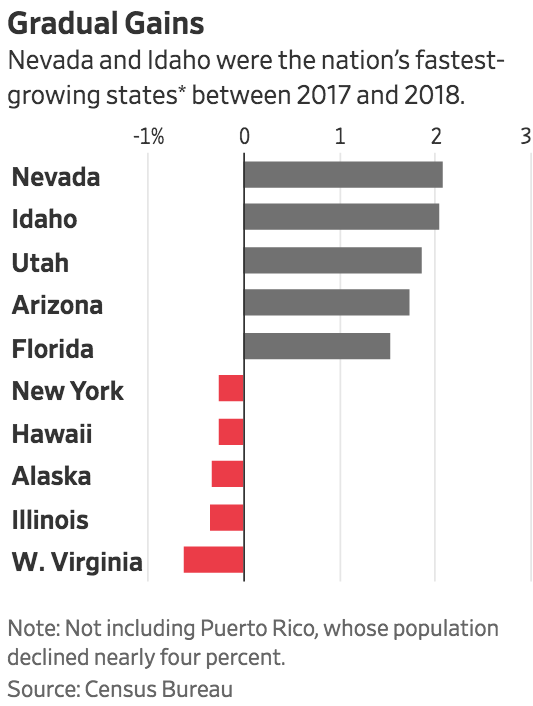
Over at Econlog, I have a post discussing the slowdown in US population growth, to 0.6% in 2018 (the slowest growth rate since 1937.)  A WSJ article also had some interesting data on state growth rates:
Screen Shot 2018-12-20 at 7.49.53 PMThe footnote on Puerto Rico is rather striking, as its population fell by 4% last year.  That was partly due to hurricane Maria, but its population has been plunging for many years, down about 14% since 2010.  Who’s going to pay off that enormous debt, and will the last Puerto Rican please turn out the lights? Hawaii is also losing people, as are Mississippi and Louisiana.  So the “Sunbelt” phenomenon is more complex than advertised.
Other trends:
1.  Mormons have lots of kids.  The four fastest growing states are all in the top five in terms of percentage of the population that is Mormon, although only in Utah and Idaho are they numerous enough to dramatically impact population growth.  (The other top five Mormon state (Wyoming) is losing people.)
2.  Illinois has been losing about 40,000 people each year, while other Midwestern industrial states like Michigan and Ohio keep growing (albeit slowly).  What makes this surprising is that Illinois is dominated by one of the few Midwestern industrial cities to successfully reinvent itself.  Chicago has a thriving lakefront area full of high paying jobs, while Detroit, Flint, Cleveland, Akron and Dayton have languished.  This Illinois underperformance may reflect the extraordinary incompetence of the Illinois state government, which is driving the state toward a fiscal crisis.  Illinois is dominated by Cook County, which has a corrupt political culture.
3.  As recently as 2013, New York had more people than Florida.  Now Florida has 1.75 million more than New York.  Indeed 35% of US population growth now occurs in Florida and Texas.
4.  The sunny, oil-rich states that border Texas continue to do very poorly, either falling in population or growing much more slowly than the national average.  Texas probably benefits from a mixture of no state income tax, lax zoning, and business friendly regulations.  While other inland states also have cheap housing prices, Texas has cheap housing prices in big urban areas.
5.  It now seems like the lack of a state income tax doesn’t provide much gain to states without a big city, such as Alaska, Wyoming and New Hampshire.  The exception is South Dakota, which is doing modestly better than its neighbors.  In contrast, states with big cities and no state income tax (Texas, Florida, Nevada, Washington, Tennessee (on wages)) tend to grow faster than their neighbors.  I think that’s because the lack of a state income tax is especially attractive for the sort of high paid professionals that live in big cities.
6.  The recent federal tax reform will raise the effective top rate on the California state income tax from about 8% to 13.3%.  Many rich people (like me) will continue to choose California, due to its amenities.  But at the margin, a few more will make the switch to Austin or Seattle or Vegas.  California always used to grow faster than the US as a whole.  Even when whites started leaving for other states, the overall California population kept growing at a good clip due to international migration.  But now its growth rate (0.4%) has fallen below the national average.  Eventually, California may begin losing Congressional seats.
7.  Today, most of our population growth is in three areas.  The southeast (Raleigh to Miami), four big Texas metros, and the non-California west (the Denver/Seattle/Phoenix triangle.)
What are the odds that the world’s two richest guys would live in the same medium size city, in the only liberal state without a state income tax?

Waterfront building binge bolsters case for BQX, backers say

Roughly 20 million square feet of new office space is being planned near the proposed Brooklyn-Queens Connector’s 11-mile route, according to a report released Thursday by the troubled tram’s booster group. That increase, the organization argued, strengthens the case for fully funding the waterfront streetcar, which would run between Astoria and Gowanus.
The biggest concentration of planned commercial space is in Long Island City, where Amazon plans to build at least 4 million square feet for its new headquarters. In addition to other projects in the neighborhood, smaller clusters are planned in Williamsburg, Downtown Brooklyn and the Brooklyn Navy Yard, which is expected to be home to 20,000 jobs by 2020 and is poorly served by transit. All told, the group expects the supply of office space along the corridor to grow to 58 million square feet in just over a decade. That would represent 10% of the city’s current stock.
“Amazon’s decision to open a Long Island City campus underscores just how essential a role the BQX will play in delivering workers—many living in areas sorely underserved by quality mass transit—to jobs and workforce development opportunities along the corridor, which will be home to more commercial space than the downtowns of Los Angeles, Philadelphia or Boston by 2029,” a spokesman said.
The report broke out a list of 43 developments planned for the short-term or long-term or are speculative and might not come to fruition. The largest of the bunch is Amazon’s proposed headquarters, which the group assumed would grow to the maximum size of nearly 8 million square feet, followed by a large Tishman Speyer office project and a new development from Silvercup Studios, both in Long Island City.
Tom Wright, head of planning nonprofit Regional Plan Association and a board member of the friends group, said that many observers have criticized the BQX as unnecessary while also bemoaning the lack of transit infrastructure in Long Island City.
“Amazon makes it more important to have this service, especially if you are trying to give people from public housing projects access to those jobs centers,” he said.
In October, Mayor Bill de Blasio announced a revised plan for the streetcar that would make its route shorter, its price tag costlier and its service operational four years after it was initially envisioned to open. And instead of paying for itself through increased tax revenue as was initially planned, it would require $1 billion in federal funding.
While New York’s congressional delegation—which includes Sen. Charles Schumer, whose daughter Jessica Schumer is executive director of the friends group—and Gov. Andrew Cuomo have met with President Donald Trump about funding infrastructure projects, a commitment from the White House has been elusive.
The friends group, which includes transit and civic groups and major real estate developers with projects along the route, hopes that Amazon and the additional commercial projects it may spur will push the streetcar project to be funded with federal or local cash.

Sunday, December 23, 2018

Buffett profits as venture in Canadian mortgage business ends

Billionaire investor Warren Buffett is cutting ties with a Canadian mortgage business after a nifty trade that provided the company with a potential lifeline.
Buffett’s Berkshire Hathaway Inc is “substantially” exiting its stake in Home Capital Group Inc (OTCBB: HCG) after selling shares back to the company, the Canadian mortgage lender and Buffett said on Wednesday.
Shares of Home Capital tumbled as much as 19 percent in early trading before paring losses to trade down 13.2 percent to C$14.30 at midday.
Berkshire bought a 20 percent stake in Home Capital last year and extended a C$2 billion credit line after the Canadian company suffered a deposit exodus resembling a bank run after being accused of, and then admitting to, concealing mortgage fraud. Home Capital reached a settlement with the Ontario Securities Commission in June last year.
Berkshire’s investment and Buffett’s vote of confidence sent Home Capital shares rallying when the investment was announced.
“Buffett was brought in as a short-term stopgap,” said Marc Cohodes, a short seller betting against Home Capital, who believes the deal with Buffett did not help the average Home Capital shareholder. “He sold his name to Home Capital and the Canadian government.”
Buffett burnished his reputation as a lender of last resort in the aftermath of the 2007-2009 global financial crisis, buying high-yielding stocks and bonds in companies including Bank of America Corp (NYSE: BAC).
In this case the cost of the folksy Omaha investor’s help was high.
The credit line carried a 9 percent interest rate and in May Home Capital said it was replacing it with new, lower-cost credit from an undisclosed lender.
Berkshire could see a profit of more than 70 percent for the shares it bought for around C$9.55 apiece in June 2017 and sold back to the company at C$16.50 per share.
“He single-handedly improved the odds of his investment just by getting involved,” said John Huber, managing member at Saber Capital Management LLC, which owns Berkshire shares.
The $153 million initial investment was small in relation to the $103.6 billion Berkshire has in cash and similar holdings. Berkshire initially planned to take a greater stake in the company, a move that had Home Capital’s blessing. But shareholders resisted, and proxy advisory firm Institutional Shareholder Services said the deal to sell shares to Berkshire at a discount would substantially dilute the value of other investors’ holdings with little additional benefit.
In a statement, Buffett said that Berkshire’s investment was “not of a size to justify our ongoing involvement” because shareholders did not approve the additional investment and Home Capital repaid its credit line.
“We are delighted to see Home Capital back on its feet with healthy liquidity and a solid capital position,” Buffett said. “Although we have decided to substantially exit from our investment, we will continue to cheer from the sidelines for our friends at Home.”
Berkshire’s exit nonetheless comes as a housing slowdown and a sharp slide in oil prices put pressure on Canada’s economy.
“Buffett is looking at the Canadian economy much the way everybody else is and is getting out of HCG at a profit while he can,” said Jared Dillian, an independent investment strategist who is betting the value of the Canadian dollar will fall. “Buffett has done a lot of things right over the last year or two. He kept a large cash position even when he was criticized for doing so. He didn’t make any deals on the highs.”

Friday, December 21, 2018

HUD’s Carson: Fed receivership possible pre-court decision on NYCHA’s future

A federal takeover of New York’s public housing is still a very real possibility, federal housing chief Ben Carson told the Daily News during an unannounced tour through the Queensbridge Houses on Tuesday.
For the first time since taking the helm of the U.S. Department of Housing and Urban Development, Carson walked the nation’s largest public housing complex and told The News that placing NYCHA into federal receivership is an option — even though Mayor de Blasio has made it clear that’s not his preference.
On Friday Carson sent NYCHA a letter requiring that the authority produce a detailed plan by Jan. 31 with milestones and metrics spelling out how they intend to fix what’s long been broken.
“There’s a host of things that are going to be required that I think are reasonable, and that can be accomplished,” Carson told The News after his brief stop at Queensbridge. “If it can be accomplished without a receivership, great. If it requires some type of receivership, it requires some type of receivership.”
Carson’s unannounced visit came a month after a federal judge shot down a carefully crafted agreement between the city, NYCHA, HUD and the Manhattan U.S. attorney to bring in a federal monitor.
Manhattan Federal Judge William Pauley declared that a monitor who would have no say over NYCHA’s day-to-day operations wasn’t tough enough to truly fix the authority’s long history of mismanagement and failures to address lead paint, toxic mold and broken elevators. Twice the judge has brought up the notion of a receiver who could hire and fire management, void labor agreements and bring in contractors.
The U.S. attorney supports some form of receivership while de Blasio opposes it. Until Tuesday Carson had not spoken publicly about his feelings on the question. In an interview with The News after touring Queensbridge, Carson spelled it out.
HUD Secretary Ben Carson tours the Queensbridge Houses apartment of longtime resident Geraldine Harvey.
HUD Secretary Ben Carson tours the Queensbridge Houses apartment of longtime resident Geraldine Harvey. (Luiz C. Ribeiro for New York Daily News)
Asked if he was opposed to either HUD taking over NYCHA or a judicial receiver stepping in, Carson replied, “I’m not opposed to any kind of receivership. It’s one of the tools in our box — but I would like to move in a way that we have excellent oversight, but that we have city and NYCHA responsible to the tenants and the people of the city.”
He dubbed receivership “a last-ditch effort. Obviously, I’d like to see local control, local responsibility. That’s going to be the best issue because the people right there controlling it are right their responsible to the people in their environment.”
“You know what’s been going on here for decades and it’s time to fix it,” he said. “It’s a huge enterprise. It’s very complex. But I’ve dealt with complex things before.”
His remarks followed an unusual off-the-radar visit to Queensbridge, located just north of where Amazon plans to open its Long Island City campus in the coming year.
Opened in the 1940s, Queensbridge has most recently been the site of a multimillion-dollar de Blasio-funded effort to patch leaky roofs but also a series of heat and cooking gas outages. One building two blocks from where Carson dropped in was without gas from August until last week.
Escorted by NYCHA General Manager Vito Mustaciuolo and Lynne Patton, administrator of HUD’s New York-New Jersey office, Carson was brought to a Queensbridge boiler room where three giant green boilers hummed away, registering temperatures of 320 degrees to heat four buildings.
Mustaciuolo let Carson know about a recent boiler failure caused by a water pipe rupture that knocked out heat for much of the development three weeks ago. NYCHA was roundly criticized last winter for a run of boiler breakdowns that left 300,000 tenants without heat or hot water, sometimes for days at a time.
Carson heads toward boiler room at Queensbridge Houses.
Carson heads toward boiler room at Queensbridge Houses. (Luiz C. Ribeiro for New York Daily News)
Carson then dropped in on the immaculate two-bedroom apartment of longtime tenant Geraldine Harvey, 73, which was brightly decorated for the holidays with a forest of poinsettias and a smart table-top Christmas tree strung with gold lights. He and Harvey — who raised two daughters there who are now grown up — worked their way across a wall of family photos.
He asked her if she felt NYCHA managers addressed her apartment concerns, to which she replied they were “fairly responsive.” He posed for photos and then was ushered out the door and down the sidewalk past a gaggle of reporters.
Later Tuesday, he met in Patton’s lower Manhattan office with de Blasio. After the mayor declined to discuss Carson’s position on receivership, implied all parties want to avoid it if possible.
“Of course the topic came up, and I think there was abroad agreement that we’re going to do all together to avert it, that both HUD and the City of New York believe there is a better way, and that better way is to come to a settlement,” the mayor said.

WeWork Starts Investment Arm

WeWork’s relentless pursuit of world domination in the office real estate industry has bothered some big names, but it doesn’t look to be slowing down anytime soon.
The coworking industry leader has launched an investment fund called ARK focused on acquiring properties, Bloomberg reports, citing anonymous sources.
ARK has not been publicly announced, but WeWork has been ramping up its involvement in property ownership.
In 2017, the company partnered with Rhône Capital to raise $400M in funds to buy properties, the first being the flagship Lord & Taylor building on Manhattan’s Fifth Avenue. That building is slated to become WeWork’s headquarters next year (if it can finance the transaction).
It has since bought properties as a part of partnerships in London and Washington, D.C. WeWork has also entered into the development arena by partnering with Rudin Management and Boston Properties on the Dock72 project in the Brooklyn Navy Yard.
It has also launched a venture called WeWork Space Services to assist startup members in finding space once they have outgrown coworking — long considered the province of brokers.
The company’s HQ by WeWork division occupies similar territory to both design and manage properties. Add them all up, and there are few areas of office real estate that WeWork doesn’t touch.
“Don’t kid yourself, these are disrupters, they are seeking to disrupt the relationship of the landlord to the tenant. They are seeking to disrupt the relationship of the landlord to the broker,” Empire State Realty Trust CEO Tony Malkin said at Bisnow’s New York State of the Market event in late November.
Both landlords and brokerages have taken notice, and responded by launching their own coworking arms. CBRE has begun offering Hana to its clients, and Tishman Speyer has included Studio in its office building within Rockefeller Plaza, Bloomberg reports.
Critics like Malkin believe WeWork’s business of taking on long-term leases and using them for a month-to-month service increases exposure to possible downturns without allowing landlords to share in the profits generated by the coworking space. Companies like Convene and Industrious have been offering “partnership leases” to address the partnership question, as well as Knotel, perhaps WeWork’s chief competitor in New York.
In an email conversation with Bisnow on Wednesday, Knotel founder and CEO Amol Sarva confirmed the use of partnership leases, saying that he considers those sorts of deals on the same spectrum as co-ownership of a building, like the ground-up development Knotel is pursuing in Brooklyn’s Gowanus neighborhood.
“We partner with owners to help them do well,” Sarva said. “Sometimes that means we are a co-owner. We are happy to have skin in the game alongside [landlords].”
WeWork Chief Development Officer Granit Gjonbalaj told Bisnow that the company plans to increase the number of partnership leases in its U.S. portfolio. But that does not get at the central question that seems to bug most of its critics in real estate: Just how successful is WeWork’s model?
The company’s valuation has skyrocketed in the past couple of years, largely driven by billions of dollars in investment by Japanese firm SoftBank and its venture arm, SoftBank Vision Fund.
The most recent infusion took WeWork’s valuation past the $40B mark, but apparently SoftBank’s own backers are concerned about WeWork’s trajectory. The majority of capital in SoftBank Vision Fund is provided by state-run investors from Saudi Arabia and the United Arab Emirates, which have largely let SoftBank CEO Masayoshi Son have free rein over their investments. But the Saudi Public Investment Fund and Emirati Mubadala Investment Co. refused to sign off on a new $16B investment that would give SoftBank majority ownership of WeWork but leave co-founder and CEO Adam Neumann in control of the company, the Wall Street Journal reports.
The funds doubt the validity of WeWork’s giant valuation, according to the WSJ, and expressed concern that the company continues to outspend its incoming revenue — it posted a $1.2B net loss through the first three quarters of this year.
Neumann contended that each individual WeWork location is profitable, and the net loss is the natural result of the company’s hyper-aggressive expansion.  But WeWork is growing in so many directions and at such a fast pace that it is giving many in the industry a sense of unease, according to Bloomberg.
Though Knotel boasts twice the number of locations in New York and is adding more seemingly every week, it has not diversified to nearly the extent WeWork has. The biggest acquisition to date for Knotel was of blockchain startup 42Floors, but Sarva told Bisnow that its investment into blockchain technology is purely a way of speeding up the process of finding and acquiring space.
When asked if Knotel had any plans to follow WeWork’s diversification playbook, Sarva gave a one-word answer: “No.”
SoftBank still hopes to convince its Middle Eastern backers to buy into WeWork further, but likely will be forced to find other capital if it wishes to complete its $16B buy-in (which would bring WeWork’s valuation back down to $36B, according to the WSJ).
Regardless, WeWork already has a significant-if-indirect connection to a Saudi sovereign wealth fund, which itself raises questions. If WeWork is to continue its dizzying pace of expansion, it will need more cash infusions of the type that SoftBank has been supplying. Meanwhile, the rest of the real estate community will be watching closely.

Thursday, December 20, 2018

Not To Be Outdone, Facebook Is Looking At Its Own Major NYC Expansion

Not To Be Outdone, Facebook Is Looking At Its Own Major NYC Expansion
Courtesy of Kohn Pedersen Fox Associates
Rendering of One Madison Avenue
Two of the world’s five bellwether tech companies have announced major expansions in New York in the last two months, and a third is looking at a Big Apple move of its own.
Facebook is in talks to lease SL Green’s One Madison Ave. tower, an indication the tech giant is expanding more in Manhattan. It is not clear how much space it is considering at the planned redevelopment at Madison and Park avenues between 23rd and 24th streets in the tech-savvy Midtown South neighborhood, the New York Post reports.
Right now, Facebook leases 758K SF at 770 Broadway and another 266K SF at 225 Park Ave. South. Facebook was reportedly close to inking a lease that would give it 870K SF across the entire office portion of 63 Madison Ave. in NoMad.
However, the Post reports that deal may not be going ahead. Earlier this month, SL Green revealed its development plans for One Madison Ave., which will be designed by Kohn Pedersen Fox and Gensler and co-developed by Hines — the same team responsible for the One Vanderbilt supertall in Midtown.
Once complete, One Madison Ave. will be almost 1.5M SF. Construction will start in in 2020 or 2021 when current leases expire. Credit Suisse is currently in the building and is moving out, according to the Post.
Amazon’s decision to build half of its HQ2 in Long Island City and Google’s recently announced plans to create a 1.7M SF campus in Hudson Square, in addition to Facebook’s growing presence have led many to tout New York City as a true rival to the West Coast as a tech epicenter.