Search This Blog

Sunday, September 9, 2018

Marriott To Greatly Expand Apartment-Only Portfolio Worldwide

Marriott International is plowing ahead with its plan to build multifamily developments under its hotel banners. The world’s largest hotel company already has 90 branded residential developments in its portfolio, and plans to grow that number by 70% in the next four years, Hotel Business reports. It already has permits and contracts signed for 60 such buildings.
58a2fd594475d_the_ritz_carlton_residences_sunny_isles_beach
Courtesy of Fortune International Group
The Ritz-Carlton Residences, Sunny Isles Beach
The incorporation of condos or apartments into hotel projects is not all that new, but Marriott has experienced considerable success with its stand-alone Ritz-Carlton Residences towers in cities such as Boston and Miami. The hotel giant has already started licensing brands such as St. Regis and W (both acquired in its takeover of Starwood Hotels & Resorts Worldwide), as well as Edition and non-luxury brands Marriott Hotels, Westin, Sheraton and Autograph Collection.
Construction has begun on the first stand-alone St. Regis residential development in the suburbs of New York City, Hotel Business reports, and is soon to begin at a second location in Boston. The development includes residential portions at 12 of its hotels, with 12 more such mixed-use projects in the pipeline.
Marriott said growing demand for hotel-style amenities in luxury apartment buildings is driving its expansion, betting that the highest-paying customers will associate well-known luxury brands with the standard of living they desire. The company estimates that 70% of its residential projects will be considered luxury developments by 2022.
The company is partnering with residential developers for such projects, such as Cronin Group for its Boston St. Regis location. Local expertise will likely be key, considering Marriott’s ambitions are global — it already has residential projects open in 17 other countries, and plans to hit 40 by 2022.

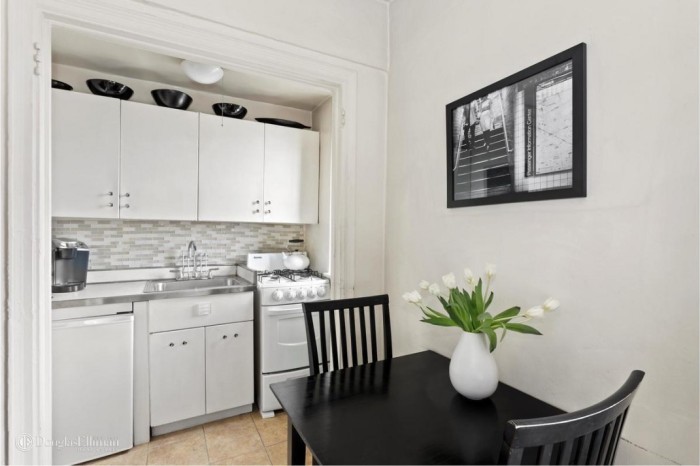
How to maximize space in a small NYC kitchen

180907smallkitchen2Typical airline galley style kitchen
Millennials love their kitchens: 35 percent consider the kitchen the most important room in the house, according to a recent national survey of millennial homeowners and home seekers by HelloFresh. And their top three must-have features are a dishwasher, storage, and a big island.
That sounds nice, you might think. Then you look at your (probably) tiny New York City apartment kitchen and sigh deeply. What are you supposed to do if all you have is a small kitchen with minimal counter space and storage? Unless you live in a newer building or renovated apartment, you’re not likely to have a dishwasher, either. (Forget about the big island for the time being.) What’s a New Yorker who loves to cook supposed to do?
Fear not. Brick Underground spoke with Claudia Sidoti, HelloFresh’s head chef and recipe developer, and she shared her professional insights—she herself grew up with NYC kitchens and then worked in tiny NYC restaurant kitchens—for how best to organize your small NYC kitchen.
HelloFresh’s Claudia Sidoti.
Sue Kwon

Get organized and declutter regularly

This is rule number one, Sidoti says. “Keeping an organized kitchen is important, otherwise it can quickly become the messiest room in the house.”
Start by having as little clutter as possible, “which will make you want to spend more time in there.” Creating a space and a layout that’s conducive to cooking will also be a motivator to do it more, she says.
Removing clutter isn’t enough. Not unlike tips from professional organizers, who say to go through your bedroom closets and drawers at least once if not twice a year, Sidoti recommends the same for the kitchen.
“Do a seasonal decluttering of your counters and kitchen gadgets and tools. You’ll be surprised how much you accumulate that you really don’t use or need,” she says.

Maximize your counter space

Counter space is valuable real estate where all the prep work happens. If you don’t have much to start with, Sidoti recommends purchasing a rolling cart to create additional space, which then can easily be moved, if necessary. She also suggests displaying only those items that you use frequently, such as knife blocks, a coffee maker, everyday cooking utensils, a dish drying rack (if you don’t have a coveted dishwasher), and paper towels to quickly clean up any mess.
As for those canisters with flour and sugar, “none of us are baking a cake every day, so these items are better off being stored elsewhere to free up counter space,” Sidoti says.
“Wall racks are a great way to create efficiencies here so you still have easy access without having to take up space,” she says.
It also helps to shop more frequently and buy less at a time to save space. While buying in bulk is great for value, it won’t work if you don’t have the storage space.

Other spatial fixes

A bright light can help make a kitchen feel more open, Sidoti says, adding that air flow is also important. “If you don’t have a window in the kitchen, make sure you have some kind of fan or something that helps with ventilation.”

Invest in multipurpose appliances

One of the most underutilized kitchen items is a food processor, Sidoti says. “It has way more uses than meets the eye. Most people only use it when they think they have a lot of chopping, but it’s actually great for so much more.” You can use it to make salad dressing, puree soup, mix pie dough, and, of course, chop anything.
She also recommends a spiralizer. “Most people just think it’s for making zoodles (zucchini noodles), but it’s a quick, easy, and mess-free alternative to chopping any vegetable. Plus, they are small and lightweight, making them easy to store and grab when needed.”

Space-saving products

Lids for pots and pans are a common annoyance, even in larger kitchens. Sidoti likes this youCopia adjustable lid rack ($14.99) that sit inside a cabinet to keep things in order. “Having them visible makes it easier to find everything you need to start cooking,” she says.
Spice racks are another area where clutter can build up. Sidoti’s favorites are these youCopia SpiceLiner drawer organizers ($12.99) that keep your spices from rolling around and can fit most standard drawers.
She also like this Lipper International two-tiered spice tower ($47).
Larger utensils (e.g., spatulas, ladles, and whisks) can take up a lot of space and not sit properly in drawers. Some solutions include this carousel rack by Joseph Joseph ($100) and this OXO steel wall rack ($12), which can help to minimize clutter and make setup and access easier when you’re actually cooking.

Clean as you go

So you’ve finally organized and maximized your kitchen space. It’s time to put the room to use.
Sidoti’s top tip for using your kitchen once it’s in order is to make sure you clean as you go. “If you save it all until you’re finished cooking, you’ll end up with a chaotic counter and extra work waiting for you once you’ve finished eating,” she says. “If you put ingredients away and clear and clean dishes step by step, you’ll be able to focus on enjoying your meal.”

Why is Amazon’s HQ2 site search taking so long?

When Amazon invited cities to compete for its second global headquarters a year ago today, it got reams of data from the 238 entrants — enough to learn details of the cities’ future plans that a lot of their residents don’t even know about.
Why it matters: The information effectively provided Amazon with a database chock full of granular details about the economic development prospects of every major metropolitan area in the United States (and some in Canada). For a rapidly-expanding tech behemoth like Amazon, that database could help it make expansion decisions that go way beyond the new headquarters.
Show less
Companies have conducted site searches in the past, but none have come close to the scale of the Amazon HQ2 search. That’s because Amazon is “not just looking for HQ2,” says Joe Parilla of the Brookings Institution. “They’re looking for where they’re going to put the next data center, the next logistics center, the next R&D facility.”
  • Amazon’s warehouses are within 20 miles of 31% of the U.S. population, while Walmart — its competitor — owns stores within 20 miles of 98% of the population, says Cooper Smith, an industry analyst at Gartner L2.
  • “Given they are siting new facilities like mad, this is a huge gift provided by taxpayers,” Richard Florida, a professor at the University of Toronto, tells Axios.
Much of the quantitative data that Amazon picked up from cities is publicly available, Parilla says. What matters is the qualitative data cities offered up — they let Amazon in on their wildest dreams.
  • The sort of details that might be in a typical HQ2 application include plans for new train stations or shopping complexes — information the city’s own residents wouldn’t have, he says.
After an initial wave of glowing publicity around Amazon’s plan to bring 50,000 jobs to the winning city through HQ2, the search has been criticized for lack of transparency around what exactly cities are offering the company to win.
  • Montgomery County, Maryland, one of the 20 finalists Amazon is considering, responded to a FOIA request by sending the New York Times a 10-page document of the financial incentives it offered — with every single line of text redacted.
  • City council members in Indianapolis and Austin, two other finalists, told the Times that their Amazon bids were put together by local chambers of commerce and many city leaders don’t even know what incentives are on the table.
  • That’s another perk of soliciting hundreds of applications, says Florida of the University of Toronto: “[Amazon] now knows what these communities are willing to dish out in terms of taxpayer funded incentives.”

Saturday, September 8, 2018

Coworking Provider The Yard Offering Suites For $20 A Month

591c94deee342_the_yard_philadelphia_office
The interior of The Yard’s new Philadelphia location near East Market
If you’re a coworking provider not named WeWork, it can be tough to establish a brand in the crowd of companies operating in the WeShadow.
That is why The Yard, a Manhattan-based operator that also has locations in Washington, D.C., Philadelphia and Boston, is offering a hefty discount: offices for $20.18 a month until the end of 2018 if a company signs a lease for a year or more, Crain’s New York Business reports.
The discount applies to The Yard’s 11 Manhattan and Brooklyn locations, and CEO Morris Levy said it is his way of making companies looking at space with his competitors, particularly WeWork, take notice.
“We do need to make some noise sometimes,” Levy told Crain’s. “Every single one of our members has heard of our competition. I can’t say that every one of our competitors’ members has heard of us because we’re the small guy.”
WeWork, which has considerable scale and continues to add to it — the company signed four leases in Midtown South in August alone, according to Colliers International’s latest report — has offered incentives like a year of free rent on a two-year lease and buying out members’ existing leases. WeWork’s $21B valuation has allowed it to grow exponentially faster than its competitors, beyond what its revenues would typically allow; it reported a nearly $1B loss in Q1 2018 alone.

WeWork Is Still Looking For Financing For Its $850M Fifth Avenue Buy

59ef392680165_lord_and_taylor_jeh
Lord & Taylor’s flagship store at 424 Fifth Ave. sold to a WeWork partnership for $850M.
It has been nearly a year since WeWork announced it would pay $850M to acquire 424 Fifth Ave., better known as Lord & Taylor’s Manhattan flagship location, but the deal has still not closed.
WeWork is still touring investors around the building and looking for another equity partner and $738M in acquisition financing, The Real Deal reports.
WeWork Property Advisors, the company’s subsidiary that bought the building, already partnered with private equity firm Rhone Group on the purchase, but it appears to be seeking another player to join the investment.
When WeWork announced the deal, the plan for the building was to reduce Lord & Taylor’s footprint to 150K SF on the lower three floors, with WeWork occupying 500K SF on the top eight. In June, however, Lord & Taylor parent company Hudson’s Bay Co., which is selling the property to the coworking giant, announced Lord & Taylor would leave the building entirely.
WeWork initially was scheduled to close on the purchase last month, according to TRD, but Hudson’s Bay granted its buyer an extension to Nov. 13 in exchange for another $25M deposit. In addition to its search for equity partners, Eastdil Secured is on the hunt for lenders to provide a $738M loan package to help fund the buy and an estimated $200M worth of renovations the building would need, Commercial Mortgage Alert reports.
While WeWork has billions in cash thanks to its venture capital investment from SoftBank, that money is not earmarked for property acquisition, according to TRD, which is why WPA and Rhone have raised at least $404M to buy property outside of WeWork’s balance sheet. It is unclear how much of that equity will go into 424 Fifth Ave., and how much they are hoping to bring in from a third party.

Sunday, September 2, 2018

The cost of buying a home is rising three times faster than the cost to rent

As the monthly cost of buying a home continues to trudge upwards, renting is becoming a more affordable option across much of the U.S.
The monthly cost of buying a home — which includes mortgage payments, taxes and insurance — jumped 14% between July 2017 and July 2018, according to a report released Thursday by Realtor.com. Comparatively, it only became 4% more expensive to rent a home over that same period.
That disparity means that for much of the country, it’s now much more affordable to rent than it is to buy. It’s cheaper to buy in only 35% of counties nationwide, and just 41% of the U.S. population lives in those counties.
The gap is even greater in counties where the population exceeds 100,000 people — buying is more affordable in only 7% of those counties. Over the past year, 20 counties with 100,000 residents or more shifted from being more affordable for home buyers to being cheaper for renters. Three-quarters of these counties were located in the South and the Midwest, Realtor.com reported.
Top 5 counties favoring buying
RankCountyMonthly cost to buyMonthly cost to rentPercent of income to buyPercent of income to rent
1Clayton County, Ga.$699$1,23618%32%
2Baltimore City, Md.$1,097$1,47527%36%
3Wayne County, Mich. (Detroit)$695$1,04018%27%
4Cumberland County, N.C.$864$1,01223%27%
5Madison County, Ill.$832$1,01917%21%
Top 5 counties favoring renting
RankCountyMonthly cost to buyMonthly cost to rentPercent of income to buyPercent of income to rent
1New York County, N.Y. (Manhattan)$9,840$2,086141%30%
2Kings County, N.Y. (Brooklyn)$4,860$2,086102%44%
3Monterey County, Calif.$4,816$1,68285%30%
4San Mateo County, Calif.$8,405$3,47189%37%
5Santa Barbara County, Calif.$4,878$1,91081%32%
This trend, if it continues, could have major ramifications for consumers, said Danielle Hale, chief economist at Realtor.com. “Even setting aside big upfront expenses like a down payment, rising month-by-month costs are likely keeping many people from purchasing,” Hale said in the report. “Since home ownership has historically been an important source of household wealth creation, it could be problematic if this trend continues for too long. Still, even in places where renting is currently more affordable, rising home prices provide wealth building opportunity for home buyers.”
Indeed, the homeownership rates in the markets that favor renting the most range from 23% to 59%, which is lower than the national rate of 64%.
Relief may be in sight though. A recent report from real-estate website ZillowZG, +0.44%  found that the rate of home-value appreciation was slowing for two-thirds of the country’s largest housing markets. And housing economists have predicted that the national housing market will shift to a buyer’s market in 2020.

Taxes, Insurance, Other Homeowner Costs Approach $10K a Year

• U.S. homeowners can expect costs associated with owning and caring for a home to total almost $9,400 a year, according to an analysis by Zillow and Thumbtack. That’s about $780 a month on top of a monthly mortgage payment.
• Property taxes, utilities and homeowners insurance are about $6,330 a year for the typical home.
• Maintenance costs come to about $3,070 a year.
While home shoppers tend to focus on listing prices, owning a home includes a heap of expenses that aren’t included in that sticker price – and they vary considerably by market. Obviously nobody chooses where they live based on how high lawn service costs are, but it’s smart to be aware of these costs—and it’s particularly important for first-time buyers or those moving to a new area who might not be familiar with all the costs of homeownership.
Three of the main costs are property taxes, homeowners insurance and utilities – the first two largely unavoidable and the latter a necessity, although homeowners’ water, waste and energy use can affect how much they pay. Together, those three total about $6,330 a year for the typical U.S home, according to an analysis by Zillow and Thumbtack. Regular home maintenance tacks on another roughly $3,070 a year. The total effect is $780 per month above and beyond the monthly mortgage payment for the typical homeowner.
The burden tends to be greater in markets with high housing costs, in large part because property taxes and homeowner’s insurance are often related to a home’s value. In San Jose, Calif., the priciest major metro in the country, the typical home is worth about $1.3 million, and the typical homeowner will pay $20,660 a year for property taxes, homeowner’s insurance, utility bills, and maintenance costs – the highest total for all homeownership costs among major metro areas. Annual property taxes and homeowner’s insurance account for sixty-five percent of the total bill—or $13,380—for the typical homeowner in San Jose. Similarly, the typical homeowner in San Francisco spends $17,760 each year on costs associated with owning a home, more than half of which ($10,370) goes toward property taxes and insurance.
But California homeowners aren’t paying the most in property taxes, thanks in large part to Proposition 13, which limits the rate at which a homeowner’s property tax bill can increase and effectively lowers tax bills relative to the value of their homes. New Jersey, Illinois, Connecticut and New York are notorious for high property taxes.
Among the country’s largest 35 metros, Chicago has the highest property tax rate. It translates to expenses of $4,590 a year on a typical home worth $220,400. That’s more than twice the $2,240 paid by the owner of a typical U.S. home, estimated to be worth $217,300.
In the New York metro, the typical homeowner spends $8,160 in property taxes alone. That’s more than $1,200 above what the typical San Jose homeowner pays, despite the fact that the median home value in New York is a third of San Jose’s, at $429,300.
Utility bills do not vary as widely across markets: According to estimates from UtilityScore, a typical homeowner in the Minneapolis metro area has the lowest average utility expense of the top 35 metros, at $2,265, while the typical homeowner in Atlanta has the highest, at $4,612.
Finally, home maintenance adds another layer of expense. It varies depending on the home, the area and the homeowner’s needs, but one baseline includes house and carpet cleaning, lawn service, gutter cleaning, pressure washing and central air and heating system repairs. Together, they average about $3,070 a year for the typical U.S. home and range among major metros from a high of $3,810 in Portland, Ore., to a low of $2,570 in Miami and New York.