Search This Blog

Sunday, November 30, 2025

London Watchdog Seeks Tougher Data Center Rules to Help Housing


A London government watchdog wants tougher rules on building data centers, warning that their power demands may impinge on the construction of new homes in the crowded capital.

The London Assembly, which scrutinizes the work of Mayor Sadiq Khan, wants data center developers to face more stringent requirements amid concerns about the pace of residential construction, according to a report published Monday.

https://www.bloomberg.com/news/articles/2025-12-01/london-watchdog-seeks-tougher-data-center-rules-to-help-housing


Update: Lumber Prices Down 8% Year-over-year


Here is another update on lumber prices.


SPECIAL NOTE: The CME group discontinued the Random Length Lumber Futures contract on May 16, 2023.  I switched to a physically-delivered Lumber Futures contract that was started in August 2022.  Unfortunately, this impacts long term price comparisons since the new contract was priced about 24% higher than the old random length contract for the period when both contracts were available.

This graph shows CME random length framing futures through August 2022 (blue), and the new physically-delivered Lumber Futures (LBR) contract starting in August 2022 (Red).

On November 28, 2025, LBR was at $544.00 per 1,000 board feet, down 7.6% from a year ago.

Lumber PricesClick on graph for larger image.

There is somewhat of a seasonal demand for lumber, and lumber prices frequently peak in the first half of the year.

The pickup in early 2018 was due to the Trump lumber tariffs in 2017.  There were huge increases during the pandemic due to a combination of supply constraints and a pickup in housing starts.  

Now, even with the tariffs, prices are down slightly year-over-year suggesting weak demand.

Saturday, November 29, 2025

Will new lawsuit free up NYC ‘zombie’ apartments — to help tenants AND landlords?

 Small-property owners are suing New York, city and state, in federal court, aiming to get tens of thousands of their “zombie” apartments back on the market.

Pray they win; tenants desperately need that housing — and local politicians need a warning about how their excess are endangering all the rent laws.

The problem: 2019 changes to the Rent Stabilization Law under then-Gov. Andrew Cuomo made even vacant apartments subject to rent regulation if their buildings were built before 1974 (which covers about a million units).

Those “reforms” also severely restricted how much of the costs for repairs and upgrades the landlord can pass along to new tenants as rent.

All that made it near-impossible for owners to recoup the money they’d have to spend to bring units up to code after a longtime tenant vacates; far better to just keep them off the market.

Take brothers Pashko and Tony Lulgjuraj, landlords in Washington Heights.

Two units in their five-story building would take thousands to fix up, but the law bars them from charging enough rent to cover that.

For example, rent in one two-bedroom unit, a would be capped at just $710 a month, not nearly enough to offset costs.

The result: Landlords like the Lulgjurajs have to warehouse units rather than lose money by fixing and renting them.

The Census Bureau counts 26,000 such “zombie” apartments as of last year — vacant even as would-be tenants would practically kill to get them; others put the count as high as 50,000.

Either way, the number would balloon under Mayor-elect Zohran Mamdani’s plans to freeze rents.

With help from the Institute for Justice public-interest law firm (which has taken 13 cases all the way to the US Supreme Court, winning 11 of them), the plaintiffs argue that these laws add up to an unconstitutional “taking” of property.

It’s hard to argue with that: By making it prohibitively expensive to rent their units, the law renders the apartments near-worthless.

Last year, the Supreme Court refused to hear a broader challenge to the rent laws: Those plaintiffs argued that, in requiring owners to renew nearly all leases and barring them from reclaiming more than one rent-stabilized apartment for their own, it, too, imposed an unconstitutional “taking” on landlords.

But even as the high court declined to confront the issue, Justice Clarence Thomas stressed that the “constitutionality of regimes like New York City’s” is a “pressing question,” arguing the Supremes should take up the issue “in an appropriate future case.”

This might be it: Since the apartments in the new suit are vacant, no tenants would lose out if the law were fixed; indeed, apartment-hunters would benefit, since more units would be available.

Watch out, New York politicians: If this obvious, everybody-loses injustice prompts the Supremes to eventually take up this case, they might feel logically compelled to completely toss the rent laws — especially if Mamdani imposes his freeze by the time they get the case.

We’ve long urged Albany to at least tweak the law so zombie apartments can be rented: The added risk of attracting the Supreme Court’s unwelcome attention should now make that fix a top priority for the Legislature.

Don’t say we didn’t warn you!

https://nypost.com/2025/11/29/opinion/pray-this-new-lawsuit-frees-up-zombie-apartments-to-help-tenants-and-landlords/

City Council pushing NYC into ‘Communist dystopia’ with affordable-housing bill dictating property sales or else

 The City Council’s far-left majority is pushing the Big Apple into a “communist dystopia” with Stalinesque legislation designed to control how private property is sold — and penalizing owners $30,000 if they resist.

The “Community Opportunity for Purchase Act,” or COPA, forces sellers to let “community land trusts” and other nonprofits providing affordable housing make first offers to buy residential buildings with at least three units once they’re on the market – and then match competing private-sector offers.

The bill, sponsored by Brooklyn Councilwoman Sandy Nurse, was introduced in May 2024 and has gained steam in recent months after Democratic Socialist Zohran Mamdani won the June Democratic primary before cruising to victory on Nov. 4.

The City Council’s far-left majority is sliding headfirst into a “communist dystopia” by fast-tracking Stalinesque legislation sponsored by Sandy Nurse (D-Brooklyn) that would torpedo private property owners in favor of socialist “community land trusts,” critics said.Michael Nagle

As of Friday, 32 of the 51 Council members had signed on as sponsors, more than the 26 votes needed to pass, and just shy of the 34 needed to override a mayoral veto.

“COPA is yet another attack on private real-estate ownership in this city,” said Council Minority Leader Joann Ariola (R-Queens).

“We’re sliding headfirst into a communist dystopia where the government and their apparatchik developers own all the property, and the rest of us get forced into perpetual rentorship, and this legislation is helping to get us there even quicker.”

Nurse told The Post she has “high hopes” the bill will get to the floor for a vote before the legislative session expires at year’s end “given the growing support” for it “with the rising cost of rent and the dream of homeownership further out of reach.”

“COPA is another tool to grow affordable housing and keep families here,” she said.

The bill would install new bureaucratic hurdles for already besieged property owners. It is modeled after similar programs already in place in other left-wing cities like Washington, D.C., and San Francisco.

“We’re sliding headfirst into a communist dystopia where the government and their apparatchik developers own all the property and the rest of us get forced into perpetual rentorship, and this legislation is helping to get us there even quicker,” said Council Minority Leader Joann Ariola (R-Queens).Ron Sachs – CNP for NY Post

Residential building owners would be required to notify the NYC Department of Housing Preservation and Development and a yet-to-be-determined list of “qualified” nonprofits before offering the properties up for sale on the open market.

Nonprofits interested would have 60 days to notify the owner and HPD of their intent to purchase and another 120 days to make a “competitive” offer. If a nonprofit doesn’t show interest, or the offer is rejected, the owner can sell the building on the open market.

If a nonprofit doesn’t show interest, or the offer is rejected, the owner can sell the building on the open market.

Building owners violating the law would face civil fines of up to $30,000.

Nurse’s staff sent out an email this week to other City Council staff saying an “amended version” of the bill would soon be released and then discussed during a web briefing on Wednesday. A Nurse spokesperson declined to discuss the planned changes with The Post.

Ann Korchak, board president of the Small Property Owners of New York, said the bill, as is, would cause a “slow and painful demise” for small building owners, while boosting politically connected non-profits who’d benefit from chaos and property devaluation the legislation would create.

“It is government-engineered interference in free-market transactions that eliminates negotiations, private sales, and potential buyers in favor of approved non-profits,” said Korchak, whose group represents more than 5,700 landlords.

Nurse told The Post she has “high hopes” the bill get voted on before the legislative session expires at year’s end “given the growing support” for it “with the rising cost of rent and the dream of homeownership further out of reach.”Christopher Sadowski

The New York State Association of Realtors, which represents more than 61,000 real estate agent, ripped the bill as “an unwarranted government intrusion into private real estate transactions that would likely establish unreasonable delays in the sale residential buildings, negatively impacting buyers, sellers, real estate professionals, and state and city coffers.”

“The opportunity to purchase a building at list price would lead property owners to lose income when multiple offers are likely to be placed on a building,” it added.

“This lost income would cost city government tax revenues, as New York City currently receives more than $1 billion in revenue from real property transfer taxes.

“Many building owners are not wealthy, corporate entities. Small landlords would be hurt by the delay in the transaction process, which would cost them income in the form of reduced sales prices.”

A City Council spokesperson said the bill is “going through the legislative process” and declined to elaborate on whether Speaker Adrienne Adams will call for a vote on it.

The Mayor’s Office said it is reviewing the legislation.

https://nypost.com/2025/11/29/us-news/nyc-councils-affordable-housing-bill-would-give-nonprofits-first-shot-to-buy-multifamily-buildings/

Friday, November 28, 2025

Plans Approved for 2,022-Unit Redevelopment of Creedmoor Psychiatric Center in Bellerose, Queens

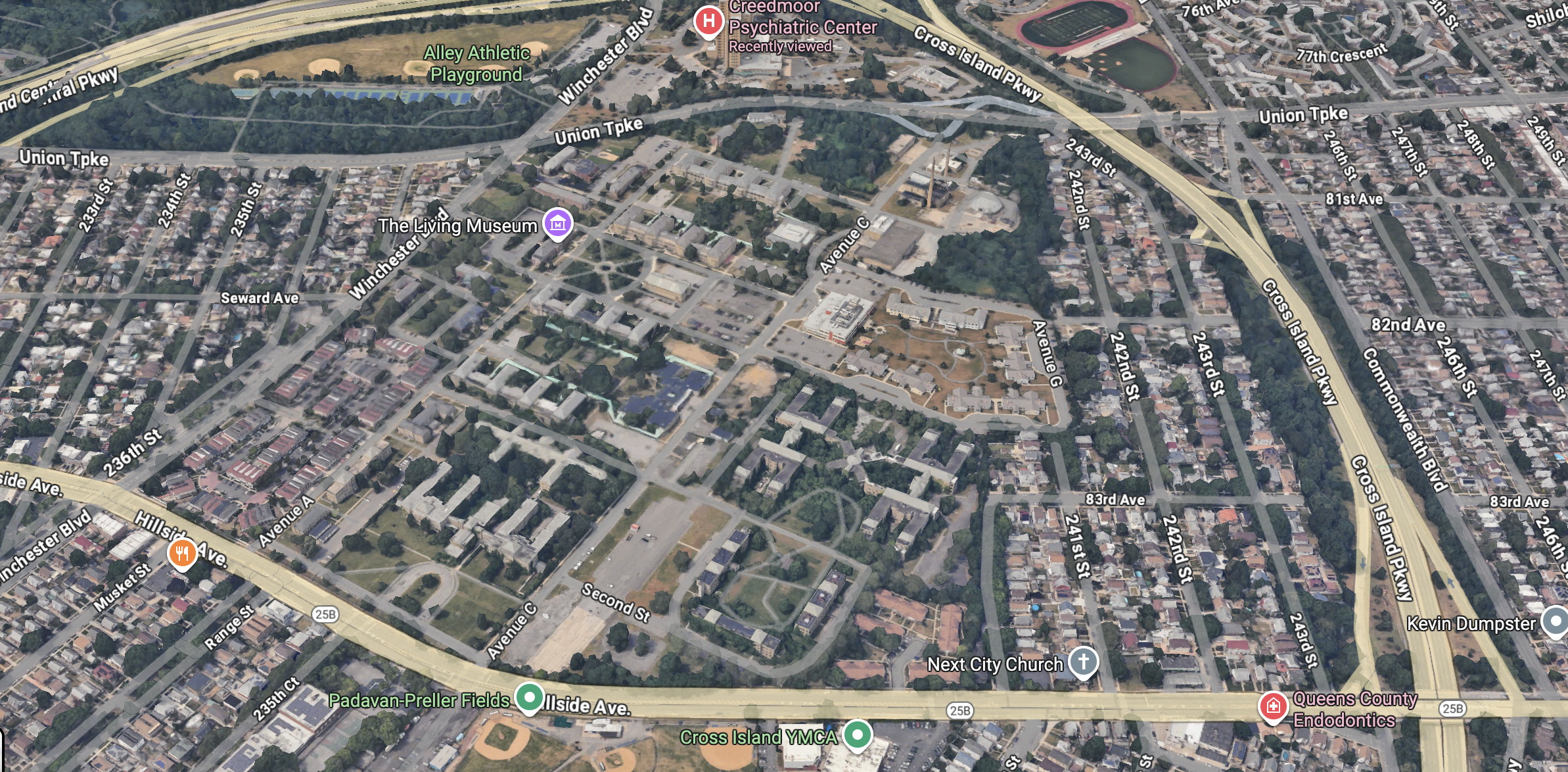
 The Public Authorities Control Board recently approved a state plan by Governor Kathy Hochul’s administration for a sprawling mixed-use residential redevelopment of the Creedmoor Psychiatric Center at 79–25 Winchester Boulevard in Bellerose, Queens. The project calls for 2,022 new market-rate and affordable rental and for-sale homes, as well as supportive housing for veterans and seniors. The plan would also include 10.3 acres of open space, a 120,000-square-foot public grade school, an 8,000-square-foot childcare facility, 16,000 square feet of recreational space for seniors, and an additional 67,000 square feet of retail space. A developer will be selected next year, according to Hochul’s office. The site spans nearly 50 acres and is generally bounded by the Cross Island Parkway to the north and east, Hillside Avenue to the south, and Winchester Boulevard to the west.

Above is a diagram oriented looking north at the approved site plan with the blue lines outlining the parameters of the redevelopment.

Below is a Google Maps aerial view with the same orientation, showing the current set of old structures. Some parts of the property that are open include the Living Museum, which displays various local artwork, and the SNAP Innovative Senior Center – Services Now for Adult Persons, Inc., an active senior citizen center.

Creedmor Psychiatric Center. Image via Google Maps.

Creedmor Psychiatric Center. Image via Google Maps.

The Creedmoore Psychiatric Center, a portmanteau of the original landowners the Creed family and the British “moorlands,” has been in operation for more than 113 years and reached a peak capacity of 7,000 patients in 1959. A portion of the complex remains in use for mental health treatment, though much of the site has been abandoned and left to deteriorate for the last several decades.

Hochul’s administration first announced plans for Creedmoor’s redevelopment in December 2023 and plans to finance the project using the city’s $500 million Redevelopment of Underutilized Sites for Housing (NY-RUSH) initiative. Early concepts called for more than 2,800 new homes, but feedback from the local community board disapproved of the project’s large scale and density in eastern Queens. As a result, the State removed five eight-story buildings from the initial design, reducing the square footage by 27 precent and eliminating 588 units for purchase and 263 rental units, including 15 percent intended for individuals with mental illnesses.

The 2,022 homes will be composed of 977 rentals consisting of 412 senior units, 277 supportive units with 78 solely dedicated to veterans, and 288 generally affordable units. Homeownership units will total 1,045 and come in a mix of affordable and market-rate apartments. The open space will be divided into 4.4 acres of public space and 5.9 acres of private space.

Construction is anticipated to commence in 2027 with completion targeted for 2029. While no project cost has been outlined to date, the state fund is not expected to cover the total sum. The redevelopment is also reported to include five future phases that will collectively be completed by 2040.

https://newyorkyimby.com/2025/11/plans-approved-for-2022-unit-redevelopment-of-creedmoor-psychiatric-center-in-bellrose-queens.html

Tuesday, November 25, 2025

HUD Launches Hotline To Crack Down On Crime, Illegal Immigrants In Public Housing

 by Naveen Athrappully via The Epoch Times,

Department of Housing and Urban Development (HUD) Secretary Scott Turner announced the launch of a new national hotline that allows public housing residents to report on criminals and illegal immigrants in HUD-funded housing.

The hotline, 1-800-347-3735, can be used by residents to call the HUD Office of the Inspector General (OIG) for reporting “criminals, illegal aliens, sex offenders, human traffickers, and those guilty of gang activity, drug distribution, and fraud,” Turner said at a Nov. 24 press briefing in Memphis, Tennessee.

Residents can also submit tips on the 24/7 monitored Hudoig.gov/hotline website.

Housing Secretary Scott Turner (R) with President Donald Trump in Washington on July 22, 2025. Andrew Caballero-Reynolds/AFP via Getty Images

According to Turner, law enforcement personnel stand ready to assist with any complaints received through the hotline or website. The activity is coordinated with assistance from the FBI, the Department of Justice, and state and local partners.

He encouraged public housing residents to make use of the reporting platforms.

“We'll clean up our public housing so that they can fulfill their function of sanctuaries for the most vulnerable people in our country, where American citizens can get a temporary hand up and then gain independence from government help,” the Housing secretary said, adding that the department wanted to assist American citizens specifically.

Illegal aliens have no place in public housing. It’s outrageous that people who should not be here come across our borders, and now usurp spots and housing units that support American people.

“Establishing this hotline is an important step in fighting this injustice for both the people of Memphis and for Americans nationwide.”

Turner said the hotline was part of President Donald Trump’s effort to make the city safe again, which includes the Memphis Safe Task Force. The task force was set up following a Sept. 15 directive from Trump that ordered the National Guard and government agencies to assist in restoring law and order in Memphis.

More than 3,000 violent fugitives have so far been arrested by the task force since the operation began in October, Turner said. This includes more than 300 known gang members and up to 12 homicide suspects.

An estimated 6.8 million Americans rely on public housing assistance, based on data from the National Center for Health in Public Housing (NCHPH).

According to a September 2020 report from NCHPH, crime rates are higher in areas where Public Housing Primary Care (PHPC) Health Centers are located than the national average. These centers provide medical services to patients living in public housing or in close proximity to it.

“There is an average of 505 violent crimes per 100,000 population in PHPC Health Center counties compared to the national average of 386 per 100,000,” the report reads.

Mixed-Status Families

Trump signed an executive order in February ordering agencies to ensure that “no taxpayer-funded benefits go to unqualified aliens.”

Following the executive order, Turner issued a letter to HUD grant recipients and stakeholders in April, informing them that federal housing assistance benefits will no longer be granted to illegal immigrants.

“The Department will take steps to ensure that Federal resources are not used to support ‘sanctuary’ policies of State and local jurisdictions that actively prevent federal authorities from deporting illegal aliens,” the letter reads.

Meanwhile, in a Sept. 15 post, policy research group Urban Institute raised concerns about how HUD’s policies would affect mixed-status families in which members have varied immigration statuses.

The institute said that fewer than 1 percent of households receiving housing assistance are mixed-status and that the “HUD’s data request will have dire consequences” on this group, including psychological distress, financial hardship, and harm to children’s development.

HUD said in a Nov. 21 statement that it has supported housing affordability for more than 1 million Americans this year.

Since January 2025, the Federal Housing Administration, an agency under HUD, has insured mortgages for more than 700,000 homebuyers and refinance borrowers, which includes first-time homebuyers and senior citizens, it said.

During this period, the Government National Mortgage Association, or Ginnie Mae, has supported more than 430,000 Veterans Affairs loans, HUD said, adding that nearly a third of these loans went to first-time homebuyers.

“President Trump’s bold leadership is empowering HUD to use every tool at our disposal to make the American dream of homeownership a reality,” Turner said in a statement.

https://www.zerohedge.com/political/hud-launches-hotline-crack-down-crime-illegal-immigrants-public-housing

'Housing Market Winter Deepens As Delistings Soar To Eight-Year High'

 Building on our earlier housing-market note that "current conditions point to more persistent headwinds" across major metro areas, we now turn to new Redfin data showing a surge in delistings - a clear sign the market is slipping into year-end paralysis.

According to Redfin's report, roughly 85,000 U.S. homes were pulled off the market in September - a 28% jump from last year and the highest September total in eight years. Redfin classifies a home as delisted when it's removed for more than 31 days without selling. 

Redfin points to a set of underlying market dynamics fueling the rapid rise in delistings:
  • Stale listings dominate: 70% of all listings in September had been on the market 60+ days. The median delisted home sat 100 days before being pulled. Markets remain oversupplied, with roughly 500,000 more sellers than buyers.

  • Demand is very weak: High rates, high prices, and broad economic uncertainty are sidelining buyers.

  • Sellers refuse to take losses: 15% of delisted homes were at risk of selling at a loss—the highest in five years—leading many owners to withdraw rather than accept lower bids.

  • Turn to renting: Many would-be sellers prefer to rent out the property and wait for better conditions.

Delistings accounted for 5.5% of all September transactions (vs. 4.8% a year earlier), the highest share for that month since tracking began in 2016.

Redfin economists say the jump is more serious than it appears because sellers "give up" after long periods without offers.

"That increase is bigger than it looks on paper; it represents a fairly significant jump in delistings from last year," Redfin senior economist Asad Khan stated, adding, "More sellers are giving up because their homes have been sitting on the market for a long time, and they don't want to or can't afford to settle on accepting a low price."

Redfin data showed that 20% of the homes delisted in summer were relisted within three months - this is typically a pricing reset tactic and also to show up on the top feeds of popular online real estate marketplaces. 

Wonder how many of those are Airbnbs?

On a geographic basis, these are the metros experiencing the most delistings in September:

  • Virginia Beach +74.5%

  • Washington, D.C. +53.9%

  • San Jose +53.3%

  • Dallas +52.1%

  • Houston +49.6%

Highest delisting share of all listings:

  • Miami 7.8%

  • Fort Lauderdale 7.7%

  • Dallas 7.5%

  • Philadelphia 7.5%

  • West Palm Beach 7.5%

The latest Case-Shiller data shows U.S. home prices in the 20 largest cities rose 0.13% MoM in September (very slightly better than the 0.1% rise expected) and are up for the second month in a row (after falling for five straight months before). This MoM rise left the average prices up just 1.36% YoY - the lowest since July 2023...

Declining mortgage rates suggest a looming rebound in aggregate prices...

Home Prices are now falling (YoY) in a majority (11/20) of America's largest cities...

Additionally, new listings remain stagnant because many homeowners are opting not to list. That's because they're locked in ultra-low mortgage rates (2020–2022) and won't give them up unless they get a premium. 

The latest weekly data from Bright MLS shows cancellations running at above-trend levels across its Mid-Atlantic coverage area.

Translation: housing-market paralysis has deepened, which is why President Trump proposed a 50-year mortgage to break the ice.

https://www.zerohedge.com/markets/housing-market-winter-deepens-delistings-soar-eight-year-high